
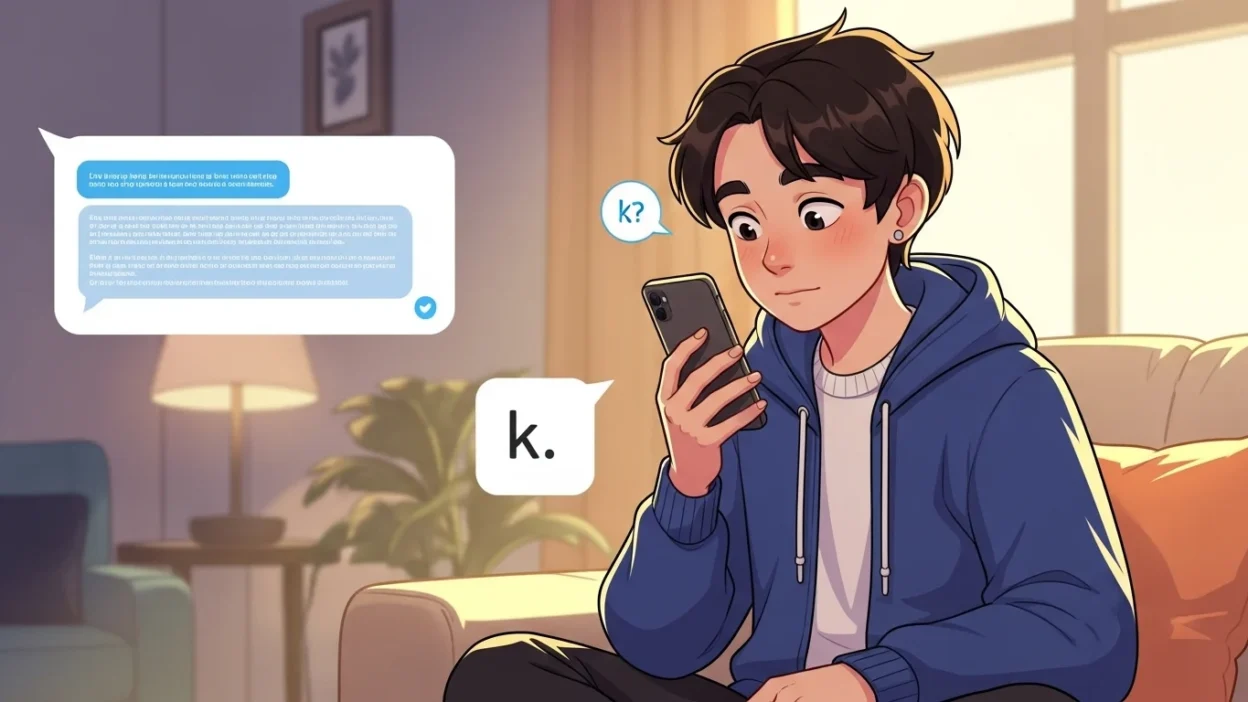
You send a long message, and suddenly the reply is just “k.” At first, it feels confusing. Did the person agree? Are they upset? Or did they just reply quickly? Because texting culture moves fast, people often use very short replies instead of full words.
As a result, K meaning in text has become very common in chats, social media messages, and group conversations. Therefore, if you have seen “k” in a message and want to understand exactly what it means, this guide will explain everything in a simple way.
Quick Answer
K in text usually means “OK” or “Okay,” and people use it as a very short reply.
What Does K Mean in Text?
First of all, K meaning in text simply stands for “OK.” People use it when they want to reply quickly without typing the full word.
Because texting is all about speed, “k” became a shorter version of “okay.”
Full Form
K = OK / Okay
Plain-English Explanation
In simple words, K means “okay,” “alright,” or “I understand.”
People often type K when:
- they agree with something
- they understand a message
- they want to reply quickly
- they do not want to type much
- they are busy
Example Sentence
“we will talk tomorrow”
Reply: “k”
Here, the person simply means okay.
Why People Use K
People use K because:
- First, it is extremely fast to type.
- Next, it keeps replies short.
- Also, it is very common in texting culture.
- Finally, it works well for quick confirmations.
In simple terms: K means “OK,” and people use it as a very short reply.
Does K Always Mean the Same Thing?
Not always. Even though K usually means OK, the tone can change depending on the situation.
1. Friendly Meaning
Sometimes K simply means okay.
Example:
“i will call you later”
Reply: “k”
2. Neutral Meaning
Sometimes K just means the person read the message.
Example:
“i sent the file”
Reply: “k”
3. Slightly Cold Meaning
Sometimes K can sound a little rude or cold, especially after a long message.
Example:
“I wrote a long explanation…”
Reply: “k”
So, context is very important when understanding K.
Where Is K Commonly Used?
Because it is one of the shortest replies possible, K appears almost everywhere in online communication.
1. Text Messages
Friends often use K in quick replies.
Example:
“we will meet at 6”
Reply: “k”
2. Social Media Chats
People use K in:
- Instagram messages
- Snapchat chats
- TikTok messages
- Messenger
Example:
“send it later”
Reply: “k”
3. Group Chats
Group chats often include fast replies, so K appears frequently.
Example:
“we will start at 5”
Reply: “k”
4. Online Conversations
People also use K in short discussions.
Example:
“i understand now k”
Real Chat Examples Using K
Here are realistic texting-style examples that show how people naturally use K.
- “ok we will go tomorrow” – “k”
- “i will send it later” – “k”
- “call me when free” – “k”
- “we will talk tonight” – “k”
- “i understand now” – “k”
- “meet at 7” – “k”
- “i got it” – “k”
- “i will do it tomorrow” – “k”
- “we can talk later” – “k”
Clearly, K is mostly used for quick agreement.
When to Use K (And When Not To)
Even though K meaning in text is simple, context still matters a lot.
When You Should Use K
You can use K when:
- chatting with friends
- replying quickly
- confirming something simple
- sending informal messages
- talking casually
Example:
“i will send it tomorrow”
Reply: “k”
When You Should Not Use K
However, avoid K in these situations:
- work emails
- professional communication
- important conversations
- emotional messages
- formal writing
Instead, write something like “Okay” or “Got it.”
Quick Comparison Table
| Context | Example Phrase | Why It Works / Doesn’t Work |
|---|---|---|
| Casual chat | “k” | Perfect usage |
| Social media | “ok k” | Works naturally |
| Work email | “k, i understand” | Too informal |
| Serious talk | Replying only “k” | May sound rude |
Therefore, always think about tone before using K.
Similar Slang Words and Alternatives
Because texting culture includes many short replies, several alternatives work like K.
| Slang | Meaning | When to Use |
|---|---|---|
| OK | Okay | Most common |
| Kk | Friendly version | Casual chats |
| Aight | Alright | Informal tone |
| Sure | Agreement | Everyday use |
| Got it | Understanding | Friendly tone |
Quick Explanation
OK
The safest and most common alternative.
Kk
Sounds friendlier than just K.
Aight
Another slang version of alright.
All these alternatives help people reply quickly in modern texting culture.
Frequently Asked Questions
What does K mean in texting?
K means “OK” or “Okay,” and people use it as a very short reply.
Is K rude in text messages?
Not always. Sometimes it is friendly, but in some situations it can sound cold.
Is K formal or informal?
K is informal slang, so it works best in casual communication.
Can K be used on social media?
Yes. People use K in messages, comments, and chats.
Is K the same as OK?
Yes. K is simply a shorter version of OK.
Who usually uses K?
People who text frequently and social media users often use K.
Should K be used in professional messages?
No. Professional communication should use full words instead.
Final Thought
Online communication continues changing, and people often create shorter ways to reply quickly. K meaning in text is one of the simplest examples of modern texting slang.
Most of the time, K simply means “OK.” People use it when they want to agree, confirm something, or reply quickly without typing a full word.
You will commonly see K in text messages, group chats, and social media conversations. However, because it is extremely short, it can sometimes sound cold if used in the wrong situation.
So next time someone replies with “k”, you will immediately understand what it means.

Kalven Driost works on the Wordifs site producing reliable content while communicating through wordifs@gmail.com to support research editing publishing consistency transparency and audience focused knowledge sharing practices for modern readers.