
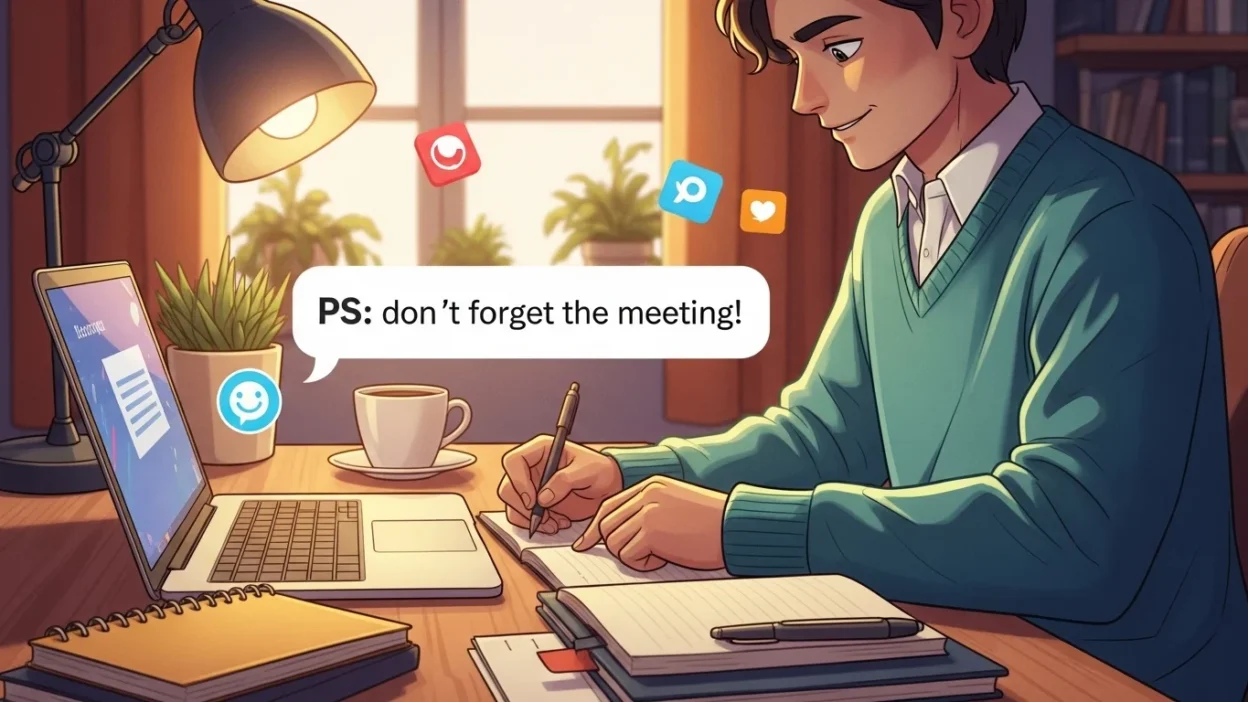
One day, you finish reading a long message from a friend. The message already explains everything clearly. However, right at the end, you notice one more line that starts with “PS.”
At first, you pause and wonder why that extra note appears after the main message. Soon, you see the same thing again in emails, social media captions, and even text messages.
Because online communication moves quickly, people often add short notes after finishing their main thought. As a result, PS appears frequently in modern texting culture. So, if you have seen PS in a text and wondered what it means, this guide explains it clearly.
Quick Answer
PS in text means “Postscript,” which is an extra note added after the main message.
What Does PS Mean in Text?
First of all, PS meaning in text comes from the word Postscript. Traditionally, people used it in letters when they wanted to add something after finishing the main message.
However, the habit continues today in emails, texting, and social media posts.
Full Form
PS = Postscript
Plain-English Explanation
In simple terms, PS introduces an extra thought, reminder, or comment that comes after the main message.
People often use PS when they suddenly remember something important after writing their message.
Example Sentence
“don’t forget the meeting tomorrow.
ps: bring the documents too.”
Here, the person adds a final reminder after the main message.
Why People Use PS
People use PS because:
- First, it adds extra information quickly.
- Next, it highlights an additional thought.
- Also, it keeps the main message simple.
- Finally, it feels natural in both emails and texting.
Simply put: PS means “postscript,” and it introduces an extra note added after the main message.
Where Is PS Commonly Used?
Now let’s explore where people usually use PS in text conversations. Unlike many slang terms, PS works in both casual and semi-formal situations.
1. Text Messages
People often add PS at the end of messages when they remember something else.
Example:
“i’ll call you tonight. ps: check the photos i sent.”
2. Emails
Emails frequently include PS because it highlights extra information clearly.
Example:
“thank you for attending the meeting. ps: the presentation slides are attached.”
3. Social Media Captions
Many creators add PS at the end of captions to include an extra thought.
Example:
“new video is out now! ps: watch till the end for a surprise.”
4. Online Forums and Comments
People sometimes use PS to add clarifications or extra opinions.
Example:
“great discussion here. ps: i found another helpful article.”
Tone of PS
The tone of PS can be:
- Casual
- Friendly
- Neutral
- Slightly formal
Therefore, PS works in more situations than most texting slang.
Real Chat Examples Using PS
Now let’s look at natural texting examples. These show how people use PS in everyday conversations.
- “i’ll send the file later
ps: remind me if i forget” - “great talking today
ps: that cafe was amazing” - “i finished the assignment
ps: it was harder than i expected” - “i’m heading out now
ps: don’t forget the tickets” - “that movie was great
ps: the ending surprised me” - “thanks for helping earlier
ps: you saved my day” - “meeting starts at 10
ps: join 5 minutes early” - “i just posted the photos
ps: check the last one” - “i’ll see you tomorrow
ps: bring snacks”
Clearly, PS appears after the main message to add one extra thought.
When to Use PS (And When Not To)
Even though PS meaning in text feels simple, context still matters.
When You Should Use PS
You can use PS when:
- adding an extra note
- remembering something after finishing a message
- highlighting a small reminder
- sending friendly emails
- writing social media captions
Example:
“see you at the party tonight
ps: don’t forget the cake”
When You Should Not Use PS
However, sometimes you should avoid PS.
Avoid using it when:
- the message already feels confusing
- too many extra notes appear
- the information belongs inside the main message
Instead, place the information directly in the message.
Quick Comparison Table
| Context | Example Phrase | Why It Works / Doesn’t Work |
|---|---|---|
| Text message | “see you later. ps: bring snacks” | Works perfectly |
| “thank you for your help. ps: slides attached” | Clear reminder | |
| Long message | “ps: ps: ps:” repeated | Confusing |
| Formal report | “ps: extra detail here” | Not appropriate |
Therefore, use PS only for short extra notes.
Similar Terms and Alternatives
Several other expressions work similarly to PS when adding extra information.
| Term | Meaning | When to Use |
|---|---|---|
| PPS | Post-postscript | Second extra note |
| BTW | By the way | Add casual side comment |
| FYI | For your information | Share helpful info |
| Note: | Important detail | Slightly formal |
| Also | Additional thought | Everyday conversation |
Quick Explanation
PPS
This stands for Post Postscript, which adds another note after PS.
BTW
People use this when introducing a side comment during conversations.
FYI
This phrase works when sharing useful information.
All these expressions help organize online communication and texting culture.
Frequently Asked Questions
What does PS mean in texting?
PS means “Postscript.” It introduces an extra note added after the main message.
Is PS used only in letters?
No. Today, PS appears in emails, texts, captions, and online messages.
What does PPS mean?
PPS means “Post Postscript,” which adds another note after PS.
Is PS formal or informal?
PS works in both casual texting and semi-formal emails, although it rarely appears in official documents.
Why do people use PS in messages?
People use PS to add reminders, extra thoughts, or additional information after finishing the main message.
Can PS appear in social media posts?
Yes. Many captions include PS to highlight bonus details or fun comments.
Should PS appear in professional reports?
No. Formal writing usually places all information inside the main text instead.
Final Thought
Digital communication constantly evolves, yet some writing habits remain surprisingly consistent. PS meaning in text comes from traditional letter writing, yet people still use it widely today.
Most of the time, PS simply introduces an extra note added after the main message. It helps writers include reminders, side thoughts, or additional details without rewriting the entire message.
Because PS works in texting, emails, and social media, it remains one of the most versatile abbreviations in modern communication. However, you should still use it carefully and avoid adding too many extra notes.
So next time you see PS in a message, you will immediately understand that the sender added one final thought after finishing their main message.

Zevran Callix works on the Wordifs site creating clear informative articles while collaborating through wordifs@gmail.com to maintain consistency quality research readability and reader focused blogging standards worldwide digital content platform.