
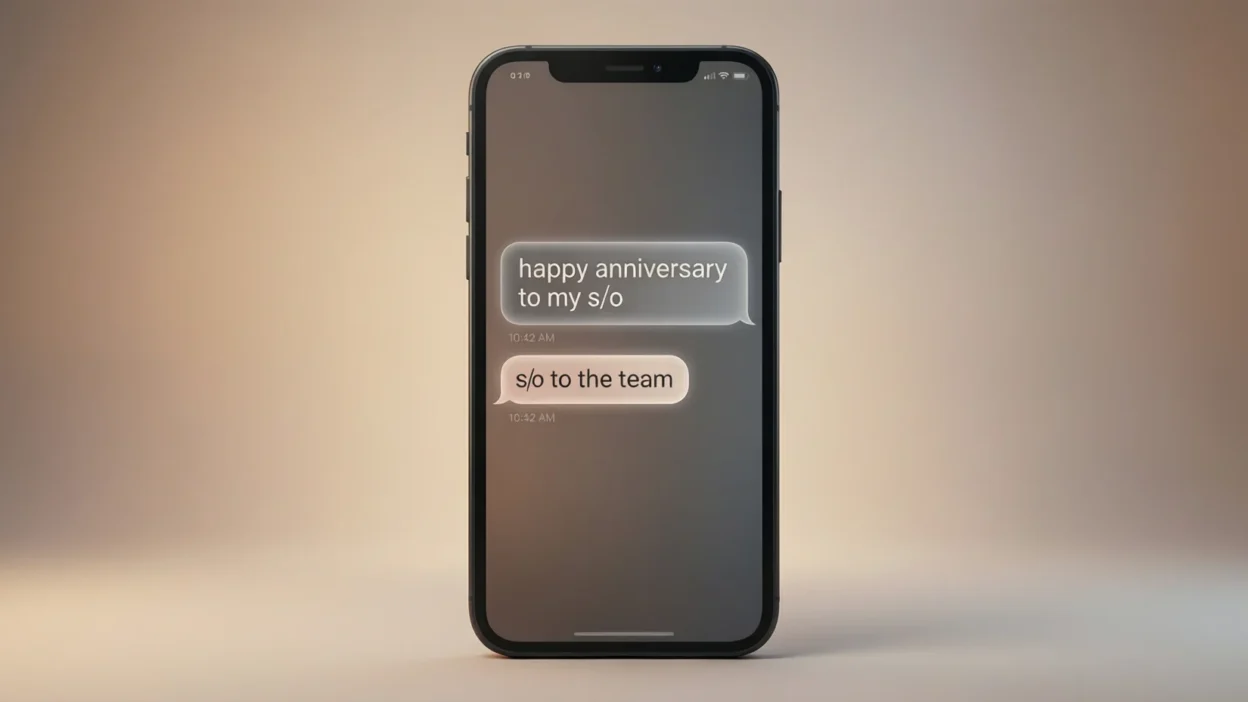
You’ve probably seen s/o used in text messages, captions, or comments on social media. Someone might write “happy birthday to my s/o” or “big s/o to everyone who helped.”
If you’re not familiar with online slang, this abbreviation can feel confusing at first.
The meaning of s/o depends on context. That’s why understanding how people use it in texting and social media is important.
The Meaning Of S/O Explained
What S/O Commonly Means
S/O usually stands for significant other.
Simple Meaning In Plain English
When someone says s/o, they are talking about their romantic partner. This could be a boyfriend, girlfriend, spouse, or partner without using a specific label.
One Easy Example
“going out with my s/o tonight.”
Quick summary: S/O most often means significant other, referring to a romantic partner.
Another Popular Meaning Of S/O
S/O As “Shoutout”
In social media and online posts, s/o can also mean shoutout.
How This Meaning Works
People use s/o to publicly thank, mention, or give credit to someone.
Example
“s/o to my friends for the support.”
Important note: Context tells you which meaning fits.
Where S/O Is Commonly Used
Text Messages
People use s/o casually when talking about relationships.
Social Media Platforms
Instagram, Twitter (X), TikTok, and Snapchat use s/o often for shoutouts.
Comments And Captions
Creators use s/o to recognize others.
Tone: casual and informal
Usage: friendly, social, and conversational
Real-Life Examples Using S/O
- “my s/o surprised me today”
- “happy anniversary to my s/o”
- “big s/o to everyone who showed up”
- “my s/o supports me a lot”
- “s/o to the team”
- “posting this with my s/o”
- “can’t do this without my s/o”
How To Tell Which Meaning Is Correct
Look At The Sentence
If it talks about love or dating, s/o means significant other.
Look At The Platform
On social media posts, s/o often means shoutout.
Look At The Tone
Romantic tone points to partner. Thankful tone points to shoutout.
When To Use S/O And When Not To
Do Use S/O When
- talking casually about a partner
- giving credit or appreciation online
- texting friends
Don’t Use S/O When
- writing formal emails
- speaking in professional settings
- the audience may not know slang
Quick Comparison Table
| Context | Example | Meaning | Why It Works |
|---|---|---|---|
| dating | “my s/o is amazing” | significant other | clear |
| “s/o to my team” | shoutout | common usage | |
| work email | using s/o | unclear | too casual |
| formal writing | s/o | confusing | avoid slang |
Similar Terms And Alternatives
Partner
A clear and respectful alternative to s/o.
Boyfriend / Girlfriend
More specific relationship terms.
Spouse
Used for married partners.
Shoutout
The full word when giving credit.
Frequently Asked Questions (FAQs)
Does S/O Always Mean Significant Other?
No. It can also mean shoutout.
Is S/O Slang?
Yes. It’s informal internet and texting slang.
Can S/O Be Used For Friends?
Yes, when it means shoutout.
Is S/O Used By All Age Groups?
Mostly younger users, but many adults use it too.
Should I Use S/O In Professional Messages?
No. Use full words instead.
Is S/O Common On Social Media?
Yes. It’s very popular on Instagram and TikTok.
Final Thoughts
S/O is a flexible abbreviation with two popular meanings. Most of the time, it refers to a significant other, but on social media it often means shoutout. Context always decides which meaning fits.
Understanding s/o helps you read messages correctly and use the term confidently in casual conversations.
Like many slang terms, it works best with friends and online spaces, not formal communication. Knowing when and how to use it keeps your messages clear and natural.

Zevran Callix works on the Wordifs site creating clear informative articles while collaborating through wordifs@gmail.com to maintain consistency quality research readability and reader focused blogging standards worldwide digital content platform.