
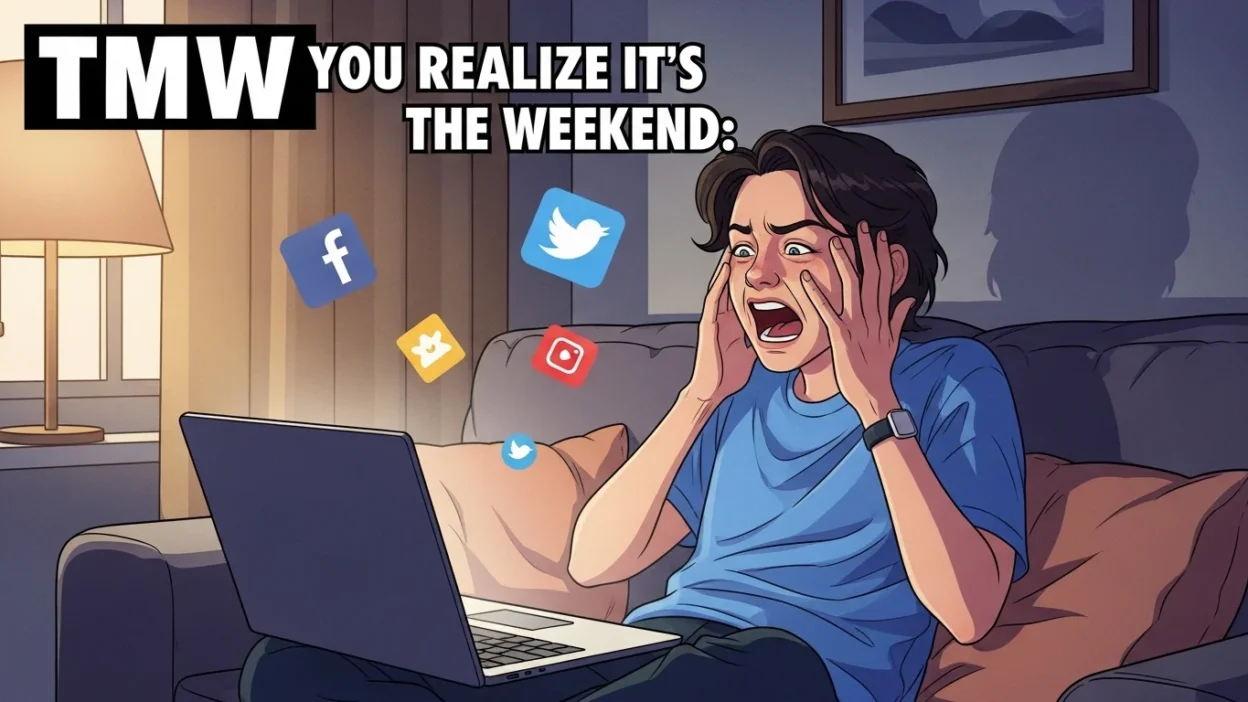
One day, you’re scrolling through social media and suddenly see a caption that says “tmw you finally finish your work early.” At first, it feels a bit confusing because the sentence seems incomplete.
However, when you look at the image or meme, everything makes sense. Because online culture relies heavily on humor and relatability, people often use short phrases to describe feelings.
As a result, abbreviations like TMW appear everywhere in memes, captions, and chats. Therefore, if you have seen TMW in a text or post and wondered what it means, you’re definitely not alone.
Quick Answer
TMW in text means “That Moment When,” and people use it to describe a relatable or emotional situation.
What Does TMW Mean in Text?
First of all, TMW meaning in text stands for “That Moment When.” People use this phrase to introduce a situation, usually something funny, awkward, or relatable.
Because internet humor often focuses on shared experiences, TMW helps people describe moments others can understand easily.
Full Form
TMW = That Moment When
Plain-English Explanation
In simple words, TMW sets up a relatable situation or feeling.
People often type TMW when:
- sharing a funny experience
- describing an awkward moment
- posting relatable memes
- expressing emotions indirectly
Example Sentence
“tmw you realize the exam is tomorrow”
Here, the person describes a relatable moment of panic.
Why People Use TMW
People use TMW because:
- First, it introduces relatable situations quickly.
- Next, it fits meme culture perfectly.
- Also, it adds humor to everyday experiences.
- Finally, it keeps captions short and engaging.
In simple terms: TMW means “That Moment When,” and people use it to describe relatable or emotional situations.
Where Is TMW Commonly Used?
Now let’s explore where people usually use TMW in online conversations. Because it feels expressive, it mainly appears in informal digital spaces.
1. Social Media Captions
People often use TMW in captions to describe relatable moments.
Platforms include:
- TikTok
- X (Twitter)
Example:
“tmw your phone dies at 1%”
2. Memes
Memes frequently use TMW to set up the joke.
Example:
“tmw you wave back but they weren’t waving at you”
3. Text Messages
Friends sometimes use TMW while sharing relatable situations.
Example:
“tmw you forget your homework at home”
4. Online Communities
Forums and comment sections often include TMW posts.
Example:
“tmw you finally understand the lesson”
Tone of TMW
The tone of TMW usually feels:
- Humorous
- Relatable
- Casual
- Expressive
However, it remains informal slang, so it does not fit formal writing.
Real Chat Examples Using TMW
Now let’s look at realistic texting-style examples. These show how people naturally use TMW in conversations.
- “tmw you wake up late for school”
- “tmw you forget your password again”
- “tmw you finally finish your homework”
- “tmw your favorite song starts playing”
- “tmw you study the wrong topic”
- “tmw you see your crush online”
- “tmw you realize it’s the weekend”
- “tmw you drop your phone by accident”
- “tmw you understand the joke late”
Clearly, TMW introduces relatable moments in a simple and fun way.
When to Use TMW (And When Not To)
Even though TMW meaning in text is simple, context still matters.
When You Should Use TMW
You can use TMW when:
- creating memes
- writing social media captions
- sharing relatable experiences
- chatting casually with friends
- describing funny or awkward moments
Example:
“tmw you finish work early”
When You Should Not Use TMW
However, avoid TMW in formal situations.
Do not use it in:
- work emails
- business communication
- academic writing
- official documents
- professional messages
Instead, write full sentences like “When you realize…”
Quick Comparison Table
| Context | Example Phrase | Why It Works / Doesn’t Work |
|---|---|---|
| Meme caption | “tmw you forget your keys” | Perfect usage |
| Social media | “tmw it’s friday” | Relatable |
| Work email | “tmw the meeting starts” | Too informal |
| School essay | “tmw you learn something” | Not appropriate |
Therefore, always use TMW in casual and creative contexts only.
Similar Slang Words and Alternatives
Because internet culture includes many relatable expressions, several alternatives exist.
| Slang | Meaning | When to Use |
|---|---|---|
| MFW | My Face When | Show reaction |
| TFW | That Feeling When | Express emotions |
| POV | Point Of View | Show perspective |
| When | Full version | Simple alternative |
| Relatable | Shared experience | Casual comment |
Quick Explanation
MFW
Used when showing a reaction to a situation.
TFW
Very similar to TMW, but focuses more on feelings.
POV
Common in videos to show a specific perspective.
All these expressions help people share experiences in modern online culture.
Frequently Asked Questions
What does TMW mean in texting?
TMW means “That Moment When,” and people use it to describe relatable situations.
Is TMW used in memes?
Yes. TMW is very popular in memes and social media captions.
Is TMW the same as TFW?
They are similar. TMW describes a moment, while TFW focuses more on feelings.
Is TMW formal or informal?
TMW is informal slang, so it works best in casual communication.
Can TMW be used in texting?
Yes. People sometimes use TMW in chats to describe relatable moments.
Who usually uses TMW?
Teenagers, meme creators, and social media users commonly use TMW.
Should TMW be used in professional messages?
No. Professional communication should use full and clear sentences instead.
Final Thought
Online communication constantly evolves, and people continue creating new ways to express thoughts quickly. TMW meaning in text represents one of the most popular ways to describe relatable moments.
Most of the time, TMW simply means “That Moment When.” People use it to introduce funny, awkward, or emotional situations that others can easily understand.
You will commonly see TMW in memes, captions, and social media posts. However, because it belongs to informal slang, it does not fit professional communication.
So next time you see “tmw” in a post or message, you will instantly understand that someone is describing a relatable moment.

Kalven Driost works on the Wordifs site producing reliable content while communicating through wordifs@gmail.com to support research editing publishing consistency transparency and audience focused knowledge sharing practices for modern readers.