Lots of people use can and could interchangeably, and in casual talk nobody blinks, but can vs could gets much easier once you know the rules. The two words carry slightly different meanings, and learning them clears things up fast. Knowing when to use can vs. could is straightforward.
They are modal verbs, and both help another verb express ability, possibility, or a request to ask for permission. For the future, if something is very likely to happen, can is the better pick. Could, on the other hand, suits an equal chance of happening or not happening.
For someone’s ability to do something, use can in present-tense scenarios (“She can swim“) and could in past-tense situations (“She could swim when she was six“). A good habit is to pause before you speak or write and ask two questions. Is this about now or then? Am I sure, or just guessing? Your answers will point you to can or could almost every time.
Quick Answer:
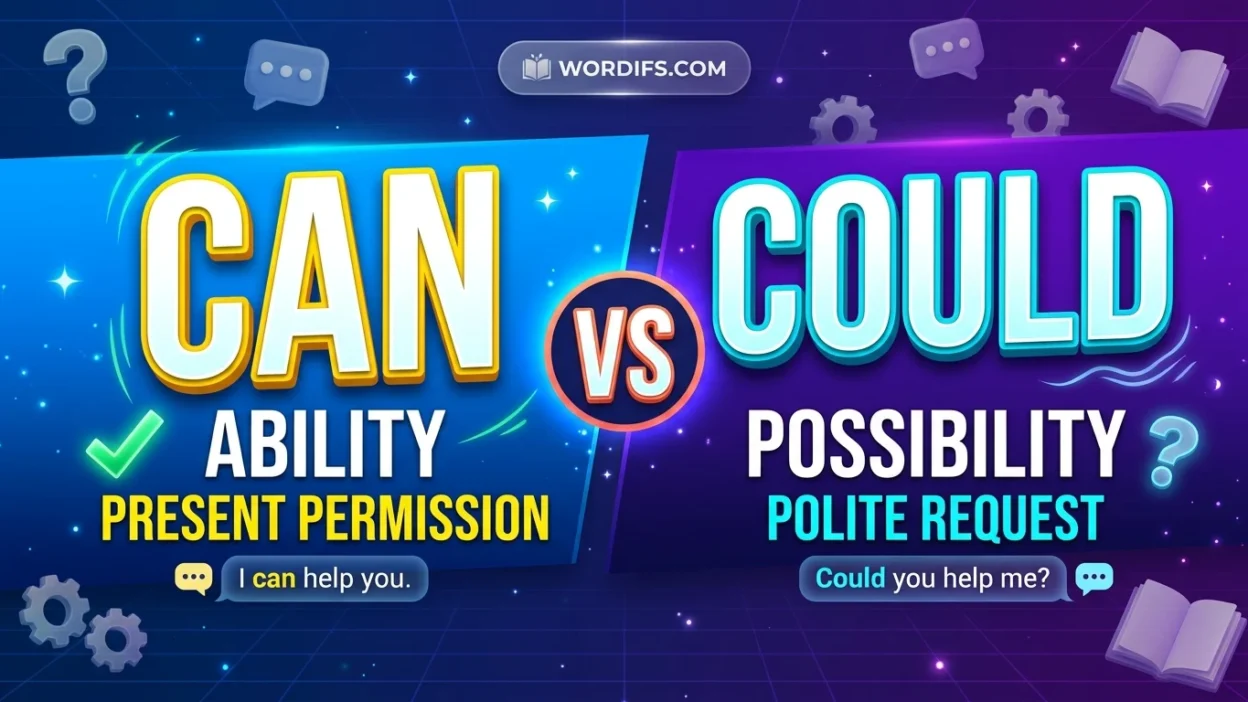
Use can for present ability, permission, and real possibility: “I can help you.” Use could for past ability, polite requests, suggestions, and less certain possibility: “I could swim at five,” “Could you help me?” Could is more polite and more tentative than can, but it does not always mean past time.
Why Do People Confuse Can and Could?
These two words look like a simple present-and-past pair, but their jobs overlap. Here is why learners mix them up:
- Could not only pass. It can talk about the present or future when you ask politely or make a suggestion: “Could you open the window?”
- Both ask for things. “Can you help me?” and “Could you help me?” are both common requests, so the difference feels unclear.
- Both show possibility. “It can rain” and “It could rain” sound close, but they mean different things.
- Other languages work differently. Many languages do not separate politeness, time, and certainty in the same way.
What Does “Can” Mean?
Can is a modal verb. A modal verb is a helping verb that adds meaning such as ability, permission, or possibility. Can is used in the present and is followed by the base form of a verb, with no “to.”
How to use can
- Present ability: “She can speak three languages.”
- Permission (informal): “You can use my phone.”
- Requests (informal): “Can you pass the salt?”
- General possibility: “Winters can be very cold here.”
- Offers: “I can carry that for you.”
The negative forms are can’t and cannot (written as one word). “Can’t” is also used for strong guesses: “That can’t be right.”
What Does “Could” Mean?
Could is also a modal verb. It is the past form of can, but it has several other uses that have nothing to do with the past. It is followed by the base verb as well.
How to use could
- Past ability (general): “I could run fast when I was young.”
- Polite requests: “Could you send me the file?”
- Suggestions: “We could eat at home tonight.”
- Possibility (less certain): “It could rain later.”
- Imaginary situations: “If I had more time, I could learn piano.”
- Past chances not taken: “You could have called me.”
Can vs Could: Comparison Table
| Feature | Can | Could |
| Main time | Present | Past, or no strong time (polite or unreal use) |
| Ability | Present ability | Past ability |
| Permission | Asking and giving permission now | Asking politely (not for giving permission) |
| Requests | Casual: “Can you help?” | More polite: “Could you help?” |
| Possibility | General or real possibility | Specific, less certain possibility |
| Tone | Direct | Softer, more tentative |
| Negative | can’t / cannot | couldn’t / could not |
| Example | “I can drive.” | “I could drive at 18.” |
When Should You Use Can and When Should You Use Could?
Use can when:
- You describe what someone is able to do right now.
- You give or ask for permission in a casual way.
- You talk about something that is generally possible.
- You make a direct offer or a quick request.
Use could when:
- You talk about what someone was able to do in the past, in general.
- You want to sound polite: “Could I borrow your pen?”
- You offer an idea: “You could try the new café.”
- You talk about something that might happen but is not certain.
- You describe an imaginary or unreal situation with “if.”
Past ability on one occasion
For one specific success in the past, English usually prefers was able to or the simple past. Say “I was able to finish the test” or “I finished the test,” not “I could finish the test.” In the negative, “I couldn’t finish the test” is fine.
12 Examples of Can and Could in Sentences
Examples with “can”
- “My brother can cook very well.”
- “You can sit here if you like.”
- “Can you help me with this question?”
- “I can’t hear you.”
- “Can I use your bathroom?”
- “Traffic can be heavy on Fridays.”
Examples with “could”
- “When I was a child, I could climb any tree.”
- “Could you close the door, please?”
- “We could watch a movie tonight.”
- “The package could arrive tomorrow.”
- “If I won the lottery, I could travel the world.”
- “She couldn’t find her keys this morning.”
Both words together
- “I can speak English now, but I couldn’t speak it five years ago.”
- “Can you call me later? Or could we meet tomorrow instead?”
Common Mistakes With Can and Could
- ✗ “I can to swim.” ✓ “I can swim.” (No “to” after can.)
- ✗ “She cans sing well.” ✓ “She can sing well.” (No -s with can.)
- ✗ “When I was young, I can run fast.” ✓ “When I was young, I could run fast.”
- ✗ “‘Could I sit here?’ ‘Yes, you could.’” ✓ “Yes, you can.” (Give present permission with can.)
- ✗ “Yesterday, I could pass the exam.” ✓ “Yesterday, I was able to pass the exam.”
- ✗ “Do you can swim?” ✓ “Can you swim?” (Can does not need “do.”)
- ✗ “He can’t to come.” ✓ “He can’t come.”
Easy Memory Trick for Can vs Could
Remember this line: “Can is for now. Could is for then, or for being kind.”
- Can = now. It describes what is true at this moment.
- Could = then (the past) or kind (polite, soft, or unsure).
When you are not sure, ask yourself two questions. Am I talking about the past? Do I want to sound softer or more polite? If either answer is yes, could is probably the better choice.
American English vs British English
The meanings of can and could are the same in American and British English. The differences are small:
- Pronunciation. In standard American English, “can’t” sounds like /kænt/. In standard southern British English, it sounds like /kɑːnt/.
- Formal permission. Both varieties use “may” for formal permission, and traditional British style guides sometimes prefer it over “can” in writing.
- “Could do with.” The phrase “I could do with a rest” (meaning “I need a rest”) is especially common in British English.
In everyday speech, “Can you…?” and “Could you…?” are used the same way on both sides of the Atlantic.
Similar Words That Cause the Same Confusion
- May: more formal for permission (“May I come in?”) and for possibility (“It may snow”).
- Might: shows a weaker possibility, often close to could (“She might be late”).
- Be able to: works in more tenses than can (“I will be able to help,” “I have been able to finish”).
- Would: used for polite requests (“Would you mind…?”) and imaginary results (“I would go if I could”).
- Should: gives advice (“You should rest”), while could only offers an option (“You could rest”).
Final Verdict:
Choose can for what is true or allowed now. Choose could for general past ability, polite requests, suggestions, and possibilities that are not certain. Both are followed by a base verb, so the grammar stays simple. Focus on time and tone, and the right word becomes clear.
Frequently Asked Questions
What is the difference between can and could?
Can show present ability, permission, or general possibility. Could show past ability, polite requests, suggestions, or less certain possibilities. Example: “I can swim” (now) and “I could swim at five” (past).
Is could the past tense of can?
Yes, could is the past form of can for general ability: “I can run” becomes “I could run when I was young.” However, could is also used in the present and future for polite requests, suggestions, and possibilities, so it is not always about the past.
Is “Could you” more polite than “Can you”?
Yes, in most situations. “Could you help me?” sounds softer and more respectful than “Can you help me?” Both are correct. Use could with strangers, teachers, and managers, and can with friends and family.
Can I use could to talk about the present?
Yes. Could work for present or future situations when you are polite, unsure, or making a suggestion. For example: “Could I ask a question?” or “We could leave early tomorrow.” Here, could does not mean past time.
Should I use could or was able to in the past?
Use could for general past ability, such as “I could read at four.” For one specific success, use was able to or the simple past: “I was able to fix the bike yesterday.” With negatives, it couldn’t work in both cases.
Should I use can or may to ask for permission?
Both are correct. Can is common and informal: “Can I go now?” May is more formal: “May I go now?” In exams, business emails, and formal speech, may or could often sound more suitable.
What is the difference between could and might?
Both show possibility and are often interchangeable: “It could rain” and “It might rain” are very close. Might usually suggest a slightly weaker chance. Only worked for past ability: “I could swim at five.”
Remember This
- Can = present ability, informal permission, offers, and general possibility.
- Could = general past ability, polite requests, suggestions, and less certain possibility.
- Use a base verb after both: “I can go,” “She could go.”
- Do not add “to,” “do,” or -s with can or could.
- For one specific past success, use was able to.
- Answer permission questions with can: “Yes, you can.”
- When in doubt about politeness, choose could.
Conclusion
The difference between can and could is mostly about time and tone. Can talks about what is true or allowed now, while could talks about the past or adds politeness and uncertainty. Once you see that it could have more than one job, many confusing sentences start to make sense.
To practice, write three sentences about what you can do today and three about what you could do when you were younger. Then turn two of them into polite requests with could. A few minutes of practice each day will help you use both words naturally in speaking, writing, and exams.

Orvian Treloux works on the Wordifs site developing structured blogs coordinating via [email protected] to ensure accuracy originality clarity usefulness engagement and long term trust among global readers across digital platforms.