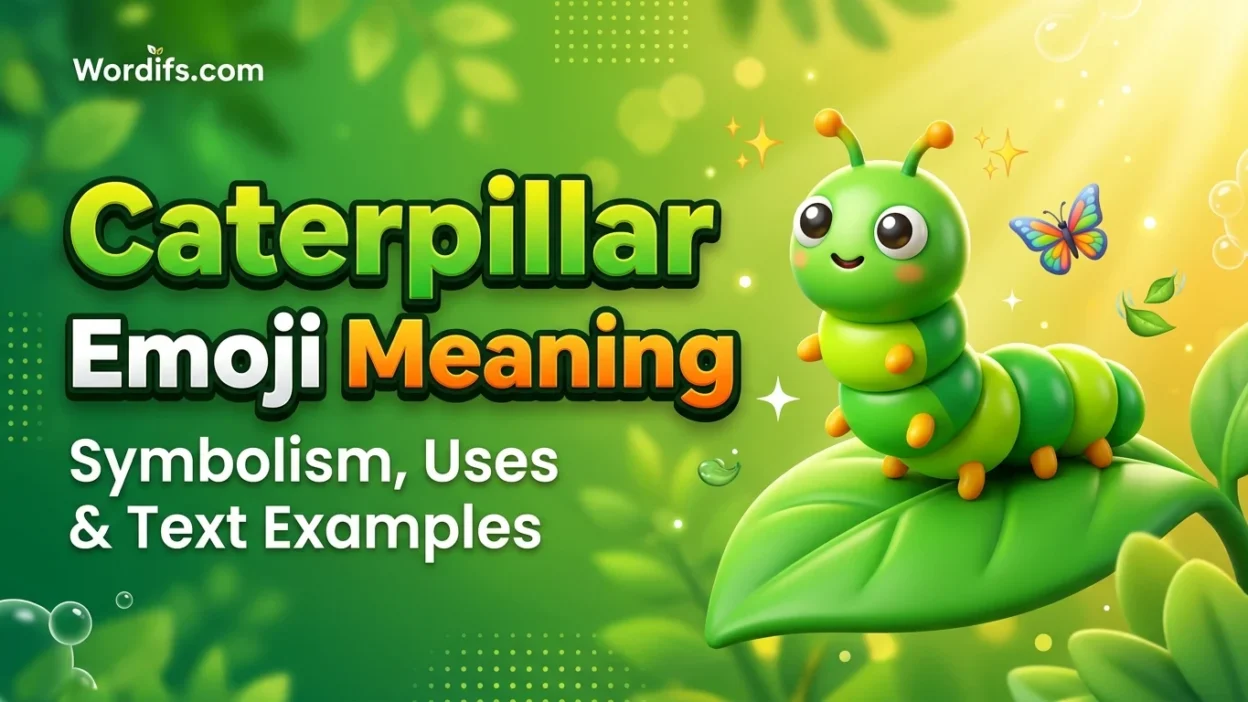
The caterpillar emoji 🐛 is a small, colorful insect symbol commonly used in text messages, social media posts, and online conversations. It is often associated with nature, insects, growth, transformation, patience, and new beginnings.
People also use it to represent a real caterpillar, express an interest in butterflies, share garden-related content, or add a playful touch to their messages. Interestingly, the official Unicode name of this emoji is Bug, even though its design on many platforms looks like a caterpillar.
Its meaning can change depending on the conversation, platform, and surrounding emojis. Whether someone sends you 🐛 in a message or you want to use it in an Instagram caption, understanding its different meanings can help you use it correctly.
Quick Answer: What Does the Caterpillar Emoji 🐛 Mean?
The caterpillar emoji 🐛 generally represents a small crawling insect, often shown as a green caterpillar. It can symbolize nature, growth, transformation, patience, and the journey toward becoming something new. It is also used in conversations about gardens, butterflies, insects, and the natural world. In technology-related conversations, the same emoji may represent a software bug, coding error, or technical problem.
In simple words, 🐛 can mean a caterpillar, an insect, personal growth, a new beginning, or a bug in a computer program. Its exact meaning depends on the context in which someone uses it.
What Is the Caterpillar Emoji 🐛?
The 🐛 emoji is officially known as the Bug emoji in the Unicode Standard. However, its illustrated appearance resembles a small caterpillar on many popular devices and platforms. It usually features a long, segmented body, tiny legs, and small antennae. The body is commonly green, although its exact appearance varies between platforms.
A caterpillar is the larval stage of a butterfly or moth. It is known for crawling along leaves, eating plant material, and eventually changing into a pupa before emerging as an adult butterfly or moth. Because of this natural life cycle, the caterpillar is often associated with change, development, transformation, and personal growth.
The emoji is part of the Animals & Nature emoji category and is frequently used in conversations about insects, gardens, wildlife, and the environment. It can also have figurative meanings when people use it to communicate ideas rather than refer to an actual insect.
For example, someone might use 🐛 when talking about a caterpillar they discovered in their garden. Another person might use it to describe a period of personal development before reaching a major goal.
Caterpillar Emoji Meaning: 7 Common Interpretations
The caterpillar emoji has several possible meanings. Although its basic appearance represents a small bug or caterpillar, people often use it in creative ways.
1. Nature and the Natural World
One of the most straightforward meanings of 🐛 is nature and wildlife. People use this emoji when discussing insects, plants, flowers, gardens, trees, and outdoor activities.
Because caterpillars live around plants and leaves, the symbol fits naturally into conversations about gardening and the environment.
For example, someone sharing a picture of a caterpillar on a green leaf might add 🐛 to the caption. A nature lover might also include it in a post about exploring a garden or observing wildlife.
Example:
“I found a tiny caterpillar on my rose plant today! 🐛🌿”
Here, the emoji represents a real insect and adds a natural, playful feeling to the message.
2. Growth and Personal Development
The caterpillar is often used as a symbol of personal growth. Its life cycle provides a familiar example of how something small can develop into something completely different.
People may use 🐛 when discussing learning new skills, improving themselves, developing confidence, or working toward personal goals.
It can represent the early stage of a journey when someone is still learning and discovering their abilities.
Example:
“Every day is another opportunity to grow. 🐛🌱”
In this message, the emoji represents the beginning of a personal development journey.
3. Transformation and New Beginnings
Another popular interpretation of the caterpillar emoji is transformation. Caterpillars are strongly connected with butterflies because many butterfly species begin their lives as caterpillars.
The transformation from caterpillar to butterfly is commonly used as a metaphor for change. People use this idea to describe moving forward, leaving old habits behind, starting a new chapter, or becoming a better version of themselves.
The 🐛 emoji can therefore communicate that someone is still developing and has not yet reached their final stage.
Example:
“I’m working on becoming the person I want to be. 🐛🦋”
The combination suggests a journey of change and self-improvement.
4. Patience and Taking Things Slowly
Caterpillars move slowly compared with many other animals. This characteristic makes 🐛 a suitable symbol for patience, slow progress, and steady development.
People sometimes use it when reminding themselves or others that meaningful improvement takes time.
It can also represent the idea that there is no need to rush through every stage of life.
Example:
“Slow progress is still progress. Keep going! 🐛💚”
Here, the emoji adds a gentle reminder that growth happens gradually.
5. Insects and Creepy-Crawlies
The emoji can simply refer to bugs, insects, and small crawling creatures. It is useful when discussing insects found in gardens, forests, parks, or homes.
Although many people recognize it as a caterpillar, its official name is broader. Depending on the design, it may be interpreted as a general bug or insect.
Example:
“Why are there so many little bugs in the garden? 🐛🐞”
In this context, the emoji refers to small insects rather than personal growth or transformation.
6. Playfulness and Cuteness
The caterpillar emoji also has a lighthearted meaning. Its small body and colorful appearance can make messages feel friendly, cheerful, and playful.
Friends may use it in casual conversations, cute captions, nature-themed posts, or messages about animals.
It does not always communicate a deep symbolic message. Sometimes, people simply like the appearance of the emoji.
Example:
“Look at this tiny little creature! 🐛🥰”
Here, the emoji expresses affection and amusement.
7. Software Bugs and Technical Problems
In technology-related conversations, 🐛 can represent a software bug, programming error, or technical issue.
This meaning comes from the word “bug,” which is commonly used in computing to describe an error that causes software or hardware to behave unexpectedly.
Developers and technology enthusiasts may use the emoji when discussing debugging, fixing code, or reporting problems in an application.
Example:
“Found a bug in the website’s login system. 🐛💻”
In this example, the emoji represents a programming problem rather than an actual caterpillar.
Caterpillar Emoji 🐛 Meaning in Text Messages
The meaning of 🐛 in text messages depends on the conversation between the people involved. Someone might send it while discussing nature, sharing something cute, or talking about personal development.
In a friendly conversation, the emoji may simply add a playful feeling. A motivational message, it may represent growth and transformation. In a technical discussion, it can indicate a software issue.
Here are some common examples of how people might use it in everyday messages.
| Text message | Possible meaning |
| “Look what I found! 🐛” | A real caterpillar or insect |
| “Growing every single day 🐛🌱” | Personal development |
| “My butterfly journey starts here 🐛🦋” | Transformation |
| “Taking life one step at a time 🐛” | Patience and slow progress |
| “There’s a bug in the app 🐛” | A technical problem |
| “This little creature is so cute! 🐛” | Playfulness and affection |
If someone sends you 🐛 without any additional words, do not automatically assume it has a hidden meaning. The sender may simply be sharing an insect-related thought or using an emoji they like.
What Does the Caterpillar Emoji 🐛 Mean on Social Media?
The caterpillar emoji can be used across different social media platforms, including Instagram, TikTok, Facebook, Snapchat, WhatsApp, and X. Its meaning generally remains connected to insects, nature, and transformation, but the surrounding content can influence how people interpret it.
Caterpillar Emoji Meaning on Instagram
On Instagram, 🐛 can be used in captions, comments, Stories, and bios. People may include it in nature photography, gardening content, inspirational posts, and aesthetic captions.
For example, someone sharing a picture of a butterfly might use 🐛🦋 to represent the transformation from one life stage to another.
It can also appear in nature-themed Instagram captions, especially when someone posts pictures of plants, flowers, insects, or outdoor scenery.
Caterpillar Emoji Meaning on TikTok
On TikTok, 🐛 can add a visual element to videos about nature, animals, gardening, or personal development.
Creators may use it alongside butterfly imagery to represent a glow-up, personal transformation, or self-improvement journey. It can also appear in educational videos about insect life cycles.
However, there is no single universal TikTok slang meaning that applies to every use of this emoji. Its interpretation depends on the video’s subject, caption, comments, and community.
Caterpillar Emoji Meaning on WhatsApp
On WhatsApp, the emoji is commonly suitable for casual conversations. Someone might send it when talking about insects, sharing a garden discovery, or making a playful comment.
It can also be used in motivational messages about growing, learning, and changing over time.
For example:
“Don’t rush your journey. Everything takes time. 🐛🌱”
Caterpillar Emoji Meaning on Snapchat
On Snapchat, 🐛 may appear in Snaps, captions, and conversations. It can add a cute or playful touch to pictures of gardens, plants, insects, and outdoor activities.
Someone might also use it as part of a nature-inspired aesthetic or a message about personal growth.
Caterpillar Emoji vs. Butterfly Emoji: What’s the Difference?
The caterpillar emoji 🐛 and butterfly emoji 🦋 are often used together because they are connected through the life cycle of many butterflies.
However, they represent different stages and ideas. The caterpillar commonly symbolizes the beginning of development, while the butterfly is often associated with completed transformation, beauty, freedom, and change.
| Feature | Caterpillar emoji 🐛 | Butterfly emoji 🦋 |
| Basic appearance | Small crawling insect | Flying butterfly |
| Life-cycle connection | Larval stage | Adult stage |
| Common symbolism | Growth and development | Transformation and freedom |
| General feeling | Playful and natural | Beautiful and uplifting |
| Common topics | Insects, gardens, beginnings | Beauty, change, nature |
| Metaphorical use | Starting a journey | Becoming something new |
For example, someone might write:
“Everyone starts somewhere. 🐛”
This suggests that growth takes time.
On the other hand:
“I finally became the person I wanted to be. 🦋”
This suggests that a period of change has resulted in personal development.
The two emojis can also be combined to communicate a complete journey:
“Trust the process. 🐛➡️🦋”
This combination represents development, patience, and transformation.
Caterpillar Emoji Combinations and Their Meanings
Combining the caterpillar emoji with other symbols can make a message more expressive. The additional emoji helps explain the intended meaning.
Here are some creative combinations and their possible interpretations.
| Emoji combination | Possible meaning |
| 🐛🦋 | Growth and transformation |
| 🐛🌱 | New beginnings and development |
| 🐛🌿 | Nature and greenery |
| 🐛🌸 | Garden life and spring |
| 🐛☀️ | Warm weather and outdoor nature |
| 🐛💚 | Love for nature or a cute insect |
| 🐛✨ | Personal growth and positive change |
| 🐛🌳 | Wildlife and the environment |
| 🐛🐞 | Different insects and garden creatures |
| 🐛💻 | Software bugs and programming |
| 🐛🔧 | Fixing technical problems |
| 🐛➡️🦋 | A journey of transformation |
These combinations do not have official fixed definitions. They are creative ways to communicate ideas, and their meanings depend on the message.
How to Use the Caterpillar Emoji in Captions and Messages
The 🐛 emoji is easy to include in everyday digital communication. You can use it when sharing nature-related pictures, writing motivational captions, discussing insects, or talking about technology.
The key is to choose a combination that matches the message you want to communicate.
Nature and Gardening Captions
If you enjoy gardening, flowers, plants, or outdoor activities, the caterpillar emoji can make your captions more interesting.
Examples include:
“Nature’s little wonders are everywhere. 🐛🌿”
“Found a tiny visitor enjoying my garden. 🐛🌱”
“Every leaf has a little story to tell. 🐛🍃”
“Exploring the beauty of nature, one tiny creature at a time. 🐛🌸”
Growth and Transformation Captions
You can use 🐛 when discussing personal improvement, learning, or positive changes in your life.
Examples include:
“Be patient with your growth. 🐛✨”
“Every journey begins with a small step. 🐛🌱”
“Still growing, still learning, still becoming. 🐛🦋”
“Great transformations take time. 💚🐛”
Cute and Playful Messages
The emoji can also make casual messages feel more cheerful.
Examples include:
“Just a little cutie crawling around! 🐛🥰”
“Small creature, big personality. 🐛💚”
“Sending you a tiny dose of nature today. 🐛🌼”
Technology and Coding Messages
If you work with websites, applications, or computer programs, 🐛 can help communicate a technical problem.
Examples include:
“Found another bug in the code. 🐛”
“Time to debug this application. 🐛💻”
“Testing the website and fixing the little errors. 🐛🔧”
These examples show that the same emoji can fit different situations without changing its basic visual identity.
Is the Caterpillar Emoji the Same as the Bug Emoji?
Yes. The 🐛 symbol is officially named the Bug emoji, but its illustration often looks like a caterpillar. This is why many people search for it using terms such as caterpillar emoji, bug emoji, or green caterpillar emoji.
The distinction is mainly between the official character name and the way people visually recognize it. Unicode assigns characters names and identifiers, while device manufacturers create their own illustrations.
For example, one platform may display a green caterpillar with a striped body, while another may show a slightly different insect design. Despite these visual differences, the underlying emoji character remains the same.
Therefore, if someone calls 🐛 a caterpillar emoji, they are referring to the familiar appearance of the bug symbol rather than a separate official caterpillar character.
Why Does the Caterpillar Emoji Look Different on Different Devices?
You may notice that the caterpillar emoji does not look exactly the same on an iPhone, Android phone, Windows computer, or social media application.
This happens because different technology companies use their own emoji artwork. Unicode standardizes the character itself, but it does not require every platform to display an identical illustration.
For example, Apple’s version may have different colors, body details, or facial features compared with Google’s or Microsoft’s version.
These differences do not usually change the emoji’s underlying identity. When you send 🐛 to another person, their device uses its own supported emoji design to display the character.
This is why the same caterpillar symbol can appear slightly different across messaging applications and operating systems.
Caterpillar Emoji Technical Details
If you want to copy, paste, or understand the technical identity of this emoji, the following information is useful.
| Technical detail | Information |
| Emoji | 🐛 |
| Common name | Caterpillar emoji |
| Official Unicode name | Bug |
| Unicode code point | U+1F41B |
| Shortcode | :bug: |
| Category | Animals & Nature |
| Common appearance | Green crawling insect |
| Related emoji | 🦋 Butterfly |
| HTML entity | 🐛 |
The character was included in Unicode 6.0 in 2010 and later became part of Emoji 1.0 in 2015. It was also present in early Japanese emoji collections before its inclusion in Unicode.
You do not need to memorize these technical details to use the emoji. However, knowing its official name and code point can help when searching for it in emoji databases, software projects, or character libraries.
How to Copy and Paste the Caterpillar Emoji 🐛
If you want to use the caterpillar emoji in a message, caption, comment, or social media bio, you can simply copy it from here:
🐛
Select the symbol, copy it, and paste it wherever your application supports emoji.
You can also find it through your device’s emoji keyboard. On most smartphones, open the keyboard, tap the emoji icon, and search for bug or browse the animals and nature section.
On computers, the available emoji picker depends on the operating system. You can also paste the symbol directly into supported text fields.
Keep in mind that some older devices or applications may not display every emoji correctly. If a device does not support the character, it may show an empty box or another replacement symbol.
Caterpillar Emoji vs. Other Insect Emojis
The caterpillar emoji is part of a larger collection of animal and insect symbols. Some of these emojis look similar, but each represents a different creature.
Understanding the differences can help you choose the right symbol for your message.
| Emoji | Common name | What it represents |
| 🐛 | Bug | A crawling insect, often resembling a caterpillar |
| 🦋 | Butterfly | A butterfly and transformation |
| 🐞 | Lady beetle | A ladybug or ladybird |
| 🐜 | Ant | An ant and small insects |
| 🪲 | Beetle | A beetle |
| 🪳 | Cockroach | A cockroach |
| 🪰 | Fly | A flying insect |
| 🦗 | Cricket | A cricket or similar insect |
| 🦟 | Mosquito | A mosquito |
| 🪱 | Worm | A worm |
Although these symbols belong to related categories, they are not interchangeable in every situation. For example, 🐛 is suitable for a crawling caterpillar-like insect, while 🦋 is more appropriate when discussing an actual butterfly.
Common Mistakes When Understanding the Caterpillar Emoji
People sometimes misunderstand the caterpillar emoji because they assume that every emoji has one fixed definition. In reality, an emoji can communicate different ideas depending on how it is used.
Mistake 1: Assuming that 🐛 is officially named Caterpillar. Its official Unicode name is Bug. Caterpillar is a common visual interpretation of its design.
Mistake 2: Thinking that it always represents transformation. Although the caterpillar’s life cycle makes it a popular symbol of change, people also use it literally to represent insects, gardens, and nature.
Mistake 3: Assuming that it has a secret romantic meaning. The emoji does not have one universally recognized romantic or flirtatious definition. If someone sends it in a personal conversation, the surrounding words are more useful for understanding their intention.
Mistake 4: Confusing it with the butterfly emoji. The caterpillar and butterfly represent different stages in the life cycle. They can symbolize different parts of a transformation journey.
Mistake 5: Assuming that every platform displays it identically. Emoji artwork varies between operating systems and applications, even when the underlying Unicode character is the same.
Mistake 6: Treating every social media use as slang. Sometimes an emoji is simply decorative. A person may add 🐛 to a caption because they like insects or enjoy nature-themed designs.
Practical Tips for Using the Caterpillar Emoji Correctly
To use 🐛 effectively, consider the topic and tone of your conversation. If you are discussing insects, gardens, or wildlife, it can represent a real crawling creature. If you are writing an inspirational message, it can communicate patience, progress, and personal development.
When using it with other emojis, choose symbols that support your intended message. For example, combining 🐛 with 🌱 creates a nature and growth theme, while pairing it with 🦋 makes the idea of transformation easier to understand.
Avoid assuming that everyone will interpret an emoji in exactly the same way. Some people may recognize the symbol as a caterpillar, while others may simply identify it as a bug. A few descriptive words can remove confusion when the meaning matters.
For professional or technical conversations, 🐛 can be useful when discussing programming errors. However, if you are reporting a serious issue, explain the actual problem rather than relying on an emoji alone.
Most importantly, use the symbol naturally. It works best when it adds meaning, personality, or visual interest to your message instead of replacing information that readers need to understand.
Frequently Asked Questions
1. What does the 🐛 emoji mean?
The 🐛 emoji represents a bug or small crawling insect, often resembling a caterpillar. It can also symbolize nature, growth, patience, transformation, and new beginnings. In technology conversations, it may represent a software error or coding bug.
2. Is 🐛 a caterpillar or a bug emoji?
Its official Unicode name is Bug, but its design commonly resembles a caterpillar. Both names are used when people describe the symbol, although Bug is its standardized character name.
3. What does the caterpillar emoji mean from a girl?
If a girl sends you 🐛, she may be talking about nature, sharing something cute, or using it playfully. It could also represent growth or transformation if the conversation is motivational. There is no universal romantic meaning, so consider the context of the message.
4. What does the caterpillar emoji mean from a guy?
When a guy sends 🐛, it may simply refer to an insect, a garden, or something funny. In a motivational conversation, it could represent personal growth or gradual change. The emoji alone does not reveal a specific intention.
5. What does 🐛 mean on Instagram?
On Instagram, 🐛 can be used in captions, comments, Stories, and bios. It commonly represents insects, nature, gardening, and transformation. Some users also combine it with 🦋 to express personal growth or a journey toward positive change.
6. What is the difference between 🐛 and 🦋?
The 🐛 emoji represents a crawling insect that resembles a caterpillar, while 🦋 represents a butterfly. Symbolically, 🐛 is often associated with beginnings and development, whereas 🦋 commonly represents transformation, freedom, and beauty.
7. How do I copy and paste the caterpillar emoji?
You can copy the symbol 🐛 directly from this article and paste it into WhatsApp, Instagram, TikTok, Facebook, or another application that supports emoji. You can also search for “bug” in your device’s emoji keyboard.
8. What is the Unicode code for the caterpillar emoji?
The caterpillar-looking bug emoji has the Unicode code point U+1F41B. Its official Unicode name is Bug, and its commonly used shortcode is :bug:.
Conclusion
The caterpillar emoji 🐛 is a versatile symbol that can represent insects, nature, gardening, personal growth, patience, and transformation. Although its official Unicode name is Bug, many people recognize it as a caterpillar because of its familiar green, crawling appearance.
Its meaning can also change depending on whether it appears in a casual text message, an Instagram caption, a TikTok video, or a technology-related conversation. Understanding its context helps you recognize what someone is trying to communicate.
If you use 🐛 to share your love for nature, describe a tiny insect, express a personal development journey, or identify a software problem, it adds a simple visual element to digital communication.
You can also combine it with emojis such as 🦋, 🌱, 🌿, and ✨ to express ideas about growth and new beginnings. Ultimately, the best way to understand the caterpillar emoji is to consider the message, situation, and intention behind its use.

Orvian Treloux works on the Wordifs site developing structured blogs coordinating via [email protected] to ensure accuracy originality clarity usefulness engagement and long term trust among global readers across digital platforms.