
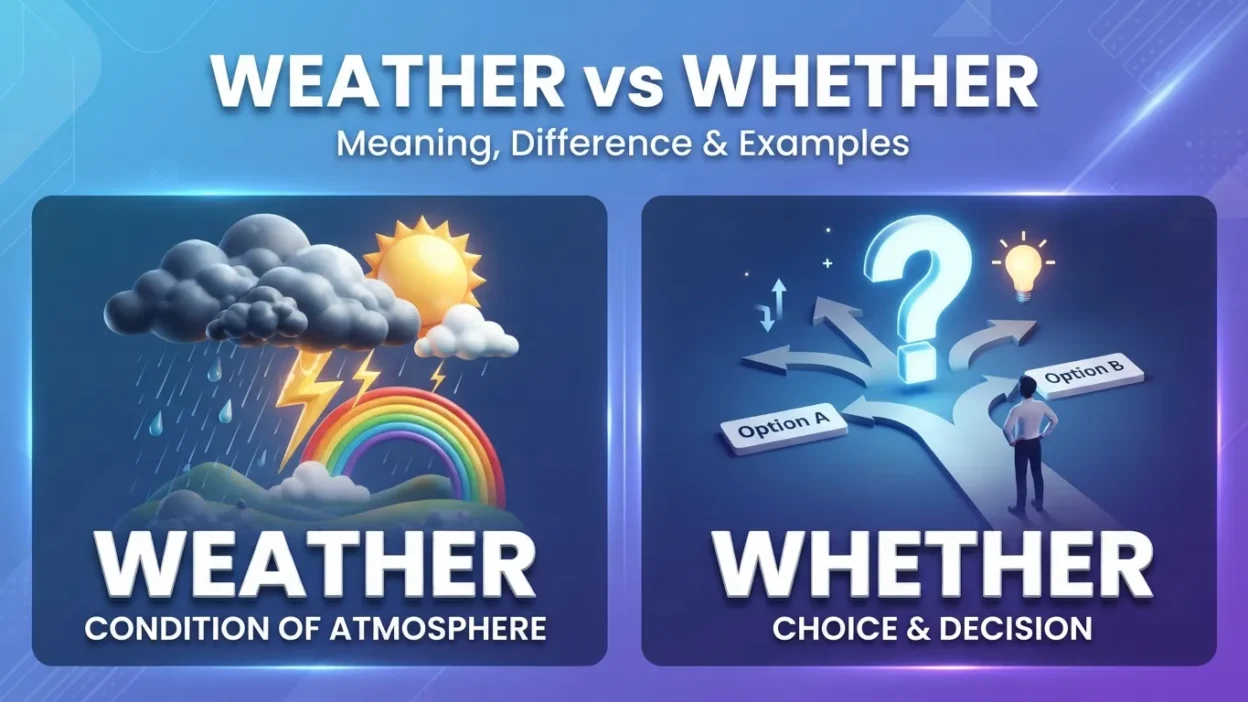
When I write, I check the meaning first because weather vs whether can confuse learners who know the three words but miss their differences. Weather describes conditions outside, whether expresses a choice or possibility, and wether has another meaning.
These homophones are commonly confused words, so learning their linguistic differences, vocabulary, and word usage can improve writing accuracy. Correct spelling also helps prevent a misspelling.
Clear grammar and punctuation make writing easier to understand and keep your text polished. You can check spelling with a spell-checker, spell checker, grammar checker, or writing tool to catch spelling mistakes, grammar mistakes, and punctuation mistakes.
Still, a tool may not understand the intended word from context. For example, it may not know whether weather or whether fits your sentence. I find that reading my work carefully before using a tool helps me proofread more effectively. Grammarly can also proofread your writing and help create polished text.
The best way to avoid confusion is to understand the correct word usage before you write. Once you know how weather, whether, and wether work, choosing the right English words becomes easier. Regular proofreading can catch errors that automated tools overlook, while careful attention to spelling, grammar, and punctuation helps your final work remain accurate and natural.
Quick Answer
Weather means the conditions outside, including temperature, rain, wind, and sunshine. Whether introduces a choice, uncertainty, or possibility between alternatives. They sound alike in many varieties of English, but their meanings, spellings, and grammatical functions are different.
Why Do People Confuse Weather and Whether?
People often confuse these words because weather and whether are homophones in most varieties of English. Homophones are words that sound the same but have different meanings and spellings.
The confusion becomes more common in writing because pronunciation cannot show which word a person means. Context is therefore important.
Compare:
- “I checked the weather before leaving.”
- “I wondered whether I should leave.”
The first sentence is about atmospheric conditions. The second expresses uncertainty about a choice.
What Does the First Word, Weather, Mean?
Weather is a noun that describes the condition of the atmosphere at a particular place and time.
It can include:
- Rain
- Snow
- Wind
- Clouds
- Sunshine
- Temperature
- Storms
- Humidity
Examples of Weather
- The weather is warm today.
- We canceled the picnic because of bad weather.
- What will the weather be like tomorrow?
- The cold weather lasted for several days.
Weather can also be used as a verb, although this use is less common in everyday conversation. As a verb, it means to survive or endure something difficult.
Example:
The old building has weathered many storms.
What Does the Second Word, Whether, Mean?
Whether is generally used to introduce alternatives, choices, or uncertainty.
It often appears when someone is considering two possibilities.
Examples:
- I don’t know whether he is coming.
- She asked whether I wanted tea or coffee.
- We need to decide whether to stay.
- I am not sure whether this is correct.
A useful pattern is:
whether + possibility/choice
For example:
I don’t know whether it will rain.
Here, whether does not mean rain or atmospheric conditions. It introduces uncertainty about whether something will happen.
Weather vs Whether: Comparison Table
| Word | Meaning | Part of Speech | Example |
| Weather | Conditions in the atmosphere | Usually a noun | The weather is cold. |
| Whether | A choice, possibility, or uncertainty | Conjunction | I don’t know whether he will come. |
| Weather | To endure or survive something | Verb | She weathered the difficult period. |
| Whether | Introduces alternatives | Conjunction | Tell me whether you agree or disagree. |
When Should You Use Weather or Whether?
Use weather when your sentence is about conditions outside or the atmosphere.
Use weather for:
- Rain
- Snow
- Heat
- Cold
- Wind
- Storms
- Sunshine
- Temperature
Use whether when your sentence involves uncertainty, alternatives, or a choice.
Use whether for:
- Decisions
- Possibilities
- Uncertainty
- Two alternatives
- Questions involving “if or not”
A Simple Test
Ask yourself:
Is the sentence about conditions outside?
If yes, use weather.
Is the sentence about a choice or possibility?
If yes, use whether.
10+ Examples of Weather vs Whether
Examples With Weather
- The weather is perfect for a walk.
- We stayed home because the weather was terrible.
- Check the weather before planning your trip.
- The hot weather made everyone tired.
- I love cold weather.
- The weather forecast says it may rain tonight.
Examples With Whether
- I don’t know whether she is at home.
- He asked whether I needed help.
- We have to decide whether to go.
- She wasn’t sure whether he was serious.
- Tell me whether you agree.
- I can’t decide whether to buy it.
- They discussed whether the plan would work.
- We don’t know whether the store is open.
Using Both Words in One Sentence
Sometimes both words can appear naturally in the same sentence:
I don’t know whether the weather will improve tomorrow.
Here, whether introduces uncertainty, while weather refers to atmospheric conditions.
What Are the Common Mistakes?
The most common mistake is using weather when the sentence requires whether, or vice versa.
Mistake 1: Using Weather for a Choice
Incorrect:
I don’t know weather I should go.
Correct:
I don’t know whether I should go.
The sentence is about uncertainty, not atmospheric conditions.
Mistake 2: Using Whether for Outdoor Conditions
Incorrect:
The whether is beautiful today.
Correct:
The weather is beautiful today.
The sentence describes conditions outside, so weather is correct.
Mistake 3: Confusing “Whether” With “If”
In many situations, whether can be used similarly to if when expressing uncertainty.
For example:
I don’t know whether he will come.
You could also say:
I don’t know if he will come.
However, whether is especially useful when presenting alternatives:
I don’t know whether to stay or leave.
What Is an Easy Memory Trick?
Remember:
WEAther = conditions outside
Think of WEA as being connected with the weather you experience outdoors.
WHETHER = a choice
Think of whether whenever you are asking yourself:
“Which possibility is true?”
For example:
- Weather → rain, wind, sunshine
- Whether → this or that, yes or no, one possibility or another
Another quick trick is:
If you can talk about rain, use “weather.”
If you can talk about a choice, use “whether.”
American vs British English
The meanings of weather and whether are essentially the same in American and British English.
The pronunciation can vary slightly by speaker and region, but the spelling and core meanings remain distinct.
In both varieties:
- Weather relates to atmospheric conditions.
- Whether introduces alternatives or uncertainty.
For formal writing in either American or British English, it is important to use the correct spelling according to the meaning of the sentence.
Similar Words to Weather and Whether
Several words are related to these terms but should not be confused with them.
Words Related to Weather
- Climate
- Forecast
- Temperature
- Storm
- Rainfall
- Sunshine
- Wind
- Humidity
- Atmosphere
Weather describes atmospheric conditions at a particular time and place, while climate refers to longer-term patterns.
Words Related to Whether
- If
- Either
- Alternative
- Choice
- Possibility
- Uncertainty
- Decision
For example:
I don’t know whether to stay.
The sentence expresses uncertainty about a decision.
Final Verdict:
The difference is simple once you focus on meaning.
Weather refers to atmospheric conditions such as rain, wind, temperature, snow, and sunshine.
Whether is used to introduce uncertainty, alternatives, or a choice.
Remember:
Weather = conditions outside
Whether = a choice or possibility
If you are unsure which spelling to use, look at the meaning of the sentence rather than how the word sounds.
Frequently Asked Questions
Is it “weather” or “whether”?
It depends on the meaning. Use weather for atmospheric conditions and whether for choices, alternatives, or uncertainty.
What is the difference between weather and whether?
Weather is mainly a noun referring to conditions in the atmosphere. Whether is a conjunction used to introduce alternatives, choices, or uncertainty.
Are weather and whether homophones?
Yes. In most varieties of English, weather and whether are pronounced alike or very similarly but have different spellings and meanings.
Can I use “whether” instead of “if”?
In many sentences expressing uncertainty, whether and if can be interchangeable. However, whether is often preferred when explicitly presenting alternatives, such as “whether to stay or leave.”
What is an example of whether?
An example is: “I don’t know whether she will come.” Here, whether introduces uncertainty about her coming.
What is an example of weather?
An example is: “The weather is cold today.” Here, weather refers to the atmospheric conditions.
Is “weather” always a noun?
No. Weather is most commonly used as a noun, but it can also be used as a verb meaning to endure or survive something difficult, as in “They weathered the storm.”
How can I remember weather vs whether?
Use weather when you are talking about rain, sunshine, wind, temperature, or other outdoor conditions. Use whether when you are talking about a choice, possibility, or uncertainty.
Remember This
Weather = what is happening outside.
Whether = which possibility or choice.
If you can replace the word with rain, sunshine, wind, or temperature, you probably need weather. If you can replace it with if or you are considering alternatives, whether is usually the right choice.
Conclusion
Although weather vs whether can be confusing because the words sound alike, their meanings are easy to separate. Weather describes atmospheric conditions, while whether introduces a choice, alternative, or uncertainty. Paying attention to what the sentence means is the easiest way to select the correct word.
With regular practice, these two homophones become much easier to recognize. Remember the simple rule: weather is outside, while whether is about possibilities or choices. Once this distinction becomes familiar, you can use both words confidently in everyday conversations, school assignments, emails, and formal writing.