Have you ever typed “openned” and wondered whether it looks right? You are not alone. This is a common spelling mistake because the word open ends with a consonant, and adding -ed can make the spelling feel less obvious.
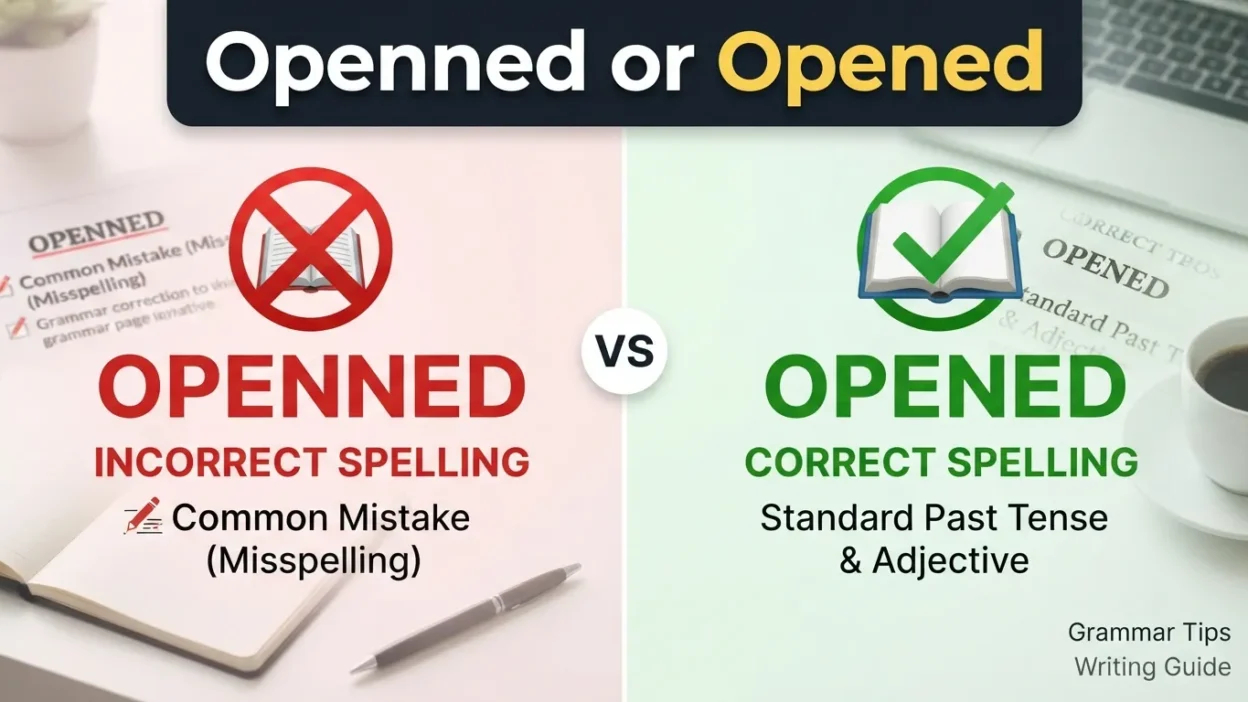
The correct spelling is opened, with only one n. Whether you are writing an email, school assignment, social media post, or professional document, understanding why opened is correct can help you avoid this frequent English spelling error.
Quick Answer
Opened is the correct spelling.
Openned is incorrect in standard English.
The verb open becomes opened when you use it in the past tense or past participle form.
- Correct: I opened the door.
- Correct: She opened the email.
- Incorrect: I openned the door.
- Incorrect: She openned the email.
The simple rule is: open + ed = opened.
What Does Opened Mean?
Opened is the past tense and past participle of the verb open. It means that something was made accessible, uncovered, unlocked, started, or no longer closed.
For example, if you move a door from a closed position to an accessible position, you opened the door.
The word can be used in many everyday situations:
- He opened the window.
- I opened my book.
- She opened the package.
- They opened a new store.
- The teacher opened the lesson with a question.
Depending on the context, opened can also describe beginning an activity or event. For example, “The speaker opened the meeting” means the speaker started the meeting.
Why Is “Openned” Incorrect?
The spelling openned is incorrect because the word open does not require the final consonant to be doubled before adding -ed.
Some English verbs do double their final consonant before certain endings. This happens under specific spelling rules, especially with short words that have a consonant-vowel-consonant pattern, such as:
- stop → stopped
- plan → planned
- drop → dropped
- admit → admitted
However, open does not follow this doubling pattern.
The word is spelled o-p-e-n, and its pronunciation and spelling do not require the final n to be doubled. Therefore:
open + ed = opened
Not:
open + ned = openned
Opened vs. Openned
| Spelling | Correct? | Explanation | Example |
| opened | Yes | Standard English spelling | She opened the door. |
| openned | No | Incorrect double-n spelling | She openned the door. |
| open | Yes | Base form of the verb | Please open the window. |
| opening | Yes | Present participle/gerund | He is opening the box. |
If you are unsure which version to use, choose opened. It is the standard spelling in both American and British English.
When Should You Use “Opened”?
Use opened when describing an action that happened in the past or when using the past participle with an auxiliary verb.
Past-Tense Examples
- I opened the door this morning.
- She opened the gift carefully.
- We opened the restaurant last year.
- He opened the message immediately.
- They opened the windows because the room was warm.
In each example, the action of opening has already happened.
Past Participle Examples
Opened can also work as a past participle:
- The store has opened.
- The package was opened yesterday.
- The museum had opened before we arrived.
- The account has been opened successfully.
These examples show why understanding the grammatical role of opened is useful beyond simply memorizing its spelling.
Open vs. Opened vs. Opening
These three forms are related, but they are not interchangeable.
Open is the base form:
Please open the door.
Opened is the past tense or past participle:
She opened the door.
Opening is the present participle or gerund:
She is opening the door.
Knowing these forms can make it easier to recognize why openned does not belong in the standard verb pattern.
Common Mistakes With “Opened”
The most common mistake is simply adding an unnecessary second n.
Mistake 1: Openned
❌ He openned the box.
✅ He opened the box.
Mistake 2: Confusing Opened and Opening
❌ She is opened the door.
✅ She is opening the door.
The word opening is needed because the sentence uses the present progressive tense.
Mistake 3: Using Open Instead of Opened
❌ Yesterday, I open the email.
✅ Yesterday, I opened the email.
Because the action happened in the past, opened is appropriate.
Mistake 4: Adding Extra Letters
Some writers may try to apply the doubling rule incorrectly:
❌ openned
✅ opened
A useful habit is to learn common verb forms as complete words rather than automatically doubling the final consonant.
American vs. British English: Is There a Difference?
There is no spelling difference between American and British English for this word.
Both varieties use:
opened
For example:
- American English: She opened the door.
- British English: She opened the door.
The pronunciation may vary slightly depending on accent, but the standard spelling remains the same.
This makes opened one of those words where you do not need to worry about choosing an American or British spelling.
How to Remember the Correct Spelling
A simple memory trick is to think of the word as two parts:
OPEN + ED = OPENED
Do not add another N.
You can also remember it by comparing it with similar verbs:
- clean → cleaned
- answer → answered
- listen → listened
- open → opened
The final consonant does not automatically double just because you are adding -ed.
More Examples of “Opened”
Here are additional examples you may encounter in everyday English:
- I opened my laptop before breakfast.
- She opened the letter carefully.
- The children opened their presents.
- He opened the gate for us.
- The company opened a new office.
- The door was opened by the manager.
- The application has opened successfully.
- The shop opened at nine o’clock.
- She opened the conversation with a simple question.
- We opened the file to check the information.
These examples demonstrate that opened can describe physical actions, business activities, digital actions, and the beginning of conversations or events.
Frequently Asked Questions
Is “openned” a correct English word?
No. Openned is a misspelling. The correct form is opened, with one n.
Why is opened spelled with one n?
The verb open does not follow the spelling pattern that requires doubling its final consonant. Therefore, adding -ed produces opened, not openned.
Is “opened” past tense?
Yes. Opened is the simple past tense of open.
Example: She opened the window.
It is also the past participle and can be used with auxiliary verbs such as has, have, had, and was.
Is “opened” correct in American English?
Yes. Opened is the standard spelling in American English.
Is “opened” correct in British English?
Yes. British English also uses opened. There is no spelling difference for this word between the two varieties.
What is the difference between open and opened?
Open is the base form, while opened is generally used for an action that has already happened.
- Please open the door.
- She opened the door.
What is the present participle of open?
The present participle is opening.
Example: He is opening the package.
How can I avoid spelling openned incorrectly?
Remember the basic pattern: open + ed = opened. When writing, avoid doubling the final n.
Summary
The correct spelling is opened, not openned. Opened is the past tense and past participle of open, and it is used to describe something that was made accessible, uncovered, unlocked, started, or no longer closed. The spelling is the same in both American and British English.
If you are writing quickly and hesitate between openned or opened, choose opened. Remember the simple formula OPEN + ED = OPENED, and you will avoid this common spelling mistake in emails, assignments, articles, messages, and everyday writing.
Actionable Takeaway
When you see openned, correct it to opened. Keep the final n single: open → opened.

Zevran Callix works on the Wordifs site creating clear informative articles while collaborating through wordifs@gmail.com to maintain consistency quality research readability and reader focused blogging standards worldwide digital content platform.