If you have ever typed “messege” instead of “message,” you are not alone. This is a common spelling mistake because both versions look and sound very similar. However, only one is the standard English spelling.
The correct spelling is message. If you are writing an email, sending a text, preparing a professional document, or communicating online, message is the form you should use. In this guide, you will learn why “messege” is incorrect, what “message” means, how to use it naturally, and how to avoid this spelling mistake.
Quick Answer
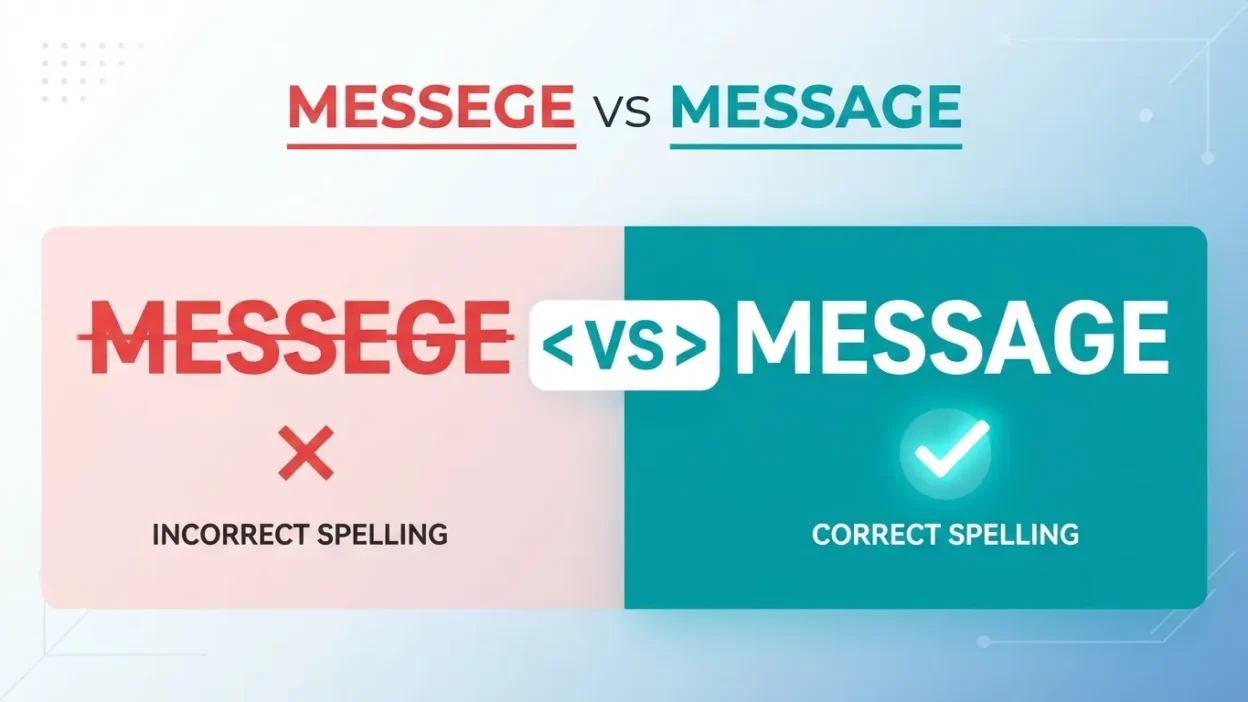
Message is the correct spelling.
Messege is a misspelling and is not considered a standard English word. If you are wondering whether to write “messege” or “message,” always choose message.
- ❌ Messege — incorrect spelling
- ✅ Message — correct spelling
- Plural: messages
- Past tense: messaged
- Related words: messaging, messenger
What Does Message Mean?
The word message is a noun and a verb.
As a noun, a message means information, an idea, or communication that someone sends or communicates to another person.
For example:
- I received a message from my friend.
- She left a message for her manager.
- The email contains an important message.
- Did you get my message?
As a verb, “message” means to communicate with someone, usually through text, an online platform, or another electronic service.
For example:
- I will message you later.
- Please message me when you arrive.
- She messaged her colleague about the meeting.
- Can you message John about the changes?
This makes “message” a very useful word in everyday English, especially when talking about texting, email, social media, and digital communication.
Why Is “Messege” Incorrect?
Messege is simply a spelling error. The standard spelling is message, with the letters “ag” in the middle:
mes + sage = message
A common mistake is changing the second “a” sound to an “e” and writing messege. Because English spelling does not always match pronunciation perfectly, this error can happen easily.
A useful way to remember the correct spelling is to focus on the ending:
message → age
Think of the word as containing “age” at the end:
- mess + age = message
- not mess + ege = messege
Message vs Messege: Comparison Table
| Word | Correct? | Meaning | Example |
| Message | ✅ Yes | A piece of communication or information | I sent you a message. |
| Messege | ❌ No | Misspelling of “message” | Please correct this messege. |
| Messages | ✅ Yes | More than one message | I have three messages. |
| Messaged | ✅ Yes | Communicated with someone | She messaged me yesterday. |
| Messaging | ✅ Yes | The act of sending messages | Messaging is convenient. |
Examples of the Correct Spelling
Seeing the correct word in different contexts can make the spelling easier to remember.
Everyday Communication
Correct: I received your message this morning.
Incorrect: I received your messege this morning.
Texting
Correct: I will message you when I get home.
Incorrect: I will messege you when I get home.
Professional Communication
Correct: Please send me a message if you need additional information.
Incorrect: Please send me a messege if you need additional information.
Social Media
Correct: She sent me a direct message on Instagram.
Incorrect: She sent me a direct messege on Instagram.
Correct: Your message was clear and easy to understand.
Incorrect: Your messege was clear and easy to understand.
Common Mistakes With “Message”
The most common mistake is writing messege instead of message, but there are a few other errors worth knowing.
1. Writing “Messege”
This is the most direct spelling mistake.
❌ I sent a messege.
✅ I sent a message.
2. Confusing Message With Messenger
Message refers to the communication itself, while messenger can refer to a person or service that delivers messages.
For example:
- I sent a message to Sarah.
- The messenger delivered the information.
3. Forgetting the Double “s”
The correct spelling starts with mess-, not mes-.
❌ mesage
❌ messege
✅ message
Remember: m-e-s-s-a-g-e
4. Using “Message” as a Noun When a Verb Is Needed
Both noun and verb uses are correct, but the sentence structure changes.
Noun: I received your message.
Verb: I will message you tonight.
Understanding this difference helps you use the word naturally.
American vs British English: Is “Message” Different?
No. Message is spelled the same in both American English and British English.
Unlike words such as color/colour or favorite/favourite, there is no standard American-versus-British spelling difference for message.
Examples:
- American English: I sent you a message.
- British English: I sent you a message.
Both use message.
The spelling messege is not the standard spelling in either variety of English.
How to Remember the Correct Spelling
If you frequently confuse messege vs message, use a simple spelling trick.
Remember:
MESSAGE = MESS + AGE
The word ends in “age,” just like:
- age
- page
- stage
- image
You can also break the spelling into individual parts:
M-E-S-S-A-G-E
Writing the word several times or using it in sentences can help reinforce the correct spelling.
Another practical trick is to remember that the middle contains “ss-a”, not “ss-e.”
✅ mess-a-ge
❌ mess-e-ge
Is “Messege” a Word?
No. Messege is not the standard English spelling of the word.
If you see “messege” in a text, social media post, email, or document, it is almost certainly a spelling mistake intended to mean message.
Some people may type “messege” because of a typing error, pronunciation influence, or unfamiliarity with English spelling. However, it should be corrected in formal and professional writing.
Message Synonyms and Related Words
Depending on the context, several words can have a similar meaning to message.
Common related words include:
- communication
- note
- text
- notification
- announcement
- information
- statement
- correspondence
- memo
- reply
These words are not always interchangeable. For example, a text usually refers to a short electronic message, while an announcement generally provides information to a larger audience.
Message in Different Contexts
The meaning of message can change slightly depending on how it is used.
Digital communication:
“I sent you a message on WhatsApp.”
Written communication:
“She left a message on my desk.”
Main idea:
“The message of the story is about kindness.”
Communication through media:
“The advertisement delivers a powerful message.”
Business communication:
“Our marketing message focuses on customer needs.”
This versatility is one reason “message” appears so frequently in everyday and professional English.
How to Avoid the “Messege” Spelling Mistake
A few simple habits can prevent this error.
Proofread before sending: Check important emails, applications, and professional documents before submitting them.
Use the spelling pattern: Remember mess + age = message.
Turn on spell check: Most modern browsers, phones, and writing applications can identify “messege” as an error.
Practice the word: Write a few sentences using “message” until the spelling becomes automatic.
Remember the pronunciation carefully: The pronunciation should not lead you to replace the “a” with an “e” when spelling the word.
Frequently Asked Questions
Is “messege” correct spelling?
No. Messege is a misspelling. The correct spelling is message.
Which is correct: messege or message?
Message is correct. Use it when referring to a piece of communication or when describing the act of communicating with someone.
How do you spell message?
The correct spelling is M-E-S-S-A-G-E.
What is the plural of message?
The plural is messages.
Example: “I received several messages today.”
Is message the same in American and British English?
Yes. Message has the same spelling in both American and British English.
Can “message” be used as a verb?
Yes. “Message” can be used as a verb.
Example: “Please message me when you arrive.”
Why do people spell message as “messege”?
Usually because of a spelling or typing error. The pronunciation can also make the correct vowel sequence difficult to remember.
Is “messege” accepted in formal writing?
No. It should be corrected to message in formal, academic, business, and professional writing.
Summary
When comparing messege vs message, there is a clear winner: message is the correct English spelling, while messege is an incorrect spelling. Message can function as both a noun and a verb, and it is commonly used for texts, emails, online communication, notes, and the main idea expressed by something.
There is also no American or British spelling difference here. Both varieties of English use message. If you want to avoid the mistake, remember the simple pattern “mess + age = message” and check the spelling before sending important communication.
Actionable Takeaway
Whenever you are unsure whether to write messege or message, choose message. Remember its spelling as M-E-S-S-A-G-E, and use your browser or device spell checker when necessary.
Correct: “I will send you a message.”
Incorrect: “I will send you a messege.”