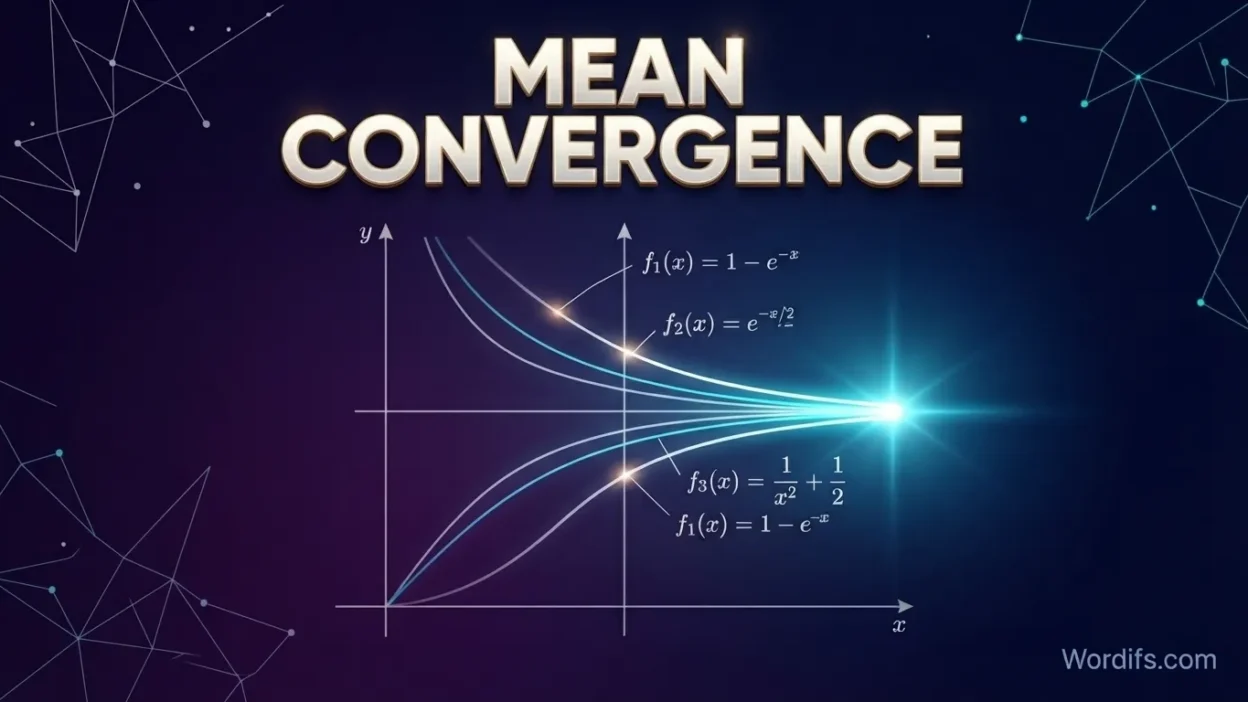
Mean convergence is a mathematical concept that describes how a sequence of random variables approaches a particular value in terms of the average size of its deviations. It is commonly discussed in probability theory, statistics, and mathematical analysis. Understanding mean convergence helps explain how statistical estimates become more reliable as more observations are collected.
The term can have slightly different meanings depending on the mathematical context. In probability theory, it often refers to convergence in mean, also called convergence in (L^p) when a specific power is involved. This concept is especially useful when studying expected errors, random variables, statistical estimators, and the behavior of sequences as they approach a limit.
Quick Answer: What Does Mean Convergence Mean?
Mean convergence describes a sequence of random variables whose average powered distance from a limiting random variable approaches zero. For convergence in mean of order (p), the expected value of the absolute difference raised to the power (p) tends to zero. For (p=1), this means the expected absolute error approaches zero.
What Is Mean Convergence?
Mean convergence is a type of convergence used to describe how closely a sequence of random variables approaches a limiting random variable on average.
Unlike ordinary numerical convergence, which examines whether individual numbers approach a particular value, mean convergence considers random variables and measures their differences using an expected value.
Suppose (X_1, X_2, X_3, \ldots) is a sequence of random variables and (X) is a proposed limiting random variable. The sequence converges to (X) in mean of order (p) if
[
\lim_{n\to\infty} E[|X_n-X|^p]=0,
]
where (p\geq 1) and the relevant expectations are finite.
Here:
- (X_n) represents the random variable at step (n).
- (X) represents the limiting random variable.
- (E[\cdot]) denotes the expected value.
- (|X_n-X|) measures the absolute difference.
- (p) determines how strongly larger errors are weighted.
For (p=1), the condition becomes
[
\lim_{n\to\infty} E[|X_n-X|]=0.
]
This is called convergence in mean, or convergence in (L^1).
For (p=2), the condition becomes
[
\lim_{n\to\infty} E[|X_n-X|^2]=0.
]
This is called convergence in mean square, or convergence in (L^2).
These distinctions matter because different forms of convergence measure error in different ways.
How Does Mean Convergence Work?
Mean convergence works by measuring the difference between a sequence of random variables and its proposed limit, then examining how that difference behaves on average.
Consider a sequence of statistical estimates. Each estimate may differ from the true value because of randomness, limited observations, or measurement variation.
If the expected absolute error becomes smaller as the number of observations increases, the estimates may converge in mean to the true value.
The important point is that mean convergence does not require every individual outcome to be close to the limit. Instead, it requires the expected magnitude of the error to approach zero.
A Simple Example of Mean Convergence
Suppose a sequence of random variables is defined by
[
X_n=\frac{Z}{n},
]
where (Z) is a random variable with a finite expected absolute value.
We want to determine whether (X_n) converges in mean to zero.
The expected absolute difference is
[
E[|X_n-0|]
=E\left[\left|\frac{Z}{n}\right|\right]
=\frac{E[|Z|]}{n}.
]
Because (E[|Z|]) is finite and (n) increases without bound,
[
\lim_{n\to\infty}\frac{E[|Z|]}{n}=0.
]
Therefore, (X_n) converges in mean to zero.
This example demonstrates the central idea: the expected absolute error decreases toward zero as the sequence progresses.
Another Example Using a Statistical Estimate
Imagine that a researcher estimates an unknown population quantity using increasingly accurate measurements. Let (X_n) represent the estimate after the (n)-th stage and let (\theta) represent the true value.
If
[
E[|X_n-\theta|]\to 0,
]
then the estimates converge in mean to (\theta).
This tells us that the expected absolute difference between the estimate and the true value becomes arbitrarily small. It does not necessarily mean that every estimate is correct or that the estimates always improve at every step.
Types of Mean Convergence
Mean convergence is closely related to several forms of convergence in probability theory. Knowing their differences helps you identify which mathematical condition a problem requires.
1. Convergence in Mean (L¹ Convergence)
Convergence in mean usually refers to convergence in the first absolute moment:
[
E[|X_n-X|]\to 0.
]
It measures the expected absolute error between a random variable and its limit.
For example, if the average absolute difference between a sequence of estimates and a target value approaches zero, the sequence converges in mean to that value.
This type is useful when the magnitude of the error matters and you want a direct measure of average deviation.
2. Mean Square Convergence (L² Convergence)
Mean square convergence occurs when
[
E[|X_n-X|^2]\to 0.
]
Because the error is squared, larger deviations receive greater weight than smaller ones.
Mean square convergence is widely used in statistics, regression analysis, estimation theory, and signal processing.
For example, a researcher might evaluate an estimator by calculating its mean squared error:
[
\operatorname{MSE}(X_n)
=E[(X_n-\theta)^2].
]
If this mean squared error approaches zero, the estimator converges in mean square to (\theta).
3. Convergence in (L^p)
More generally, convergence in (L^p) occurs when
[
E[|X_n-X|^p]\to 0,
]
for a specified (p\geq1).
Different values of (p) produce different measures of error.
- (L^1): Measures expected absolute error.
- (L^2): Measures expected squared error.
- (L^3) and higher orders: Give increasingly strong weight to larger deviations.
The appropriate type depends on the problem, the available moments, and the mathematical properties being studied.
Mean Convergence vs. Other Types of Convergence
Mean convergence is not the only way to describe the behavior of a sequence of random variables. Two other important concepts are convergence in probability and almost sure convergence.
| Type of convergence | Main condition | What it tells us | ||
| Convergence in mean | (E[ | X_n-X | ]\to0) | Expected absolute error approaches zero |
| Mean square convergence | (E[ | X_n-X | ^2]\to0) | Expected squared error approaches zero |
| Convergence in probability | (P( | X_n-X | >\varepsilon)\to0) for every (\varepsilon>0) | Large deviations become increasingly unlikely |
| Almost sure convergence | (P(\lim_{n\to\infty}X_n=X)=1) | The sequence converges to the limit with probability one | ||
| Convergence in distribution | Distribution functions converge at continuity points of the limiting distribution | The distributions approach a limiting distribution |
These concepts describe different aspects of convergence. They are related, but they are not interchangeable.
Mean Convergence vs. Convergence in Probability
Convergence in probability means that the probability of an error larger than any fixed positive threshold approaches zero.
Mean convergence is stronger in the sense that it requires the expected absolute error to approach zero, which implies convergence in probability.
However, convergence in probability does not necessarily imply convergence in mean.
For example, consider
[
X_n=
\begin{cases}
n^2, & \text{with probability }1/n^2,\
0, & \text{otherwise}.
\end{cases}
]
For any fixed (\varepsilon>0), the probability that (|X_n|>\varepsilon) approaches zero. Thus, (X_n) converges in probability to zero.
However,
[
E[|X_n|]=n^2\cdot\frac{1}{n^2}=1.
]
The expected absolute error does not approach zero. Therefore, this sequence does not converge in mean to zero.
This example illustrates how rare but extremely large errors can prevent mean convergence even when convergence in probability holds.
Mean Convergence vs. Almost Sure Convergence
Almost sure convergence describes what happens along individual sequences of outcomes, except on an event with probability zero.
Mean convergence instead measures expected error.
Mean convergence implies convergence in probability, but it does not generally imply almost sure convergence for the entire sequence. Conversely, almost sure convergence alone does not guarantee mean convergence.
Additional conditions are needed to establish these stronger relationships.
Mean Convergence vs. Convergence in Distribution
Convergence in distribution concerns the probability distributions of random variables rather than directly measuring their expected errors.
It is particularly important in statistical inference and the central limit theorem.
Convergence in distribution is generally weaker than convergence in probability when both are considered toward the same random variable on the same probability space. Convergence in probability implies convergence in distribution, but the reverse does not generally hold.
Why Is Mean Convergence Important?
Mean convergence has several important applications in mathematics, probability, and statistics.
Statistical Estimation
Statisticians often use estimators to estimate unknown population parameters, such as a mean, variance, or regression coefficient.
Mean convergence helps describe whether an estimator’s expected absolute error decreases toward zero as the sample size increases.
This is valuable when evaluating the long-run accuracy of a statistical procedure.
However, an estimator being unbiased does not automatically mean it converges in mean. Its error must also satisfy the relevant convergence condition.
Machine Learning
In machine learning, prediction errors and estimation errors are often evaluated using loss functions.
Mean squared error, for example, measures the expected squared difference between predictions and actual outcomes.
Understanding mean convergence can help researchers analyze whether a sequence of estimates approaches a target under an appropriate error measure.
Still, convergence of a training loss does not automatically guarantee good performance on new data. Generalization depends on additional factors, including model assumptions, data quality, and the learning procedure.
Numerical Analysis
Numerical methods approximate mathematical quantities through sequences of computations.
Mean convergence can be useful when these computations involve randomness, such as Monte Carlo methods or randomized numerical algorithms.
Researchers may examine whether the expected error of an approximation approaches zero as computational effort increases.
Signal Processing
Signal processing frequently uses mean square error to compare an estimated signal with a reference signal.
Mean square convergence helps describe whether the expected squared difference between these signals becomes smaller as a processing method improves.
Applications include noise reduction, signal estimation, and certain filtering techniques.
How to Determine Whether a Sequence Converges in Mean
When solving a mathematical problem involving mean convergence, use a systematic approach.
Step 1: Identify the Limiting Random Variable
Determine the random variable (X) that the sequence (X_n) is expected to approach.
The proposed limit may be zero, a constant, or another random variable.
Step 2: Calculate the Difference
Find the absolute error:
[
|X_n-X|.
]
For mean square convergence, use the squared error instead:
[
|X_n-X|^2.
]
Step 3: Take the Expected Value
For convergence in mean, calculate
[
E[|X_n-X|].
]
For mean square convergence, calculate
[
E[|X_n-X|^2].
]
The calculation may involve a sum for a discrete random variable or an integral for a continuous random variable.
Step 4: Evaluate the Limit
Determine what happens to the expected error as (n) approaches infinity.
If the expected absolute error approaches zero, the sequence converges in mean to (X).
If the expected squared error approaches zero, it converges in mean square to (X).
Step 5: Check the Required Assumptions
Make sure the relevant expectations exist and are finite where required. Do not assume convergence merely because the formula appears to become small.
This final check is particularly important when working with unbounded random variables or distributions with heavy tails.
Common Mistakes When Studying Mean Convergence
Students and researchers can confuse mean convergence with other concepts because their definitions look similar.
Avoid these common mistakes:
- Confusing mean convergence with convergence of means: The condition (E[|X_n-X|]\to0) is stronger than simply having (E[X_n]\to E[X]).
- Ignoring absolute values: The expected signed error can be zero because positive and negative errors cancel, even when the errors themselves remain large.
- Assuming convergence in probability implies mean convergence: Rare, large errors can prevent the expected absolute error from approaching zero.
- Treating mean square convergence and mean convergence as identical: They use different error measures, although mean square convergence implies convergence in mean when the relevant moments exist.
- Ignoring the limiting random variable: A convergence statement must identify what the sequence is approaching.
- Forgetting the role of expectations: Mean convergence depends on the expected magnitude of the error, not just the numerical appearance of a sequence.
Understanding these distinctions makes probability theory easier to apply correctly.
Frequently Asked Questions
1. What is the simple definition of mean convergence?
Mean convergence occurs when the expected absolute difference between a sequence of random variables and its limiting random variable approaches zero. It describes increasingly small average errors.
2. What is the formula for mean convergence?
For convergence in mean, the standard condition is
[
\lim_{n\to\infty}E[|X_n-X|]=0.
]
For mean square convergence, the condition is
[
\lim_{n\to\infty}E[|X_n-X|^2]=0.
]
The correct formula depends on which type of convergence is being studied.
3. Does mean convergence imply convergence in probability?
Yes. Convergence in mean implies convergence in probability. This relationship follows from Markov’s inequality, provided the expected absolute error is finite.
For every (\varepsilon>0),
[
P(|X_n-X|>\varepsilon)
\leq \frac{E[|X_n-X|]}{\varepsilon}.
]
As the expected absolute error approaches zero, the probability of exceeding any fixed error threshold also approaches zero.
4. Does convergence in probability imply mean convergence?
No, not in general. A sequence can converge in probability while retaining a nonvanishing expected absolute error.
This can happen when very large errors occur with increasingly small probabilities, as demonstrated by the rare-event example above.
5. What is the difference between mean convergence and mean square convergence?
Mean convergence measures expected absolute error, while mean square convergence measures expected squared error.
Mean square convergence implies convergence in mean on a probability space, because the Cauchy–Schwarz inequality gives
[
E[|X_n-X|]
\leq \sqrt{E[|X_n-X|^2]}.
]
The reverse implication does not generally hold.
6. Is mean convergence the same as convergence of expected values?
No. Convergence of expected values means (E[X_n]\to E[X]), assuming the expectations are defined. Mean convergence requires (E[|X_n-X|]\to0), which controls the magnitude of the error rather than only its signed average.
Mean convergence implies convergence of expected values when the relevant expectations exist, but convergence of expected values alone is insufficient.
7. Where is mean convergence used in real life?
Mean convergence is useful in statistical estimation, machine learning, signal processing, numerical analysis, and probability theory. It helps researchers evaluate whether expected errors become smaller as estimates or approximations improve.
Final Thoughts
Mean convergence is an important concept in probability theory and statistics because it describes how the expected error between a sequence of random variables and its limit approaches zero. Its main forms include convergence in mean, mean square convergence, and the more general convergence in (L^p).
The key is to distinguish mean convergence from convergence in probability, almost sure convergence, and convergence in distribution. Each concept describes a different aspect of limiting behavior.
By understanding the definitions, checking the expected error, and applying the appropriate mathematical conditions, you can determine whether a sequence converges in mean and understand why that result matters in statistical analysis and other mathematical applications.

Zevran Callix works on the Wordifs site creating clear informative articles while collaborating through wordifs@gmail.com to maintain consistency quality research readability and reader focused blogging standards worldwide digital content platform.