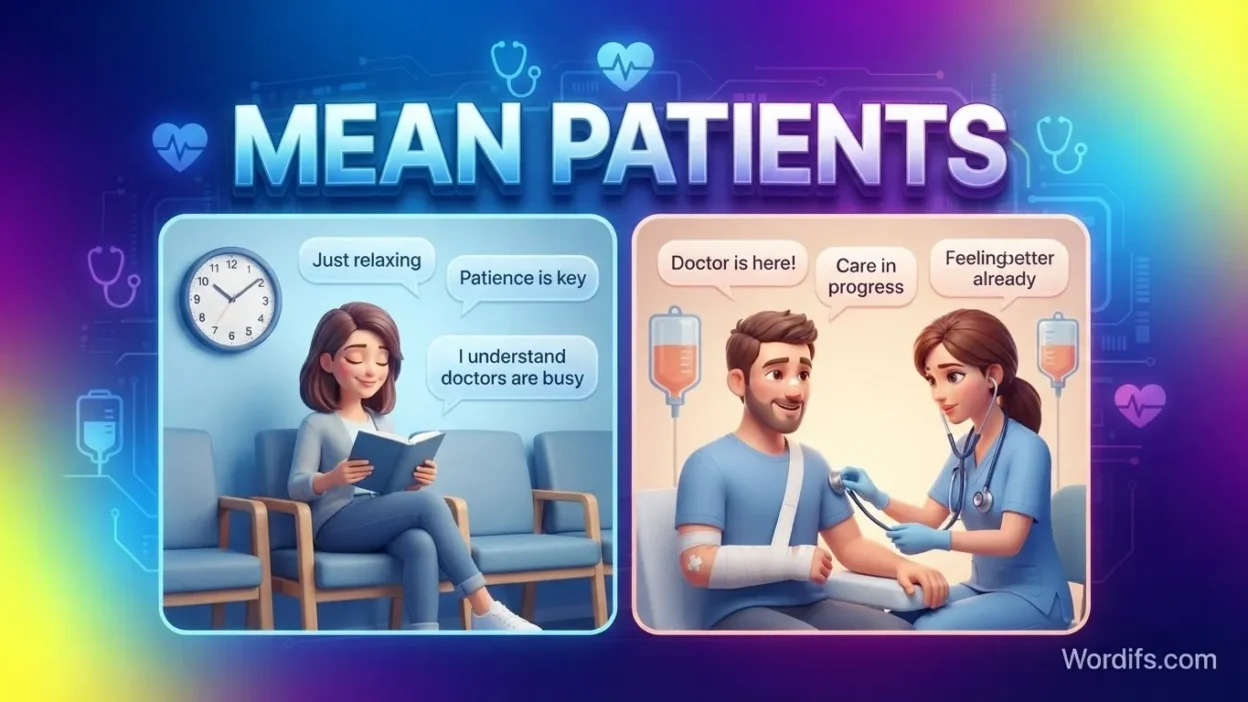
Mean patients are people who behave rudely, disrespectfully, or aggressively toward others, especially in a healthcare setting. They may insult doctors or nurses, complain harshly, refuse to cooperate, or express frustration in hurtful ways.
However, a patient who seems mean may also be experiencing pain, fear, stress, or anxiety. Understanding the difference between difficult behavior and intentional mistreatment can help healthcare workers respond professionally while protecting their own well-being.
If you have encountered a mean patient at a hospital, clinic, dental office, or medical practice, you may wonder why some patients act this way and how to handle them. The best approach combines empathy, clear communication, professional boundaries, and appropriate safety measures.
This guide explains what mean patients are, why they may behave badly, common examples, and practical strategies for managing challenging patient interactions.
Quick Answer: What Does Mean Patients Mean?
Mean patients are patients who treat healthcare professionals or others rudely, disrespectfully, or aggressively. Their behavior may include insults, yelling, unreasonable demands, or refusal to cooperate. Some act this way because of pain, fear, confusion, or frustration, while others may intentionally behave disrespectfully. Understanding the cause can help staff respond appropriately without accepting abuse.
What Are Mean Patients?
Mean patients are individuals receiving medical care who display unpleasant, hostile, or disrespectful behavior toward healthcare workers, caregivers, or other patients. The term is informal rather than a medical diagnosis. It describes behavior, not a person’s entire character.
For example, a patient who shouts at a nurse because an appointment is delayed may be behaving rudely. A patient who repeatedly insults a receptionist, threatens a doctor, or deliberately humiliates a healthcare worker is displaying more serious misconduct.
Not every upset patient is a mean patient. Someone can be disappointed with their care, question a medical decision, or complain about a long wait without mistreating anyone. The important distinction is how the person communicates their concerns.
Common Characteristics of Mean Patients
Mean or difficult patients may demonstrate one or more of these behaviors:
- Rudeness: Speaking dismissively, using insults, or making disrespectful comments.
- Aggression: Yelling, threatening, intimidating, or behaving in a physically confrontational manner.
- Unreasonable demands: Expecting immediate attention regardless of medical urgency or established procedures.
- Disrespect for boundaries: Ignoring staff requests, making inappropriate remarks, or refusing to respect personal space.
- Blaming others: Holding healthcare workers personally responsible for every inconvenience or disappointing outcome.
- Refusal to cooperate: Declining necessary discussions, interrupting explanations, or resisting reasonable instructions.
- Manipulative behavior: Attempting to pressure staff through threats, guilt, or intimidation.
These behaviors can occur occasionally or repeatedly. Their seriousness depends on the circumstances, frequency, impact, and potential safety risks.
Why Are Some Patients Mean?
There is no single reason patients behave badly. Their behavior may reflect emotional distress, medical circumstances, personal expectations, or a deliberate choice to treat others disrespectfully.
Understanding possible causes helps healthcare workers choose an effective response. However, identifying a possible explanation does not mean excusing harmful behavior.
1. Pain and Physical Discomfort
Pain can make people impatient, irritable, and emotionally overwhelmed. A patient waiting for pain medication or struggling with a serious illness may react sharply to questions or delays.
For example, someone experiencing severe dental pain might speak angrily to a receptionist after waiting longer than expected. The pain may help explain the reaction, but staff should still address abusive language appropriately.
2. Fear and Anxiety
Medical appointments can be frightening. Patients may worry about surgery, test results, diagnoses, financial costs, or losing control over their health.
Fear sometimes appears as anger. A patient who feels vulnerable may become defensive, challenge recommendations, or respond harshly because they do not know how to express their concerns.
Clear explanations and opportunities to ask questions can help reduce this tension.
3. Long Wait Times and Frustration
Long waits, scheduling problems, insurance complications, and repeated paperwork can frustrate patients. Someone who feels ignored may direct that frustration toward the first available employee.
Healthcare workers can acknowledge delays honestly, explain what is known, and provide realistic updates. They should avoid making promises about wait times that they cannot keep.
4. Feeling Ignored or Disrespected
Patients may become angry when they believe their symptoms are being dismissed or their questions are not answered.
Sometimes the concern reflects a communication failure. In other situations, the patient may have misunderstood the explanation or may disagree with the treatment plan.
Listening carefully, summarizing the concern, and explaining available options can help establish trust.
5. Confusion or Cognitive Difficulties
Confusion, memory problems, certain medical conditions, medication effects, and other health-related factors can influence behavior.
A patient who seems unusually agitated or confused may need medical assessment rather than a disciplinary response alone. Sudden changes in behavior should be taken seriously, especially when accompanied by other concerning symptoms.
Healthcare workers should follow their clinical procedures instead of assuming that difficult behavior is intentional.
6. Personal Expectations and Communication Habits
Some patients expect immediate service, have difficulty accepting limits, or are accustomed to communicating aggressively.
Personality, past experiences, cultural differences, and communication preferences may also affect interactions. These factors should be considered without stereotyping individuals or assuming that a particular background causes disrespectful behavior.
7. Intentional Disrespect
Some people knowingly use insults, threats, or intimidation to obtain special treatment or control an interaction.
When a patient repeatedly engages in abusive behavior after expectations have been explained, staff may need to establish firmer boundaries, document incidents, and follow workplace policies.
Examples of Mean Patients in Healthcare Settings
Mean patient behavior can look different depending on the situation. These examples illustrate the distinction between understandable frustration and inappropriate treatment.
| Situation | Example of behavior | Appropriate response |
| Hospital waiting room | Shouting at staff about a delay | Acknowledge frustration and explain the process |
| Doctor’s appointment | Insulting the doctor after hearing a diagnosis | Listen to concerns and set communication boundaries |
| Nursing care | Repeatedly making degrading remarks to a nurse | State that respectful communication is required |
| Dental office | Demanding immediate treatment and threatening employees | Explain options and follow safety procedures |
| Pharmacy | Blaming the pharmacist for an insurance denial | Clarify the issue and explain available next steps |
| Emergency department | Threatening staff when asked to wait | Prioritize safety and activate the appropriate response |
Difficult Patient vs. Mean Patient
A difficult patient is not necessarily a mean patient. The distinction matters because healthcare professionals should respond to the actual behavior rather than labeling someone unfairly.
A difficult patient may ask many questions, disagree with treatment, need repeated explanations, or struggle to follow instructions. These behaviors can make care more challenging without being abusive.
A mean patient, in the informal sense, crosses the line into disrespectful or hostile treatment. Examples include personal insults, deliberate humiliation, discriminatory comments, or threats.
The key difference is not whether the patient agrees with the healthcare worker. It is whether the patient communicates concerns in a way that respects others’ safety and dignity.
How to Deal With Mean Patients Professionally
Handling an angry or disrespectful patient requires patience, emotional control, and clear boundaries. The goal is to address legitimate concerns, maintain professional standards, and prevent the interaction from escalating.
1. Stay Calm and Control Your Tone
When a patient raises their voice, responding with anger can intensify the conflict. Speak slowly, keep your tone neutral, and avoid sarcasm or personal criticism.
For example, instead of saying, “You need to stop being so rude,” try:
“I want to help you, and I can do that more effectively if we speak calmly.”
This approach focuses on the behavior and the next step rather than attacking the person.
Staying calm does not mean tolerating threats or remaining in an unsafe situation.
2. Listen to the Patient’s Main Concern
Sometimes people become less confrontational when they feel heard. Allow the patient to explain the issue without unnecessary interruptions, provided the situation is safe.
Use short, clarifying questions such as:
- “Can you tell me what has been most frustrating?”
- “What are you most concerned about right now?”
- “What would you like us to clarify?”
Then summarize the concern to confirm that you understand it. You may discover a correctable problem, such as a misunderstanding about an appointment, medication, or treatment plan.
3. Acknowledge Feelings Without Accepting Abuse
Empathy can help lower tension. You can recognize a patient’s frustration without agreeing with every accusation or permitting mistreatment.
Useful statements include:
- “I understand that waiting has been frustrating.”
- “It sounds like you’re worried about your test results.”
- “I can see that this situation is upsetting.”
- “Let’s review the options available to you.”
Avoid saying that you agree with an accusation when you do not have enough information to verify it.
4. Set Clear and Respectful Boundaries
Healthcare professionals have a responsibility to provide appropriate care, but they do not have to accept verbal abuse as part of their jobs.
If a patient begins insulting or intimidating staff, calmly explain the boundary.
For example:
“I want to discuss your concerns, but I cannot continue the conversation while you are insulting me. We can continue when we can speak respectfully.”
Use language consistent with your workplace policies. If the patient continues the behavior, involve a supervisor or follow the established escalation procedure.
5. Explain What You Can and Cannot Do
Some conflicts arise because patients expect services that staff cannot provide immediately. Explain the reason for a delay, the available choices, and what will happen next.
For instance, a receptionist might explain that a clinician is treating an urgent case and provide an estimate only if one is available.
Avoid arguing over demands you cannot meet. Clear, factual explanations are usually more useful than repeatedly defending yourself.
6. Offer Practical Options
When possible, give the patient a choice between reasonable alternatives.
Depending on the situation, these might include:
- Speaking with the appropriate clinician.
- Asking for clarification about the treatment plan.
- Reviewing appointment or scheduling options.
- Contacting the billing department about a charge.
- Requesting a supervisor to help resolve a service concern.
Offering options gives the patient a constructive way to move forward without rewarding threats or inappropriate demands.
7. Document Serious or Repeated Incidents
Follow workplace policies for documenting abusive or threatening interactions. Records should be factual, objective, and relevant to care and safety.
Include details such as:
- The date, time, and location.
- The specific behavior or statements observed.
- The circumstances leading up to the incident.
- Any witnesses present.
- The steps taken to de-escalate the situation.
- Whether a supervisor or security team was notified.
Avoid personal judgments such as “the patient is a terrible person.” A factual description, such as “the patient shouted an insult and threatened to strike the employee,” is more useful.
Documentation should follow applicable privacy requirements and organizational procedures.
8. Prioritize Safety When Behavior Escalates
Threats, physical aggression, stalking, or attempts to harm staff require more than communication techniques.
If you believe someone may become violent:
- Maintain a safe distance and avoid blocking the person’s exit.
- Follow your workplace’s emergency and security procedures.
- Notify a supervisor or trained security personnel.
- Seek emergency assistance when necessary.
- Do not attempt to physically restrain someone unless you are trained, authorized, and acting under applicable procedures.
Your safety and the safety of other patients matter. Empathy is important, but it should never require you to remain in immediate danger.
What Should Healthcare Workers Avoid When Dealing With Mean Patients?
Certain reactions can make an already tense interaction worse.
Avoid these common mistakes:
- Arguing or insulting the patient: Personal attacks shift attention away from resolving the issue.
- Taking every comment personally: A patient’s anger may relate to pain, fear, or circumstances beyond your control.
- Making unrealistic promises: Promising immediate treatment or a specific outcome can create further frustration.
- Ignoring potential medical causes: Sudden confusion or agitation may require clinical evaluation.
- Threatening consequences impulsively: Follow established policies rather than making emotional statements.
- Tolerating repeated abuse without support: Seek assistance when the interaction exceeds your role or becomes unsafe.
- Assuming all complaints are unreasonable: Patients can behave badly and still have legitimate concerns.
Professionalism means treating patients fairly while maintaining appropriate limits.
How Mean Patients Affect Healthcare Workers
Repeated exposure to hostile patient behavior can contribute to workplace stress, emotional exhaustion, reduced job satisfaction, and difficulty concentrating.
Nurses, doctors, medical assistants, receptionists, pharmacists, and other healthcare workers may feel anxious before appointments or worry about future confrontations.
A single difficult encounter does not affect everyone in the same way. However, repeated abuse can become a workplace safety and staff well-being concern.
Helpful ways to manage the impact include:
- Discussing serious incidents with a supervisor.
- Using employee support resources when available.
- Taking appropriate breaks after stressful interactions.
- Debriefing with trusted colleagues while protecting patient confidentiality.
- Participating in de-escalation or conflict-management training.
- Reporting threats or harassment through established channels.
Healthcare organizations can also help by maintaining clear behavioral policies, providing staff training, and establishing reliable procedures for responding to abusive conduct.
Can a Healthcare Provider Refuse to Treat a Mean Patient?
Whether a healthcare provider can decline or end a patient relationship depends on the circumstances, professional obligations, applicable laws, and organizational policies.
A patient being rude does not automatically mean a clinician can abandon their care. Emergency situations, continuity-of-care responsibilities, licensing rules, and nondiscrimination requirements may limit the available options.
For example, a provider may be able to establish behavioral expectations or arrange a transfer of care under an appropriate process. However, the provider must consider the patient’s medical needs and follow relevant procedures.
If a patient makes credible threats or becomes physically aggressive, staff should prioritize immediate safety and use the organization’s emergency protocols.
Healthcare workers should consult their supervisors, compliance teams, or legal advisers when deciding how to handle repeated abuse or end a professional relationship.
How Patients Can Avoid Being Seen as Mean
Patients can express dissatisfaction firmly without treating healthcare workers disrespectfully. You do not need to hide your concerns or agree with every medical decision to communicate constructively.
Try these practical steps:
- Explain the problem clearly rather than attacking an individual.
- Ask questions if you do not understand a diagnosis or treatment recommendation.
- Describe how a delay or mistake affects you.
- Request a supervisor or patient advocate when a concern remains unresolved.
- Avoid insults, discriminatory remarks, threats, and personal accusations.
- Ask what options are available if your preferred solution is not possible.
For example, saying, “I’ve been waiting for an hour, and I’m concerned because my symptoms are getting worse. Could someone update me?” communicates urgency more effectively than shouting at the receptionist.
Respectful communication benefits both patients and healthcare teams.
Frequently Asked Questions
1. What does “mean patients” mean?
“Mean patients” refers informally to people receiving medical care who behave rudely, aggressively, or disrespectfully toward healthcare professionals or others. The phrase describes behavior rather than a formal medical or psychological diagnosis.
2. Why are some patients rude to nurses?
Patients may be rude to nurses because of pain, fear, anxiety, confusion, frustration, or dissatisfaction with care. Some may also have difficulty managing their emotions or respecting boundaries. Understanding the circumstances can guide the response, but it does not make abusive behavior acceptable.
3. How should a nurse respond to a mean patient?
A nurse should remain calm when safe, listen to the patient’s concern, acknowledge reasonable frustration, and establish clear boundaries. If behavior escalates into threats or violence, the nurse should follow workplace safety procedures and seek appropriate assistance.
4. Is an angry patient always a mean patient?
No. Anger is an emotion, and patients have the right to question care, express concerns, and request explanations. A patient becomes disrespectful when their behavior involves insults, intimidation, harassment, threats, or other inappropriate treatment.
5. What is the difference between a difficult patient and a mean patient?
A difficult patient may require additional explanations, disagree with treatment, or struggle with care instructions. A mean patient, as the phrase is commonly used, behaves in a hostile or disrespectful way. The categories can overlap, but difficulty alone does not establish abusive behavior.
6. Can pain make patients behave badly?
Yes. Pain and physical discomfort can contribute to irritability, impatience, and emotional distress. However, behavior varies between individuals, and pain does not automatically cause aggression. Sudden or unusual behavioral changes may warrant clinical assessment.
7. Should healthcare workers tolerate verbal abuse?
Healthcare workers should respond professionally, but professionalism does not require tolerating repeated abuse, harassment, or threats. They should set appropriate boundaries, report serious incidents, and follow workplace procedures to protect themselves and others.
Final Thoughts
Mean patients can make healthcare work emotionally challenging, but their behavior is not always caused by the same factors. Pain, anxiety, confusion, frustration, and intentional disrespect can all contribute to difficult interactions. Recognizing the difference helps healthcare professionals respond with empathy while maintaining clear boundaries.
The most effective approach combines calm communication, active listening, practical solutions, factual documentation, and appropriate safety measures. Patients also play an important role by expressing concerns respectfully and working with healthcare teams to resolve problems. Ultimately, compassionate care and mutual respect should go hand in hand.

Kalven Driost works on the Wordifs site producing reliable content while communicating through wordifs@gmail.com to support research editing publishing consistency transparency and audience focused knowledge sharing practices for modern readers.