The phrases what kind of vs what kinds of often look similar, but their meaning and usage can differ depending on context and purpose. When learners pause mid-sentence, what kind of and what kinds of can look almost identical, yet they serve slightly different purposes.
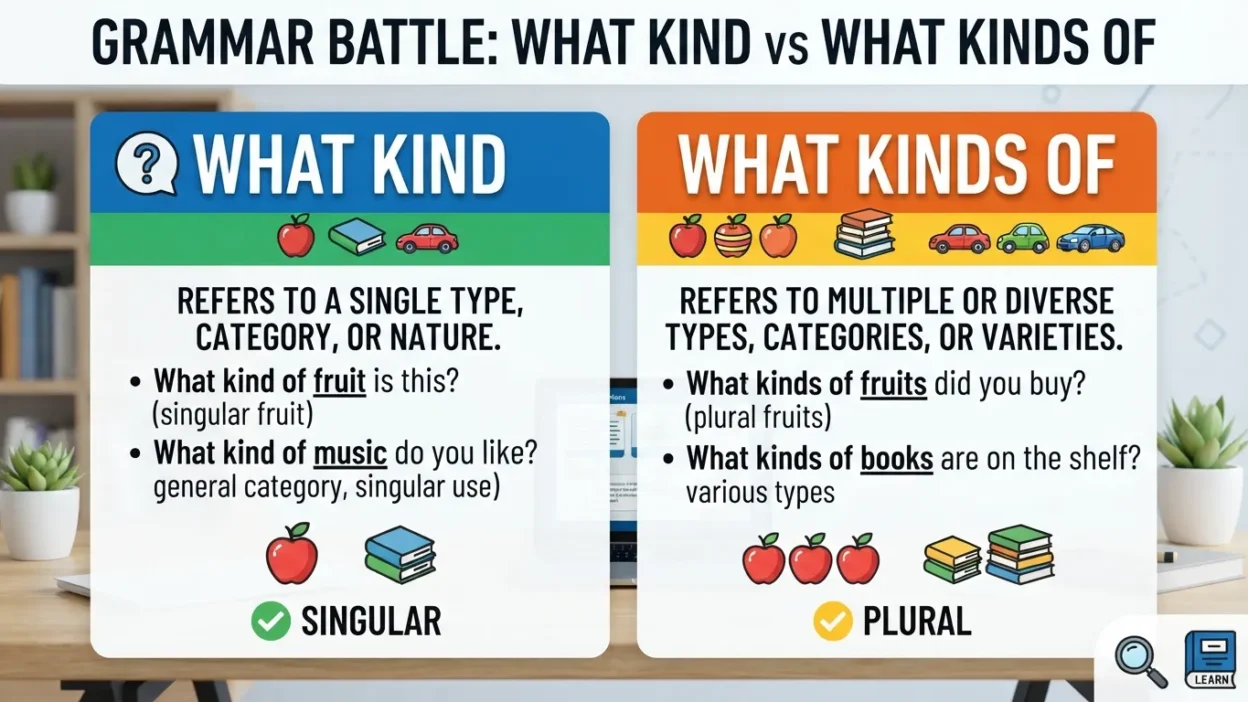
The exact difference is that what kind of usually asks about one kind or general type, while what kinds of often asks about several kinds or varieties. In English grammar, both forms are correct.
For example, “What kind of music do you like?” focuses on a general type, while “What kinds of music do you enjoy?” can invite several answers. As a writer, I find that this simple distinction helps an English learner speak and write more confidently and sound more natural.
A useful guide is to focus on the purpose of the question instead of memorizing complicated rules. In everyday speech and writing, what kind of is common, including before plural nouns, while what kinds of is useful when you clearly mean multiple types.
If you are wondering which form to use, compare “what type” with “what types.” This simple rule makes the application easier. Consider these real-life examples: “What kind of job do you want?” and “What kinds of jobs are available?” These examples show how the two forms serve different meanings.
This understanding of grammatical usage helps you learn correct English language patterns without hesitation. One common problem is treating every plural noun as a reason to choose what kinds of, which can cause unnecessary mistakes.
Other common mistakes include leaving out “of” or choosing the wrong form while saying a question aloud. The most practical tips are to focus on the intended meaning, check the surrounding context, and practice through real communication.
A friendly, clear, and easy approach makes correct usage easier to apply. From an English learner perspective, regular practice can instantly improve understanding. From an NLP perspective, recognizing semantically related and contextual patterns also helps explain why natural communication does not always follow rigid formulas.
Quick Answer:
Use “what kind of” when asking about one type or category.
- What kind of music do you like?
- What kind of car does she drive?
- What kind of food is this?
Use “what kinds of” when asking about multiple types, varieties, or categories.
- What kinds of music do you like?
- What kinds of cars are popular here?
- What kinds of food do they serve?
A simple way to remember the difference is:
What kind of = one type
What kinds of = more than one type
However, English usage has an important detail: “what kind of” can sometimes be used naturally before plural nouns, especially when the speaker is thinking of a general category rather than deliberately asking for several distinct categories.
What Does “What Kind Of” Mean?
“What kind of” is used to ask about the type, nature, category, or variety of something.
The word “kind” is singular, so it traditionally suggests that you are looking for one type or category.
For example:
What kind of movie do you want to watch?
The question asks you to identify the type of movie, such as comedy, drama, action, or horror.
More examples include:
- What kind of job are you looking for?
- What kind of phone do you use?
- What kind of person is he?
- What kind of book are you reading?
- What kind of exercise do you enjoy?
Here, the focus is on identifying a category or general type.
What Does “What Kinds Of” Mean?
“What kinds of” is the plural form. It is used when you are asking about multiple types, varieties, or categories.
For example:
What kinds of books do you enjoy?
This question can invite several answers, such as:
- mystery books
- historical novels
- science fiction
- biographies
Similarly:
- What kinds of restaurants do you prefer?
- What kinds of problems can this software solve?
- What kinds of animals live in this area?
- What kinds of products does the company sell?
- What kinds of activities are available for children?
The plural “kinds” makes it clearer that more than one category may be included in the answer.
What Kind Of vs What Kinds Of: Comparison Table
| Phrase | Main Use | Example | Meaning |
| What kind of | One type or general category | What kind of music do you like? | Asking about a type of music |
| What kinds of | Several types or categories | What kinds of music do you like? | Asking about different types of music |
| What kind of + singular noun | One category/item type | What kind of car is it? | Identifying the category |
| What kinds of + plural noun | Multiple categories | What kinds of cars are available? | Asking about varieties |
The distinction is usually simple: singular “kind” focuses on one category, while plural “kinds” emphasizes multiple categories.
Examples of “What Kind Of”
Here are some natural examples using the singular form:
Everyday conversation
- What kind of coffee do you want?
- What kind of music does your brother like?
- What kind of clothes do you usually wear?
- What kind of movies do you watch?
- What kind of food should we order?
Asking about a person
- What kind of person is she?
- What kind of leader is he?
- What kind of teacher do you need?
Asking about things
- What kind of computer do you have?
- What kind of car are you looking for?
- What kind of information do you need?
Notice that the noun after “what kind of” can sometimes be plural in natural English:
What kind of movies do you like?
This is common and does not automatically make the sentence incorrect. The speaker may be asking about someone’s preferred type or general category of movies.
Examples of “What Kinds Of”
Use the plural form when you want to emphasize different varieties or multiple categories.
- What kinds of books do children enjoy?
- What kinds of jobs are available in this field?
- What kinds of businesses are growing quickly?
- What kinds of exercises are good for beginners?
- What kinds of questions should I expect?
- What kinds of desserts do you make?
- What kinds of problems did you encounter?
For example:
What kinds of books do you read?
This sounds especially natural when you expect the person to name several categories.
What Kind Of or What Kinds Of With Plural Nouns?
This is where many English learners become uncertain.
Both forms can occur with plural nouns, but they can communicate slightly different intentions.
Compare:
What kind of movies do you like?
This can mean:
What type or genre of movies do you like?
What kinds of movies do you like?
This more strongly suggests:
Which different types or genres of movies do you like?
The difference is often about focus rather than strict grammar.
If you are asking for one general classification, “what kind of” is natural. If you want several varieties or categories, “what kinds of” is clearer.
Common Mistakes
Mistake 1: Using “kinds” when asking about one specific category
Incorrect or unnecessarily plural:
What kinds of car is this?
Correct:
What kind of car is this?
Because “a car” is singular, use “what kind of.”
Mistake 2: Using “kind” when clearly asking for multiple varieties
Less precise:
What kind of products does this store sell?
This sentence can still be natural, but if you specifically want several categories, use:
What kinds of products does this store sell?
Mistake 3: Forgetting “of”
A common learner error is:
What kind music do you like?
The standard construction is:
What kind of music do you like?
Likewise:
What kinds of books do you read?
The word “of” is normally an essential part of this expression.
Mistake 4: Confusing “kind” with “type”
“Kind,” “type,” and “sort” often have similar meanings.
- What kind of car is it?
- What type of car is it?
- What sort of car is it?
All three can be grammatically correct, although the most natural choice depends on context and regional preference.
What Kind Of vs What Type Of vs What Sort Of
These expressions are closely related.
What kind of is extremely common in everyday American and British English.
What type of can sound slightly more formal or precise.
What sort of is also common, particularly in British English, although it is certainly understandable to American English speakers.
Examples:
- What kind of music do you like?
- What type of music do you like?
- What sort of music do you like?
The basic meaning is similar: you are asking someone to identify a category or variety.
American vs British English
There is no major American-versus-British grammar rule that makes “what kind of” correct in one variety and “what kinds of” correct in the other.
Both forms are used in American and British English.
However, British English commonly uses “what sort of” in situations where American English may more often use “what kind of.”
For example:
American English:
What kind of music do you like?
British English:
What sort of music do you like?
Both are natural and correct.
The important distinction between kind and kinds is mainly about whether the speaker is referring to one general type or multiple varieties.
How to Choose the Right Phrase
When you’re unsure, ask yourself one question:
Am I asking about one type or several types?
If you mean one general category:
What kind of food do you like?
If you want several categories:
What kinds of food do you like?
Another useful test is to imagine the expected answer.
If the answer is likely to be one category, singular kind often works well.
If the answer could naturally contain a list of categories, plural kinds may be more appropriate.
Frequently Asked Questions
Is “what kind of” grammatically correct?
Yes. “What kind of” is a standard and very common English expression used to ask about a type, category, or variety.
Is “what kinds of” grammatically correct?
Yes. “What kinds of” is also correct. It is generally used when referring to multiple types, varieties, or categories.
Can “what kind of” be used with plural nouns?
Yes. In natural English, “what kind of” can be followed by a plural noun, particularly when asking about a general type or category.
For example:
What kind of movies do you like?
This is completely natural.
Which is correct: “what kind of books” or “what kinds of books”?
Both can be correct. “What kind of books” usually focuses on a general type or category, while “what kinds of books” more strongly suggests multiple varieties.
Is “what kind of” singular or plural?
“Kind” is singular, but the noun that follows can be singular or plural depending on the sentence and intended meaning.
Is “what kinds of” more grammatically correct than “what kind of”?
No. Neither is automatically better. The correct choice depends on what you mean.
What is another word for “kind”?
Depending on context, alternatives include type, sort, category, variety, class, group, and form.
What is the difference between “what kind” and “what kinds”?
“What kind” generally refers to one type or a broad category, while “what kinds” emphasizes multiple types or varieties.
Summary
The difference between “what kind of” and “what kinds of” is mainly about number and meaning. Use “what kind of” when you are identifying one type or asking about a general category. Use “what kinds of” when you want to emphasize several types, varieties, or categories.
Remember that real-world English is flexible. Native speakers frequently use “what kind of” before plural nouns, so you should not assume that every plural noun requires “what kinds of.” Pay attention to the meaning you want to communicate rather than relying only on a rigid grammar formula.
Actionable Takeaway
Before choosing between the two expressions, identify your intended meaning. If you are asking “Which type?”, choose “what kind of.” If you are asking “Which different types?”, choose “what kinds of.” Reading and listening to natural English will also help you recognize when each expression sounds most appropriate.
For quick reference, remember: What kind of = one/general type; what kinds of = multiple types/varieties. Once you understand this distinction, choosing the right phrase becomes much easier in conversations, emails, academic writing, and everyday English.

Zevran Callix works on the Wordifs site creating clear informative articles while collaborating through wordifs@gmail.com to maintain consistency quality research readability and reader focused blogging standards worldwide digital content platform.