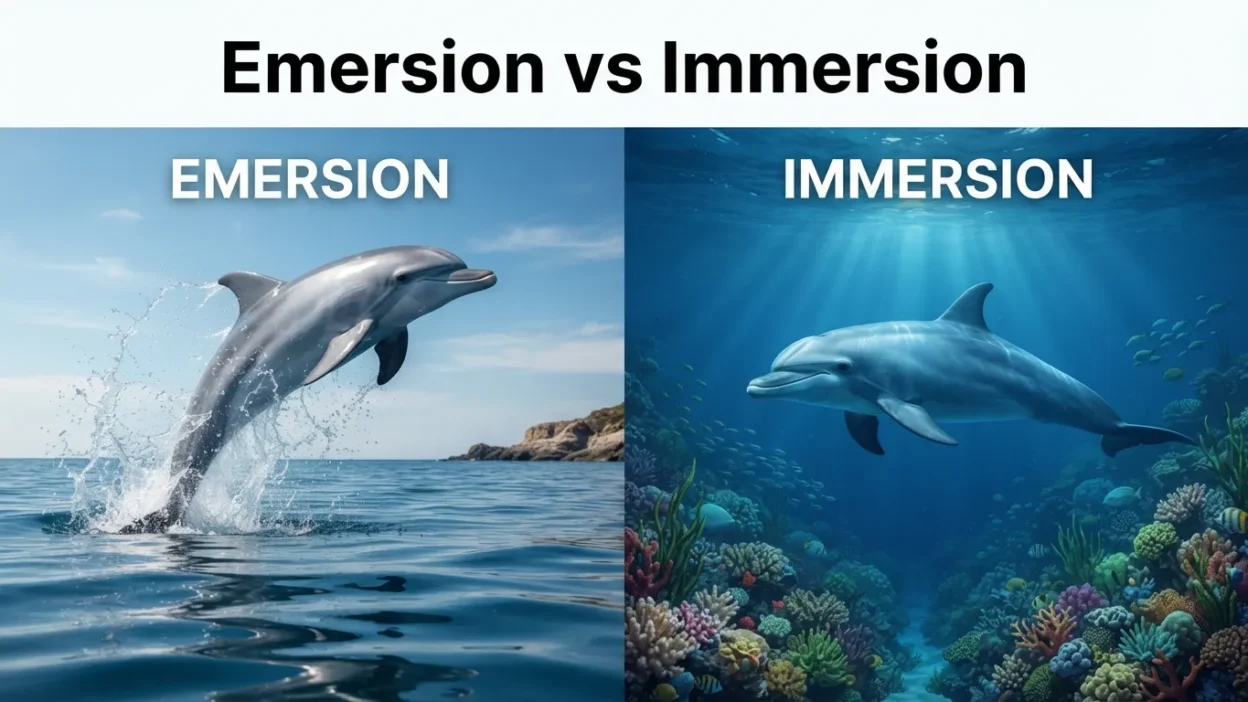
“Emersion vs immersion” is a common word-choice question because the two terms look and sound remarkably similar. However, they describe opposite ideas: immersion generally means entering into or being deeply surrounded by something, while emersion refers to emerging from something or becoming visible after being covered.
Knowing the difference can help you avoid awkward wording in academic writing, professional communication, science, and everyday English. In this guide, you’ll learn the meanings, examples, common mistakes, and practical ways to remember which word to use.
Quick Answer
Immersion means being completely surrounded, involved, or absorbed in something. For example, “language immersion” means learning a language by being surrounded by and actively using it.
Emersion means the act or process of emerging from something, especially after being covered, hidden, or submerged. It is a much less common word and is often used in astronomy, science, and technical contexts.
Easy memory trick:
- Immersion = going in
- Emersion = coming out
What Does Immersion Mean?
Immersion is the more common word of the two. It comes from the idea of being placed deeply into something or surrounded by it.
In everyday English, immersion can describe physical, educational, emotional, or mental involvement.
For example:
- “The immersion of the object in water was carefully measured.”
- “She joined an English immersion program.”
- “The game provides an immersive experience.”
- “He became fully immersed in the novel.”
The word can also describe intense involvement. If someone is completely focused on a task, you might say they are immersed in their work.
Common meanings of immersion
Immersion can refer to:
- Physical submersion: placing something under a liquid
- Language learning: learning through constant exposure to a language
- Mental involvement: becoming deeply absorbed in an activity
- Technology: creating an experience that feels highly realistic
- Religious practice: entering water as part of a ceremony
The related adjective immersive is also widely used, especially when discussing games, virtual reality, education, and entertainment.
What Does Emersion Mean?
Emersion is a real English word, but it is considerably less common than immersion.
It means the act of emerging from something or becoming visible after being concealed or submerged.
The word is related to emerge, which makes its basic meaning easier to understand.
For example:
- “The emersion of the object from the water was observed.”
- “Astronomers recorded the emersion of the moon from the eclipse.”
- “The satellite became visible after its emersion from the shadow.”
In technical and scientific writing, emersion may describe an object becoming visible after passing out of an obscuring position.
Because emersion is uncommon in everyday conversation, writers sometimes accidentally replace it with “immersion” or assume that “emersion” is simply a spelling mistake. It is not.
Emersion vs Immersion: Key Differences
The easiest way to distinguish these words is to think about direction.
| Word | Meaning | Main Idea | Example |
| Immersion | Entering, being submerged, or becoming deeply involved | Going in / being surrounded | “The immersion of the device in water was tested.” |
| Emersion | Emerging or becoming visible after being covered or submerged | Coming out / becoming visible | “The emersion of the object was recorded.” |
There is also a major difference in frequency.
Immersion is common in general English. You will encounter it in education, technology, entertainment, science, and everyday writing.
Emersion is relatively specialized. It is more likely to appear in scientific, astronomical, or technical contexts.
Immersion Examples
Here are several examples showing how immersion works naturally in sentences.
Physical immersion
“The instructions warn against immersion of the electronic device in water.”
Here, immersion means placing the device completely under water.
Language immersion
“Students improved their Spanish through an immersion program.”
In this context, immersion means being surrounded by the language and using it regularly.
Emotional or mental immersion
“Her immersion in the project helped her finish it ahead of schedule.”
This means she became deeply involved or absorbed in the project.
Entertainment and technology
“The virtual reality headset creates an immersive experience.”
Here, immersive describes something that makes users feel deeply involved in an environment or experience.
Emersion Examples
Because emersion is less common, examples can make its meaning clearer.
Emerging from water
“The emersion of the diver was visible from the shore.”
The word describes the process of coming out of the water.
Astronomy
“The astronomers observed the emersion of the moon from the shadow.”
Here, emersion refers to an object becoming visible after leaving an obscuring shadow.
Scientific observation
“The researchers recorded the emersion of the specimen from the surrounding material.”
The object becomes exposed or visible after previously being covered.
A Simple Way to Remember the Difference
If you frequently confuse these two words, remember their relationship to in and out.
Immersion → in
Think of an object going into water or a person going deeply into an activity.
Emersion → exit
Think of something emerging and becoming visible again.
You can also remember:
Immersion = submerged or deeply involved.
Emersion = emerged or becoming visible.
This simple association works in most situations.
Common Mistakes With Emersion and Immersion
Mistake 1: Treating emersion as a misspelling
Some writers assume that emersion is an incorrect version of immersion. It is not. Both words exist, but they have different meanings.
Use emersion when something is emerging or becoming visible.
Mistake 2: Using immersion when you mean emergence
Because immersion is much more familiar, it can be tempting to use it automatically.
For example:
Incorrect for the intended meaning:
“The emersion of the object from the water was complete.”
If your intended meaning is the object coming out of the water, emersion is appropriate.
Mistake 3: Confusing emersion with emergence
Emersion and emergence are closely related in meaning, but they are not always interchangeable.
Emergence is the much broader and more common word for the process of appearing, becoming known, or coming into existence.
Emersion has a more specific sense of emerging from something, especially after being covered or submerged.
Mistake 4: Assuming the words are interchangeable
They are not interchangeable.
If you say someone is immersed in a subject, you mean they are deeply involved in it. Saying they are “emersed” would not communicate the same idea.
Immersion vs Emersion in American and British English
There is no major American-versus-British spelling difference between these words.
Both American English and British English use immersion with the same basic meaning. Both also recognize emersion, although it is uncommon in ordinary conversation.
The main difference you may notice is not regional spelling but frequency and context. Immersion is widely used in both varieties of English, while emersion tends to appear in specialized or technical contexts.
Therefore, if you are writing for an American or British audience, the same basic distinction applies:
- Immersion = being put into or deeply involved in something
- Emersion = emerging from or becoming visible after being covered
Immersion, Emersion, and Related Words
Understanding related vocabulary can make the distinction even easier.
Immersion
Means being submerged or deeply involved.
Related words: immerse, immersed, immersive, submersion.
Emersion
Means emerging from something or becoming visible.
Related words: emerge, emerging, emergence.
Submersion
Usually emphasizes being completely placed under water or another substance.
Emergence
Means becoming visible, known, developed, or present. It has a broader meaning than emersion.
For example:
- “The emergence of new technology changed the industry.”
- “The emersion of the object from the water was observed.”
These sentences demonstrate why context matters.
Why Immersion Is Much More Common
If you searched a large collection of modern English writing, you would encounter immersion far more often than emersion.
That is because immersion has developed many everyday uses. People talk about language immersion, immersive games, immersive learning, immersion therapy, immersion in culture, and physical immersion.
Emersion, by contrast, has a narrower meaning and is often reserved for technical descriptions.
This difference in usage is important when choosing vocabulary. A rare word is not automatically a better word. In most everyday contexts, immersion will be the natural choice.
FAQs
Is emersion a real word?
Yes. Emersion is a legitimate English word meaning the act of emerging from something or becoming visible after being concealed or submerged. It is much less common than immersion.
What is the difference between emersion and immersion?
Immersion means entering, being submerged, or becoming deeply involved in something. Emersion means emerging from something or becoming visible after being covered or hidden.
Is emersion the opposite of immersion?
In many physical contexts, they can be understood as opposite processes. Immersion involves going into or being submerged, while emersion involves coming out or becoming visible again.
Which word is more common: emersion or immersion?
Immersion is much more common in modern English. It is frequently used in education, technology, entertainment, science, and everyday communication.
Is emersion the same as emergence?
They are related but not identical. Emergence is a broad term for appearing or coming into existence, while emersion more specifically refers to emerging from something, particularly after being covered or submerged.
Is immersion used in American English?
Yes. Immersion is standard in American English and British English. The spelling and core meaning are essentially the same in both varieties.
What is an example of immersion?
“After years of immersion in French, she became fluent.”
Here, immersion means being deeply exposed to and involved with the French language.
What is an example of emersion?
“The astronomers observed the emersion of the moon from the shadow.”
Here, emersion describes the moon becoming visible after leaving an obscuring shadow.
Final Summary
The difference between emersion vs immersion becomes simple once you focus on direction. Immersion means going into something, being submerged, or becoming deeply involved. It is the common word used in phrases such as “language immersion,” “water immersion,” and “immersive experience.”
Emersion means coming out of something or becoming visible after being covered, hidden, or submerged. It is a legitimate but uncommon word that appears mainly in technical and scientific contexts. When in doubt, remember immersion = in and emersion = emerging out.
Actionable Takeaway
Before using either word, ask yourself one question: Is something going in or coming out?
- Going in or becoming deeply involved → immersion
- Coming out or becoming visible → emersion
Using this simple distinction will help you choose the correct word confidently in both everyday and professional writing.

Kalven Driost works on the Wordifs site producing reliable content while communicating through wordifs@gmail.com to support research editing publishing consistency transparency and audience focused knowledge sharing practices for modern readers.