If you have ever paused while writing and wondered whether you should use “too” or “to,” you are not alone. These two words sound alike in everyday speech, but they have completely different meanings and grammatical jobs. Choosing the right one can make your writing clearer and more polished.
The good news is that the difference between too vs to is easier to understand than it first appears. Once you know what each word does in a sentence, a few simple tests can help you choose the correct spelling every time.
Quick Answer:
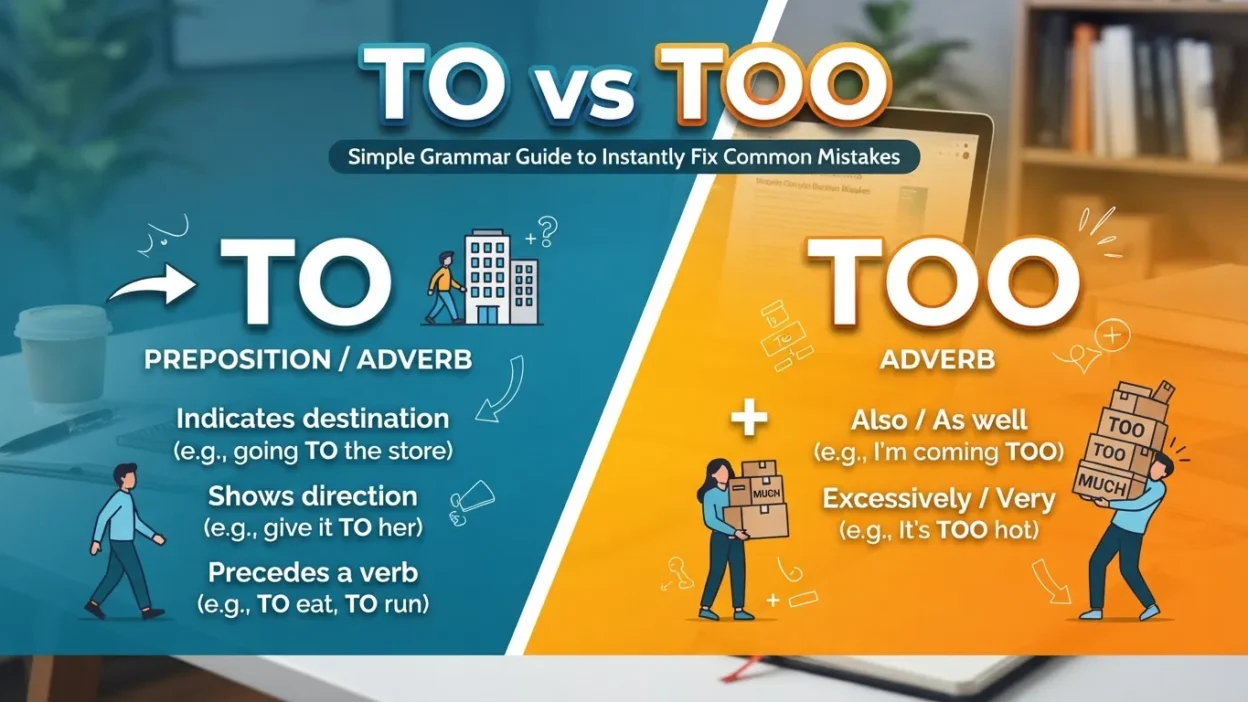
To is usually used before a verb or to show direction, movement, or a relationship between things.
- I want to learn Spanish.
- We are going to school.
- Give the book to Sarah.
Too usually means “also,” “as well,” or “more than necessary.”
- I want to come too.
- This coffee is too hot.
- He talks too much.
Easy trick to remember
If you can replace the word with “also” or “excessively,” you probably need too.
If the word comes before a verb or indicates movement or direction, you probably need to.
What Does “To” Mean?
To is one of the most frequently used words in English. It has several grammatical functions, but two are especially important: it can act as a preposition or as part of an infinitive verb.
“To” for direction or movement
Use to when someone or something moves toward a place, person, or destination.
- She walked to the store.
- We drove to New York.
- Please send the letter to my office.
- He went to the kitchen.
Here, to helps show where someone or something is going.
“To” before a verb
Use to before the base form of a verb when forming an infinitive.
- I want to eat.
- They decided to leave.
- She needs to study.
- We hope to win.
A useful pattern is:
to + base verb
Examples include:
- to work
- to read
- to write
- to sleep
- to understand
However, remember that not every use of to before a word is an infinitive. In phrases such as “go to school,” to is functioning as a preposition.
What Does “Too” Mean?
Too has two main meanings in modern English.
“Too” means “also”
When too means “also” or “as well,” it indicates that something applies to another person or thing.
- I like pizza too.
- She is coming too.
- He wants to join us too.
- We watched the movie too.
In these examples, you could replace too with also without changing the basic meaning.
For example:
I like pizza too.
means:
I also like pizza.
“Too” means “excessively”
Too can also mean more than is wanted, needed, appropriate, or possible.
- The bag is too heavy.
- This room is too cold.
- You are driving too fast.
- The test was too difficult.
In this use, too often appears before an adjective or adverb.
Common patterns include:
too + adjective
- too expensive
- too difficult
- too cold
- too noisy
too + adverb
- too quickly
- too slowly
- too loudly
- too often
It can also appear before quantities or verbs in certain constructions:
- I ate too much.
- She spends too much money.
- He talks too much.
Too vs To: Comparison Table
| Word | Main meaning/function | Common use | Example |
| to | Direction or destination | Before a place/person | We went to school. |
| to | Infinitive marker | Before a base verb | I want to learn. |
| too | Also/as well | Adding similar information | I want to come too. |
| too | Excessively | Before adjectives/adverbs | It is too expensive. |
| too | More than necessary | With much/many | There is too much noise. |
Too vs To Examples
Seeing the words side by side makes the distinction much easier.
Examples with “to”
- I need to finish my homework.
- She went to the library.
- He gave the keys to his brother.
- We plan to travel next month.
- They walked to the park.
Examples with “too”
- I want some coffee too.
- The soup is too salty.
- She talks too loudly.
- There are too many people here.
- He arrived too late.
Using both in one sentence
Sometimes to and too appear together.
- I want to go too.
- She needs to study too.
- It is too late to call him.
- He went to the store too.
Notice that each word performs a different job.
In “I want to go too,” the first to introduces the verb “go,” while too means “also.”
Common Mistakes With Too and To
Because too and to are pronounced alike, they are common spelling mistakes in informal writing, emails, school assignments, social media posts, and professional communication.
Mistake 1: “I want too go.”
Incorrect:
I want too go home.
Correct:
I want to go home.
Why? To comes before the base verb go.
Mistake 2: “I want to come to.”
Incorrect:
I want to come to.
Correct:
I want to come too.
If you mean “I also want to come,” use too.
Mistake 3: “This is to expensive.”
Incorrect:
This phone is to expensive.
Correct:
This phone is too expensive.
Here, too means “more expensive than is acceptable or desired.”
Mistake 4: “She likes it to.”
Incorrect:
She likes the movie to.
Correct:
She likes the movie too.
When you mean also, use too.
How to Remember the Difference
A simple memory trick can help.
Think of too as having an extra “o.” That extra letter can remind you of an extra amount or an additional person or thing.
- too = also
- too = more than enough
- to = direction or verb form
Try asking yourself what the word means.
If the sentence means “also,” choose too.
I want one too.
= I also want one.
If it means “more than necessary,” choose too.
It is too expensive.
= It is more expensive than I want.
Otherwise, if you are showing direction or using an infinitive, to is usually correct.
Too, To, and “Two”
There is one more word that often causes confusion: two.
To, too, and two are homophones. They sound the same or nearly the same in many varieties of English, but they have different meanings and spellings.
- to = direction or infinitive marker
- too = also or excessively
- two = the number 2
Examples:
- I went to the store.
- I went too.
- I bought two apples.
Remembering all three together can make spelling mistakes much easier to spot.
American vs British English: Is There a Difference?
The distinction between too and to is essentially the same in American and British English. Both varieties use to for direction and infinitives and too for “also” or “excessively.”
For example, both American and British English use:
- I want to go home.
- She came too.
- This bag is too heavy.
The pronunciation can vary slightly depending on accent and sentence stress, but there is no major American-versus-British spelling difference between these two words.
When Should You Use “To”?
Use to when:
- Showing movement or direction: “Go to the office.”
- Introducing an infinitive: “I want to learn.”
- Indicating a recipient: “Give it to me.”
- Showing a relationship or connection: “The answer to the question.”
When Should You Use “Too”?
Use too when:
- You mean also: “I want to go too.”
- You mean excessively: “It is too hot.”
- You mean more than necessary: “There is too much sugar.”
- You are adding someone or something to an existing statement: “She wants one too.”
Frequently Asked Questions
Is it “me too” or “me to”?
The correct phrase is “me too” when you mean “I also do” or “the same applies to me.”
Example:
“I love this song.”
“Me too!”
Is it “too much” or “to much”?
The correct phrase is “too much.”
Use too because it means more than necessary.
Example: “There is too much traffic today.”
Is it “to many” or “too many”?
The correct phrase is “too many.”
Example: “There are too many advertisements on this page.”
Is “to” always followed by a verb?
No. To can be a preposition followed by a noun or pronoun.
Example:
- We went to the beach.
- Give the package to him.
It can also introduce an infinitive:
- I want to swim.
Can “too” come at the beginning of a sentence?
Yes, although its position depends on its meaning and sentence structure. For example:
Too much noise can make it difficult to concentrate.
Here, too means an excessive amount.
When too means “also,” it is commonly placed near the end:
I would like to join too.
Are “to” and “too” pronounced the same?
In many accents, they are pronounced the same or very similarly. That is why they are easy to confuse in writing. Context and grammatical function determine which spelling is correct.
How can I quickly check whether I need “too” or “to”?
Replace the word with “also.” If the sentence still makes sense, use too.
For example:
“I want to come also.”
This sounds awkward stylistically but shows the meaning, so the correct sentence is:
“I want to come too.”
If “also” does not fit and the word introduces a verb or shows direction, to is likely correct.
Summary:
The difference between too vs to is mainly about meaning and grammatical function. To is commonly used for direction, recipients, relationships, and infinitive verbs, while too means “also,” “as well,” or “more than necessary.” Although they sound alike, they should never be treated as interchangeable in writing.
The easiest way to remember the distinction is to look at the sentence’s meaning. If you mean also or excessively, choose too. If you are talking about movement, direction, a recipient, or an infinitive verb, choose to. With a little attention to context, this common English grammar mistake becomes easy to avoid.
Actionable Takeaway
Before submitting an email, article, assignment, or social media post, quickly check every to/too that you have written. Ask: Does it mean “also” or “more than necessary”? If yes, use too. Otherwise, check whether to is showing direction or introducing a verb.
A simple rule to keep in mind is: to = direction or verb; too = also or extra. Remembering that one distinction will help you use too and to correctly and make your everyday English writing more accurate.