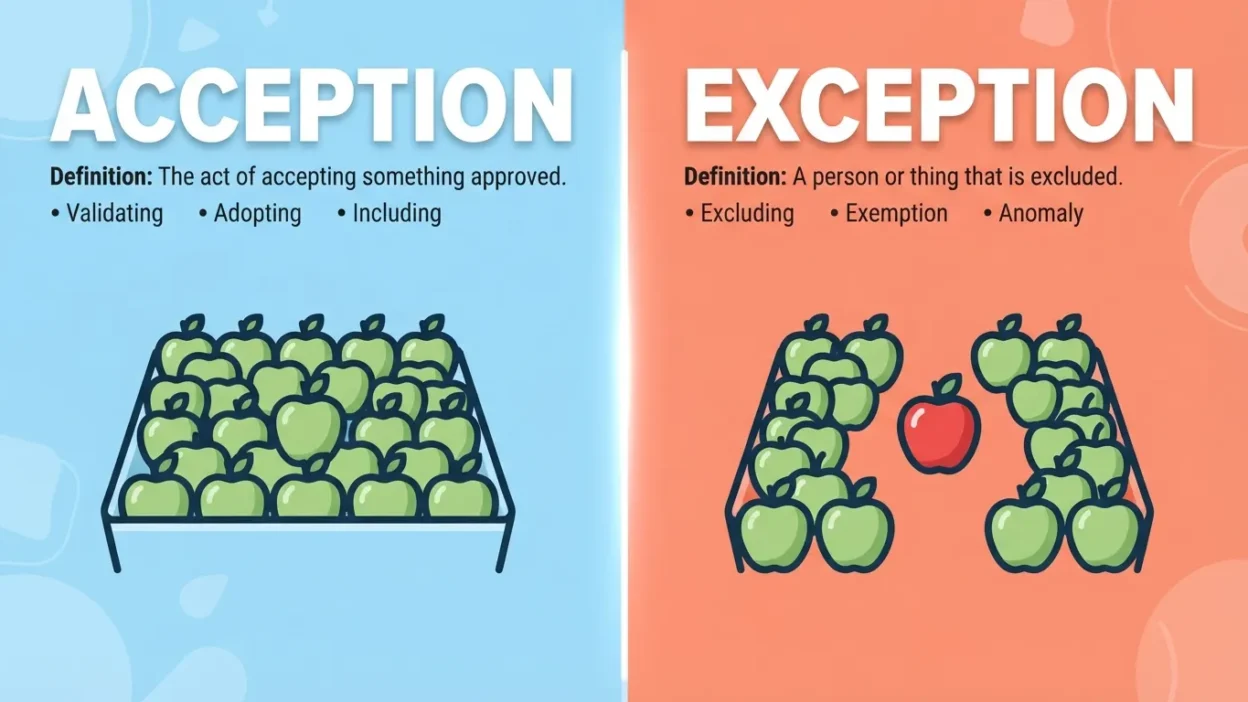
Acception vs exception can be confusing because the two words look and sound similar, but they have completely different meanings. If you have ever wondered whether to write acception or exception in a sentence, you are not alone.
The confusion becomes even greater because acception is a real English word, but it is extremely rare and usually considered obsolete or archaic in modern English.
In everyday American and British English, exception is the word you will normally need when you mean something that is excluded from a rule or something unusual.
If you actually mean “acceptance,” however, the correct modern word is usually acceptance, not acception. This guide explains the difference clearly, with examples and practical tips.
Quick Answer
Exception is the common modern English word meaning something that does not follow a general rule, or something unusual.
Acception is a legitimate but very rare word. Historically, it could mean the accepted or received meaning of a word. Modern dictionaries identify it mainly with acceptation, and historical sources describe it as obsolete or not generally used today.
If you are writing normal modern English, use:
- exception → something excluded from a rule
- acceptance → the act of accepting something
- acceptation → the accepted meaning or sense of a word
- acception → an archaic or very rare term, generally best avoided
What Does Exception Mean?
Exception is a common noun used when someone or something is excluded from a rule, statement, category, or expectation. It can also describe a person or thing that does not follow what is normally expected.
For example:
- Everyone attended the meeting with one exception.
- The store is open every day, except Sunday.
- This rule applies to all students, with a few exceptions.
- She is an exception to the usual pattern.
The related word except is usually used to introduce what is excluded:
Everyone came except Daniel.
Here, except identifies the person left out, while exception names the situation or case that is outside the general rule.
Exception as Something Unusual
Exception can also refer to something that differs from what is normal.
For example:
- The company usually responds within 24 hours, but this case was an exception.
- Most children enjoyed the activity, and Liam was the only exception.
- Her performance was exceptional compared with the rest of the team.
Common related words include except, exceptional, exceptionally, exclusion, unusual case, special case, and departure from the rule.
What Does Acception Mean?
Acception is a real English word, but it is not a normal modern substitute for acceptance.
Merriam-Webster defines acception as acceptation, while historical dictionary sources connect it with the “received meaning” of a word.
Historically, acception could refer to the meaning or sense in which a word was understood. For example, an older text might use acception when discussing the particular sense of a term.
However, this usage is extremely uncommon today. In modern writing, meaning, sense, or sometimes acceptation will normally communicate the idea much more clearly.
For example:
- Archaic: “The word has a different acception in this context.”
- Modern: “The word has a different meaning in this context.”
- Modern: “The term has a different sense in this context.”
So, although acception is technically a word, using it in everyday writing may confuse your readers.
Acception vs Exception: Comparison Table
| Word | Main meaning | Modern usage | Example |
| Exception | Something excluded from a rule or something unusual | Very common | “There is one exception to the rule.” |
| Acception | Historically, an accepted or received meaning | Extremely rare/archaic | “The term had a different acception.” |
| Acceptance | The act or state of accepting | Very common | “We received her acceptance.” |
| Acceptation | The accepted or usual meaning of a word | Rare/formal | “The word is used in its traditional acceptation.” |
This distinction is important because acception and acceptance are not interchangeable, even though they look closely related. Collins defines acceptance as the act of accepting, approval, agreement, or the state of being accepted.
Acception vs Exception Examples
Seeing the words in context makes the difference easier to remember.
Examples With Exception
1. Everyone passed the test except Mark.
2. Mark was the only exception.
3. There are no exceptions to this safety rule.
4. The museum is open daily, with the exception of Monday.
5. Her case was an exception rather than the rule.
In each example, exception relates to exclusion, a special case, or something outside the normal pattern.
Examples With Acception
Because acception is archaic or extremely uncommon, you are unlikely to encounter it in ordinary conversation.
A historical-style example would be:
“The word was used in a different acception by earlier writers.”
In modern English, a clearer version would be:
“The word was used with a different meaning by earlier writers.”
That is why professional, academic, business, and general web writing should normally avoid acception unless you are specifically discussing historical language or quoting an older source.
Acception vs Acceptance: An Important Difference
Many people searching for acception vs exception may actually be thinking of acceptance vs exception. This is one of the most useful distinctions to learn.
Acceptance means agreeing to, receiving, approving, or recognizing something. Collins gives examples involving acceptance of offers, ideas, situations, and people.
For example:
- She received acceptance into the university.
- His acceptance of the offer surprised us.
- The proposal gained widespread acceptance.
- Learning acceptance of change can take time.
Exception, on the other hand, refers to something excluded from a rule.
Compare:
- Acceptance: “I received acceptance into the program.”
- Exception: “I am an exception to the program’s usual eligibility rule.”
A simple memory trick is:
Accept = say yes → acceptance
Except = leave out → exception
American vs British English
There is no major American-versus-British spelling difference between exception and acception. The bigger issue is usage.
Exception is standard in both American and British English.
Acceptance is also standard in both varieties, although pronunciation can differ slightly between regional varieties. Collins lists both American and British pronunciations for acceptance.
Acception, meanwhile, remains an uncommon historical or archaic term rather than a normal regional alternative.
One related word worth knowing is acceptation. In both American and British English, it can refer to the accepted meaning of a word or expression. Collins specifically defines it as the generally accepted meaning of a word or phrase.
Therefore, do not assume that acception is simply a British spelling of acceptance or exception. It is not.
Common Mistakes to Avoid
1. Using acception when you mean acceptance
Incorrect for normal modern English:
“Thank you for your acception of my offer.”
Better:
“Thank you for your acceptance of my offer.”
2. Using acception when you mean exception
Incorrect:
“There was one acception to the rule.”
Correct:
“There was one exception to the rule.”
3. Confusing except and accept
These are different verbs.
Accept means to receive, agree to, approve, or recognize something as valid.
Except means to exclude.
Examples:
- I accept your invitation.
- Everyone was invited except John.
4. Assuming a rare word is automatically a better word
A dictionary entry does not necessarily mean a word is suitable for everyday communication. Acception has historical legitimacy, but modern readers are much more likely to understand meaning, sense, or acceptance, depending on the intended idea.
How to Remember the Difference
Try this simple rule:
EXCEPTION = EXCLUDE
Both begin with EX, which can help you remember that an exception involves leaving something out.
ACCEPTANCE = ACCEPT
If someone accepts an offer, invitation, idea, or situation, the noun is acceptance.
And if you are talking about the meaning of a word, meaning or sense is usually the clearest modern choice.
Quick memory examples
- “Everyone came except Sarah.” → exclusion
- “Sarah was an exception.” → excluded/special case
- “Sarah accepted the invitation.” → agreed
- “Sarah’s acceptance was confirmed.” → agreement
- “The word has several meanings.” → senses of a word
Frequently Asked Questions
Is acception a real word?
Yes. Acception is a real English word, and Merriam-Webster defines it as acceptation. However, it is extremely rare in contemporary English and is mainly encountered in historical or specialized contexts.
Is acception the same as acceptance?
No. Acceptance is the standard modern word for the act or state of accepting something. Acception has historical meanings related to an accepted or received sense and is not normally used as a replacement for acceptance.
Is acception the opposite of exception?
No. They are not opposites. Exception refers to something excluded from a rule or something unusual. Acception is a rare historical noun related to meaning or acceptation.
Which is correct: acception or exception?
For most modern sentences, exception is correct when you mean something excluded from a rule or a special case. If you mean agreeing to or receiving something, use acceptance.
Is acception used in American English?
It can be found in historical American English dictionaries, but it is not a normal contemporary American English word. Historical Webster’s dictionaries recorded it as the received sense of a word and marked the usage as no longer current.
What is the difference between acceptation and acception?
Both have historical connections with the meaning or received sense of a word. Acceptation remains a dictionary word meaning the accepted or usual meaning of a word or expression, while acception is much rarer and is generally considered archaic or obsolete in this sense.
What is an easy way to remember exception?
Think exception = exclusion. If something is left outside a general rule, it is an exception.
Should I use acception in formal writing?
Usually, no. Unless you are discussing historical language or deliberately using an archaic term, meaning, sense, acceptance, or exception will usually be clearer and more natural.
Summary
The key difference between acception vs exception is that exception is a common modern English word for something excluded from a rule or something that differs from what is normal. It is widely used in both American and British English.
Acception, although a genuine historical word, is extremely rare today and is generally associated with an old meaning related to the accepted or received sense of a word.
If you are unsure which word to choose, look at the meaning first rather than the spelling. Use exception for exclusion or a special case, acceptance for agreeing to or receiving something, and meaning or sense when discussing what a word means. This simple approach will keep your writing natural, clear, and appropriate for modern readers.
Actionable takeaway:
Before using acception, replace it mentally with “acceptance,” “exception,” or “meaning.” Choose the word that matches your intended meaning. In most everyday situations, exception or acceptance will be the correct modern choice.

Orvian Treloux works on the Wordifs site developing structured blogs coordinating via wordifs@gmail.com to ensure accuracy originality clarity usefulness engagement and long term trust among global readers across digital platforms.