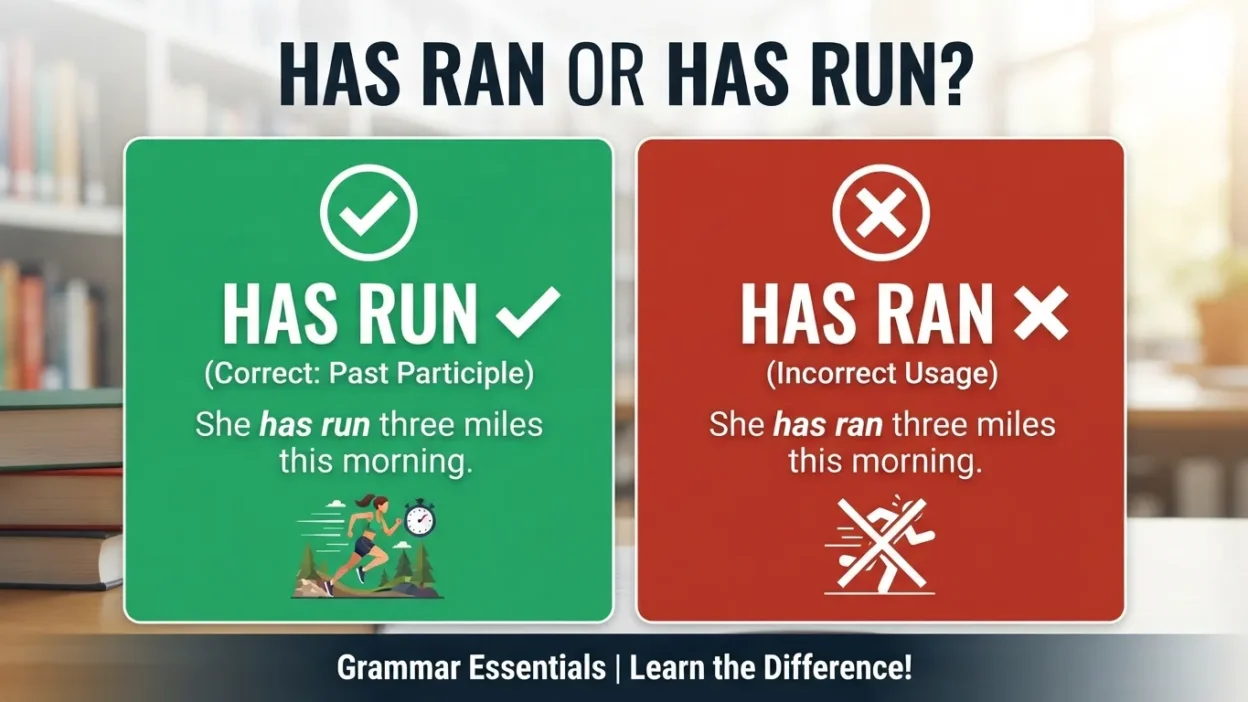
If you have ever wondered whether to say “has ran” or “has run,” you are not alone. This is a common English grammar mistake because “ran” and “run” are both forms of the same verb, but they are used in different situations.
The correct phrase after “has” is “has run.” For example, “She has run five miles today” is correct, while “She has ran five miles today” is incorrect in standard English. Understanding this simple rule can make your writing and everyday speech much more accurate.
Quick Answer:
“Has run” is correct. “Has ran” is incorrect in standard English.
The reason is simple:
- Run is the past participle of the verb run.
- Ran is the simple past tense.
- The helping verb has must be followed by a past participle.
So:
Correct: He has run three miles.
Incorrect: He has ran three miles.
A useful pattern to remember is:
has/have/had + past participle
Because run is the past participle, the correct form is has run.
What Does “Has Run” Mean?
“Has run” is the present perfect form of the verb run. It describes an action that happened in the past but is connected to the present in some way.
For example:
- She has run every morning this week.
- The machine has run continuously for six hours.
- He has run the marathon three times.
- The company has run several successful campaigns.
- My dog has run away again.
The exact meaning depends on the context. Sometimes the action has just happened, while in other cases it describes an experience or repeated activity up to the present.
Why Is “Has Ran” Incorrect?
The confusion comes from the fact that ran is a legitimate form of run. The problem is that it cannot normally follow has.
The verb run has three important forms:
| Verb Form | Word | Example |
| Base form | run | I run every morning. |
| Simple past | ran | I ran yesterday. |
| Past participle | run | I have run before. |
Notice that ran is used for the simple past, while run is used as the past participle.
Therefore:
- I ran yesterday. ✓
- I have run today. ✓
- She has run five miles. ✓
- She has ran five miles. ✗
Has Run vs. Ran
The easiest way to understand the difference is to compare the sentence structures.
Use “ran” for simple past
Use ran when talking about a completed action at a definite time in the past.
Examples:
- I ran five miles yesterday.
- Sarah ran in the race last Sunday.
- They ran to the bus stop this morning.
- He ran home after school.
Words such as yesterday, last week, last year, two hours ago, and in 2024 often signal the simple past.
Use “has run” for present perfect
Use has run when the action has a connection to the present, when the exact time is not important, or when discussing experiences up to now.
Examples:
- She has run five marathons.
- He has run every day this week.
- The engine has run for eight hours.
- The store has run out of milk.
The present perfect commonly uses words such as already, recently, ever, never, just, yet, and so far.
Has Run or Has Ran: Simple Rule
Here is a quick grammar formula that you can remember:
Has + past participle = has run
Not:
Has + simple past = has ran
For example:
- He has run away. ✓
- She has run the business for ten years. ✓
- The program has run successfully. ✓
But:
- He ran away yesterday. ✓
- She ran the business last year. ✓
This distinction applies regardless of whether you are writing an email, article, school assignment, social media post, or professional document.
More Examples of “Has Run”
Here are several natural examples showing how has run works in different contexts:
Everyday situations
- My brother has run three miles today.
- The baby has run around the house all morning.
- She has run out of coffee.
- He has run to the store.
Work and business
- The manager has run several successful projects.
- The company has run this campaign for six months.
- Our team has run multiple tests.
- The software has run without any problems.
Sports and fitness
- Michael has run five kilometers today.
- She has run in several international races.
- He has run faster this season.
- The athlete has run more than 1,000 miles this year.
Technology and machines
- The server has run continuously since Monday.
- The program has run successfully.
- The computer has run several diagnostic tests.
Common Mistakes to Avoid
1. Using “has ran”
This is the most common mistake.
Incorrect: She has ran five miles.
Correct: She has run five miles.
Remember: has + run, not has + ran.
2. Using “have ran”
The same rule applies to have.
Incorrect: They have ran three miles.
Correct: They have run three miles.
3. Using “had ran”
The past perfect also requires the past participle.
Incorrect: He had ran before breakfast.
Correct: He had run before breakfast.
The pattern is:
has/have/had + run
4. Assuming “ran” is always wrong
“Ran” is not an incorrect word. It is the correct simple past form.
For example:
She ran yesterday.
That sentence is completely correct because there is no helping verb such as has, have, or had before it.
American vs. British English
There is essentially no standard American-versus-British difference in this particular grammar rule.
Both American English and British English use:
- I ran yesterday.
- I have run today.
- She has run several races.
You may occasionally encounter “has ran” in informal speech, dialects, song lyrics, online writing, or regional varieties of English. However, it is not considered standard grammar in either formal American or formal British English.
For professional, academic, or polished online writing, “has run” is the safe and correct choice.
How to Remember the Difference
A simple memory trick can help:
Ran stands alone. Run needs a helper.
When you use ran, it can stand as the main verb:
She ran yesterday.
When you use run as a past participle, it normally needs a helping verb:
She has run today.
Think of these three forms together:
run → ran → run
- Present: run
- Past: ran
- Past participle: run
This pattern is similar to other irregular verbs, although each verb has its own forms.
Has Run in Questions
The same rule applies when forming questions.
Correct examples include:
- Has she run today?
- Has he run the program?
- Has the machine run long enough?
- Has your dog run away?
You would not normally say:
- Has she ran today? ✗
- Has he ran the program? ✗
The helping verb has requires the past participle run.
Has Run in Negative Sentences
Negative sentences follow the same pattern.
Examples:
- She has not run today.
- He hasn’t run the test yet.
- The machine has not run properly.
- The company hasn’t run that campaign before.
Again, has + run is the correct structure.
FAQs
Is “has ran” grammatically correct?
No. In standard English, “has ran” is incorrect. The correct expression is “has run” because run is the past participle required after has.
Is “has run” correct?
Yes. “Has run” is the correct present perfect form. For example: “She has run five miles today.”
What is the past tense of run?
The simple past tense of run is ran. For example: “He ran yesterday.”
What is the past participle of run?
The past participle is run. It is used with helping verbs such as has, have, and had.
Should I say “I have ran” or “I have run”?
You should say “I have run.” For example: “I have run five miles today.”
Is “had ran” correct?
No, not in standard English. The correct form is “had run.” For example: “She had run five miles before lunch.”
Do Americans say “has ran”?
You may hear or see “has ran” in informal speech, dialects, or nonstandard writing, but it is not standard American English. “Has run” is the appropriate form for formal and standard English.
How can I remember “has run” vs. “has ran”?
Remember this simple rule: ran is the simple past, while run is the past participle. After has, have, or had, use run.
Summary
The correct phrase is “has run,” not “has ran.” The word ran is the simple past form of run, while run is both the base form and past participle. Because has is a helping verb that forms the present perfect tense, it must be followed by the past participle: has run.
When you are describing a completed action at a specific time in the past, use ran: “She ran yesterday.” When you are using the present perfect or past perfect, use run: “She has run today” or “She had run before lunch.” This rule is the same in standard American and British English.
Actionable Takeaway
Whenever you see has, have, or had before the verb, stop and check the form. For run, the correct structure is has run, have run, or had run.
Quick memory tip:
Yesterday → ran
Has/have/had → run
If you follow that pattern, you can confidently avoid the common “has ran or has run” mistake in everyday and professional English.