“Paid” and “payed” look almost identical, so it is easy to hesitate when writing a sentence about money, bills, or payment. The good news is that the difference is actually quite simple once you know what each word means.
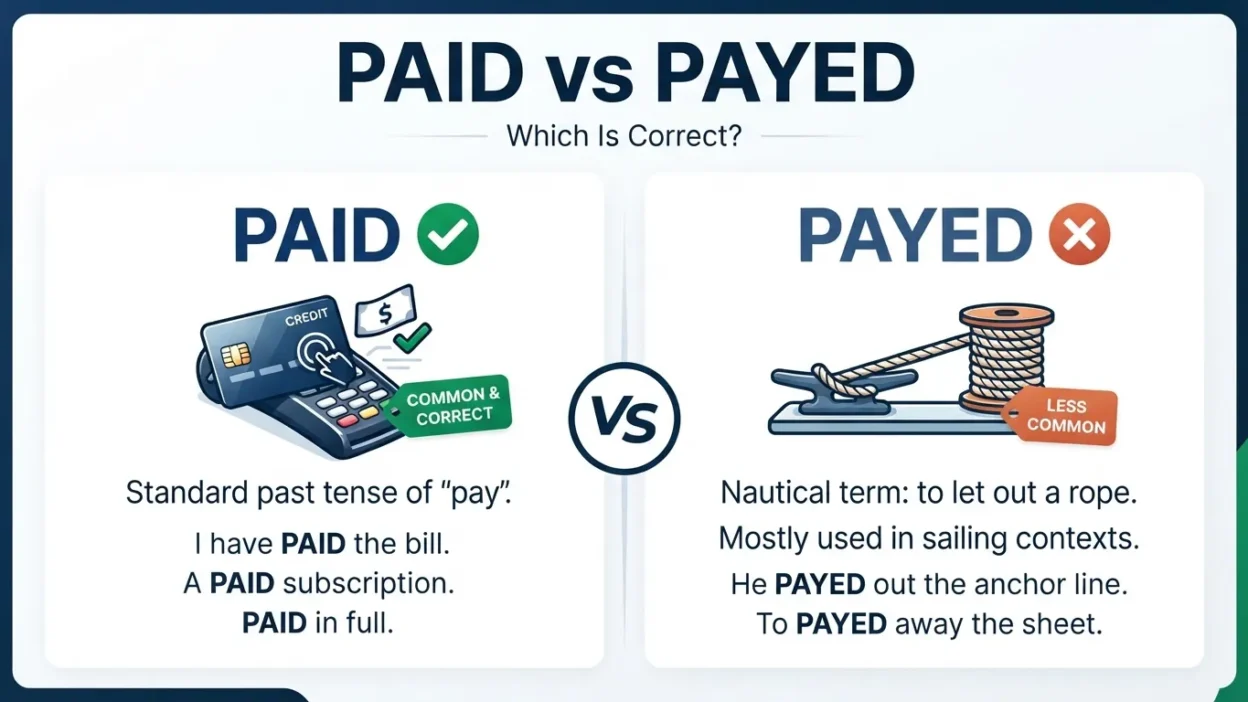
In modern English, paid is the correct past tense and past participle of pay when you are talking about money, bills, debts, purchases, wages, or services.
Payed is a much less common word used mainly in specific nautical contexts. Understanding this distinction can help you avoid a common spelling and grammar mistake in emails, business writing, schoolwork, and everyday communication.
Quick Answer:
Paid is almost always the word you need when you mean that someone gave money or settled an amount owed.
- Correct: I paid the bill yesterday.
- Correct: She has paid for the tickets.
- Correct: We paid the employee on Friday.
- Incorrect in ordinary financial contexts: I payed the bill yesterday.
Payed is a specialized form of pay that is traditionally used in nautical language, especially when referring to letting out or loosening rope, cable, or a similar material.
Easy rule: If you are talking about money, use “paid.” If you are talking about rope, cable, or certain nautical actions, “payed” may be correct.
What Does “Paid” Mean?
Paid is the past tense and past participle of the verb pay. It is used when someone gives money in exchange for something, settles a debt, or provides compensation.
The verb forms are:
Pay → Paid → Paid
Unlike regular verbs such as “walk → walked,” the verb pay is irregular. You do not add -ed to create its past tense. Instead, the past form is paid.
For example:
- I pay my rent every month.
- I paid my rent yesterday.
- I have paid my rent already.
“Paid” can be used in many everyday situations involving money:
- paid a bill
- paid a debt
- paid for a meal
- paid the rent
- paid an employee
- paid the fee
- paid in cash
- paid by card
- paid online
It can also describe something that has received compensation or has a financial status:
- a paid employee
- a paid subscription
- a paid invoice
- a paid position
- a paid advertisement
What Does “Payed” Mean?
Payed is a legitimate English word, but it has a very limited use.
It is primarily associated with nautical terminology. In this context, “payed” can refer to letting out, releasing, or loosening a rope, cable, or line.
For example:
- The sailors payed out the rope.
- The crew payed out more cable.
- The anchor line was payed out slowly.
You may also encounter the phrase “payed out” in technical or maritime writing.
For most ordinary writing, however, payed is not the past tense you want.
If you write about paying rent, purchasing something, settling a bill, or receiving a salary, use paid.
Paid vs Payed: The Main Difference
| Word | Meaning | Common Use | Example |
| Paid | Past tense of “pay” involving money or compensation | Everyday and business English | I paid the invoice. |
| Payed | Specialized past form used mainly for nautical actions | Nautical/technical English | They payed out the rope. |
The easiest distinction is based on context.
If the sentence involves money, choose paid.
If the sentence describes letting out rope, cable, or a line, particularly in nautical language, payed may be appropriate.
Examples of “Paid” in Sentences
Here are common examples showing how “paid” works in everyday English:
- I paid the electricity bill this morning.
- She paid for dinner last night.
- They paid their employees on time.
- Have you paid the registration fee?
- We have already paid for the hotel.
- He paid off his student loan.
- The customer paid in cash.
- I paid by credit card.
- She was paid for her work.
- The invoice has been paid in full.
Notice that “paid” works naturally with different forms of the verb:
- Past simple: I paid the bill.
- Present perfect: I have paid the bill.
- Past perfect: I had paid the bill before leaving.
- Passive voice: The bill was paid yesterday.
Examples of “Payed” in Sentences
Because “payed” has a specialized meaning, examples are less common in everyday communication.
- The sailors payed out the anchor line.
- The crew payed out additional cable.
- The rope was payed out as the vessel moved forward.
- The workers payed out the line carefully.
In these examples, “payed” is not referring to money. It describes the controlled release or letting out of a line, rope, or cable.
For most readers, “payed” will appear unusual because the word is uncommon outside specialized contexts.
Why Do People Confuse Paid and Payed?
The confusion comes mainly from the regular spelling pattern of English verbs.
Many verbs form their past tense by adding -ed:
- walk → walked
- work → worked
- call → called
- clean → cleaned
Because pay ends in “y,” writers sometimes assume that its past tense should follow a similar pattern and produce payed.
However, pay is an irregular verb when it refers to financial payment:
pay → paid
This is similar to other irregular verbs:
- go → went
- buy → bought
- take → took
- see → saw
- give → gave
- pay → paid
Remembering “pay → paid” is much more useful than trying to apply a regular spelling rule.
Common Mistakes With Paid and Payed
Mistake 1: “I payed the bill.”
The correct sentence is:
I paid the bill.
Because the sentence is about money, paid is required.
Mistake 2: “She has payed for the service.”
The correct version is:
She has paid for the service.
After has, use the past participle paid.
Mistake 3: Assuming “payed” is always wrong
This is also inaccurate. Payed can be correct in specialized nautical contexts.
For example:
The crew payed out the rope.
So it is better to say that payed is rarely used, rather than saying it is never correct.
Mistake 4: Using “paid” for every meaning of “pay”
“Paid” is overwhelmingly common, but context still matters. Specialized technical or nautical writing can use payed with a different meaning.
Paid vs Payed in American and British English
There is essentially no major American-versus-British difference in the ordinary use of these words.
Both American English and British English use:
pay → paid → paid
For example:
- American English: I paid the bill.
- British English: I paid the bill.
The nautical use of payed can also appear in both varieties of English, although it is uncommon in general conversation.
Therefore, you should not choose payed simply because you are writing British English. The distinction is based on meaning and context, not primarily on regional English.
Paid vs Payed in Professional Writing
When writing emails, resumes, invoices, reports, applications, academic assignments, or business documents, paid is almost certainly the correct choice when referring to money.
For example:
Professional: The invoice was paid on August 20.
Professional: All outstanding fees have been paid.
Professional: The employee was paid for the additional hours.
Using payed in these sentences would be considered a spelling or word-choice error.
If you are unsure, ask yourself:
“Am I talking about money?”
If the answer is yes, choose paid.
A Simple Trick to Remember the Difference
Use this memory rule:
Money = PAID.
Think of common phrases such as:
- paid the bill
- paid the rent
- paid the price
- paid for lunch
- paid a debt
You can also remember the basic verb pattern:
Pay → Paid → Paid
If you are writing about a rope or cable being released, then stop and consider whether the specialized nautical word payed applies.
This simple distinction will prevent the vast majority of mistakes.
Paid vs Payed: Which One Should You Use?
For normal English, paid is the clear winner.
Use paid when you mean:
- gave money
- settled a bill
- cleared a debt
- purchased something
- received wages
- compensated someone
- completed a payment
Use payed only in specialized contexts, particularly when describing the nautical action of letting out a rope, line, or cable.
So if you are writing “I ___ for the meal,” the answer is always:
I paid for the meal.
Not:
I payed for the meal.
Frequently Asked Questions
Is “payed” a real word?
Yes. “Payed” is a real English word, but it has a specialized meaning. It is mainly used in nautical contexts to describe letting out or releasing a rope, line, or cable.
Is “paid” or “payed” correct for money?
Paid is correct. For example, “I paid the bill” and “She paid for the service.” Use paid when discussing money, purchases, wages, fees, or debts.
Is “I payed the bill” correct?
No. The standard sentence is “I paid the bill.” “Payed” is not the normal past tense of “pay” when referring to financial transactions.
What is the past tense of pay?
The past tense of pay is paid.
Example:
Present: I pay the bill every month.
Past: I paid the bill yesterday.
What is the past participle of pay?
The past participle is also paid.
For example:
I have paid the invoice.
The verb forms are pay → paid → paid.
When should I use “payed”?
Use payed only when the context calls for its specialized nautical meaning, particularly when referring to letting out rope, cable, or a line.
Do Americans and British people use “paid” differently?
No significant difference exists in ordinary usage. Both American and British English use paid for the financial meaning of “pay.”
How can I easily remember paid vs payed?
Remember: money is paid. If you are paying a bill, fee, debt, employee, or purchase, use paid. Reserve payed for specialized nautical contexts.
Final Summary
The difference between paid vs payed is mostly a matter of context. Paid is the standard past tense and past participle of “pay” when discussing money, bills, purchases, salaries, debts, and compensation. It is the word you will need in almost every ordinary sentence involving payment.
Payed is not simply a common alternative spelling of “paid.” It has a specialized nautical use, particularly for letting out or releasing a rope, line, or cable. When writing everyday English, especially in professional, academic, or business situations, choose paid whenever money is involved.
Actionable Takeaway
When you are unsure, use this rule:
Talking about money? → PAID.
Talking about releasing rope or cable in a nautical context? → PAYED.
The standard verb pattern to memorize is:
Pay → Paid → Paid
Once you remember that pattern, choosing between paid and payed becomes straightforward.

Kalven Driost works on the Wordifs site producing reliable content while communicating through wordifs@gmail.com to support research editing publishing consistency transparency and audience focused knowledge sharing practices for modern readers.