If you have ever wondered whether to say “interested in” or “interested on,” you are not alone. This is a common English grammar question, especially for learners who are unsure which preposition naturally follows the adjective interested.
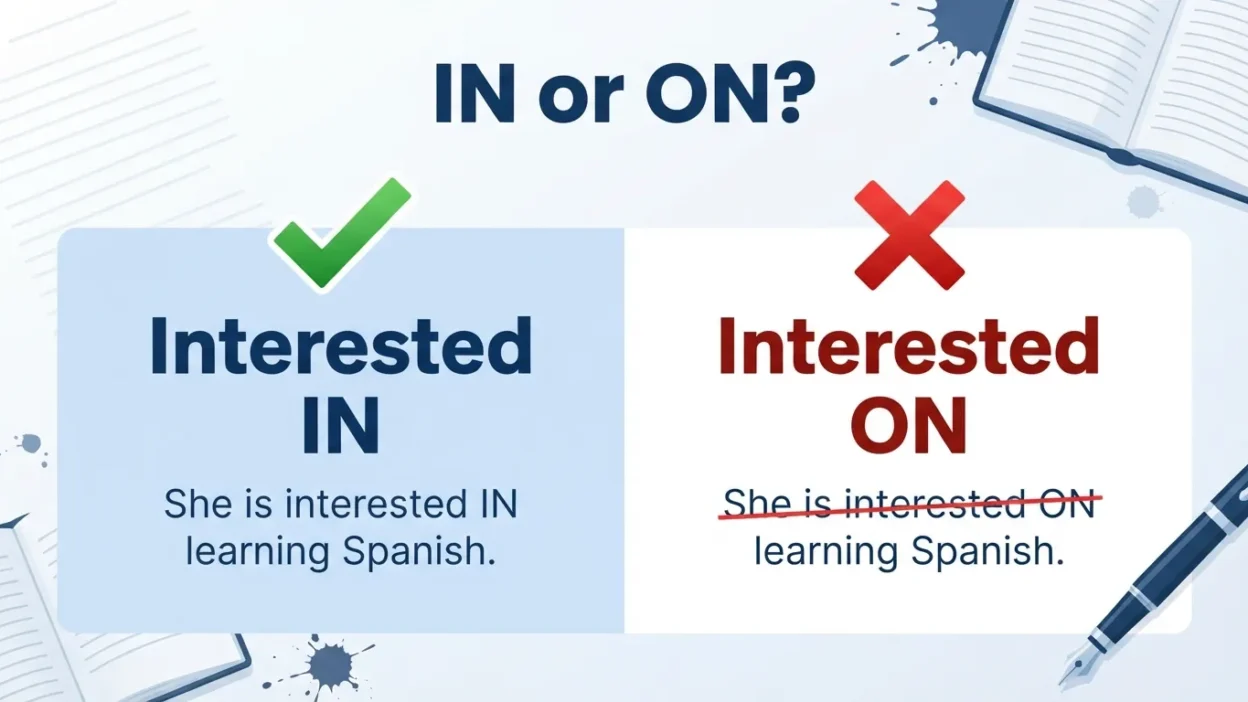
The good news is simple: “interested in” is the standard and correct expression in English. We use it when talking about something that attracts our attention, curiosity, enthusiasm, or desire to learn more. In normal English, “interested on” is not correct when interested means curious or enthusiastic about something.
Quick Answer
The correct phrase is “interested in.”
- Correct: I am interested in photography.
- Correct: She is interested in learning Spanish.
- Correct: They are interested in the new project.
- Incorrect: I am interested on photography.
- Incorrect: She is interested on learning Spanish.
Use interested in + noun, pronoun, or -ing verb when describing something that captures someone’s attention or curiosity.
What Does “Interested In” Mean?
Interested in means having curiosity, enthusiasm, concern, or a desire to know more about something.
The word interested is an adjective, and in is the preposition normally used after it.
For example:
I am interested in history.
This means that history attracts my attention and that I want to learn more about it.
You can also use interested in when talking about activities, subjects, careers, people, opportunities, hobbies, and ideas.
Examples of “Interested In”
- I am interested in science.
- Maria is interested in graphic design.
- He is interested in starting a business.
- We are interested in your proposal.
- She became interested in photography during college.
- Are you interested in joining our team?
- They are interested in learning more about the course.
- My brother is interested in sports cars.
Notice that in remains the same even when the word after it changes.
Why Is “Interested On” Incorrect?
The confusion usually comes from the fact that English uses many different prepositions after adjectives. Some adjectives take in, while others take on, at, for, with, or another preposition.
For example:
- interested in something
- dependent on something
- good at something
- responsible for something
- familiar with something
Because on is a common English preposition, learners may naturally try to use interested on. However, when interested means curious or enthusiastic about something, on is not the normal preposition.
So, instead of:
I am interested on digital marketing.
Say:
I am interested in digital marketing.
Interested In vs. Interested On: Comparison Table
| Phrase | Correct? | Meaning/Use | Example |
| Interested in | Yes | Shows curiosity, enthusiasm, or attention | I am interested in art. |
| Interested on | No | Not standard when expressing curiosity or enthusiasm | I am interested on art. |
| Interested in + noun | Yes | Shows interest in a subject or thing | She is interested in music. |
| Interested in + -ing | Yes | Shows interest in an activity | He is interested in studying abroad. |
The key rule is easy to remember: interested + in, not interested + on.
Interested In + Noun
One of the most common structures is:
interested in + noun
A noun can refer to a person, subject, activity, object, field, or idea.
Examples:
- I am interested in psychology.
- She is interested in fashion.
- He is interested in technology.
- We are interested in your offer.
- They are interested in environmental issues.
- Are you interested in this position?
Here, in connects the adjective interested to the thing that attracts someone’s attention.
Interested In + Verb
When you want to use a verb after interested in, use the -ing form, also known as the gerund.
The structure is:
interested in + verb-ing
Examples:
- I am interested in learning French.
- She is interested in becoming a teacher.
- He is interested in working abroad.
- We are interested in buying a new house.
- They are interested in improving their English.
- Are you interested in attending the meeting?
A common mistake is to use the infinitive directly after in:
❌ I am interested in learn English.
The correct form is:
✅ I am interested in learning English.
This happens because in is a preposition, and a verb following a preposition generally takes the -ing form.
Interested In Examples in Everyday English
Here are some natural examples you might hear or use in everyday conversations.
Talking About Hobbies
I am interested in photography.
My sister is interested in painting.
Are you interested in playing tennis?
Talking About Careers
He is interested in becoming a software engineer.
She is interested in a career in medicine.
I am interested in working for your company.
Talking About Education
They are interested in studying overseas.
I am interested in taking an English course.
She became interested in history at school.
Talking About Opportunities
We are interested in your business proposal.
I am interested in the job opening.
Are you interested in this opportunity?
These examples show how flexible interested in is across personal, academic, professional, and everyday situations.
Common Mistakes With “Interested In”
Understanding the correct phrase is easy, but several related mistakes are worth avoiding.
1. Using “Interested On”
Incorrect:
I am interested on computers.
Correct:
I am interested in computers.
2. Using the Wrong Verb Form
Incorrect:
She is interested in learn Spanish.
Correct:
She is interested in learning Spanish.
3. Confusing “Interested” and “Interesting”
These two adjectives have different meanings.
Interested describes how a person feels.
I am interested in astronomy.
Interesting describes something that creates interest.
Astronomy is interesting.
A useful way to remember the difference is:
- I am interested.
- It is interesting.
So:
The book is interesting, and I am interested in reading it.
4. Omitting the Preposition
Incorrect:
I am interested photography.
Correct:
I am interested in photography.
The preposition in is normally required when interested is followed by the thing that attracts your attention.
American vs. British English: Is There a Difference?
There is no meaningful American vs. British English difference in the standard use of this expression. Both varieties use interested in.
American English:
I am interested in learning French.
British English:
I am interested in learning French.
Both are grammatically correct and natural.
You should therefore use interested in whether you are writing for an American, British, Canadian, Australian, or international English-speaking audience.
How to Remember “Interested In”
A simple memory trick can make this grammar point much easier:
Interested goes with IN.
Think of these common expressions:
- interested in music
- interested in sports
- interested in business
- interested in science
- interested in learning
- interested in helping
If you are talking about something that attracts your curiosity or attention, interested in is almost certainly the expression you need.
When Should You Use “On” Instead?
Although interested on is incorrect in the usual sense, on is perfectly correct after many other words.
For example:
- The decision depends on the results.
- The report focuses on education.
- The book is based on a true story.
- She worked on a new project.
- We agreed on a solution.
The important point is that prepositions depend on the word or expression they accompany. You cannot simply replace one preposition with another because they have similar general meanings.
“Interested In” in Professional English
Interested in is particularly common in professional communication.
For example:
I am interested in applying for the position.
We are interested in discussing a potential partnership.
Our company is interested in your services.
I would be interested in learning more about the opportunity.
The phrase can sound polite and professional, especially when expressing interest in a job, proposal, service, collaboration, or business opportunity.
Frequently Asked Questions
Is “interested in” grammatically correct?
Yes. Interested in is the standard grammatical expression used to describe curiosity, enthusiasm, or attention toward something.
Is “interested on” ever correct?
Not when interested means curious or enthusiastic about something. In standard English, use interested in instead.
Should I say “interested in learning” or “interested in learn”?
The correct form is interested in learning. Because in is a preposition, a following verb normally takes the -ing form.
Is it “interested in” or “interested about”?
The standard expression is interested in. For example, say “I am interested in history,” not “I am interested about history.”
Can “interested in” be followed by a person?
Yes. Depending on context, interested in can refer to a person. For example, “She is interested in him” can mean she has romantic or personal interest in him.
Is “interested in” the same as “interesting”?
No. Interested describes a person’s feeling, while interesting describes something that causes interest.
For example:
I am interested in astronomy because it is interesting.
Do Americans and British speakers use “interested in” differently?
No. Both American and British English use interested in as the standard expression.
What is the easiest way to remember the correct phrase?
Remember this simple combination: interested in. Examples such as “interested in music,” “interested in learning,” and “interested in business” can help reinforce the pattern.
Summary
When choosing between interested in or on, the correct choice is almost always interested in. Use it to express curiosity, enthusiasm, attention, or a desire to learn more about a subject, activity, person, opportunity, or idea. For example, “I am interested in photography” and “She is interested in studying abroad” are both natural and grammatically correct.
Avoid interested on when expressing this meaning. Also remember that interested in + verb-ing is the correct structure, as in “interested in learning” rather than “interested in learn.” The same rule applies in both American and British English, making interested in a reliable choice for everyday, academic, and professional writing.
Actionable Takeaway
Whenever you want to express curiosity or enthusiasm, use this pattern:
interested + in + noun/-ing verb
- I am interested in music.
- She is interested in reading.
- We are interested in the project.
- They are interested in joining us.
If you remember just one thing, remember: “Interested in” is correct; “interested on” is not.