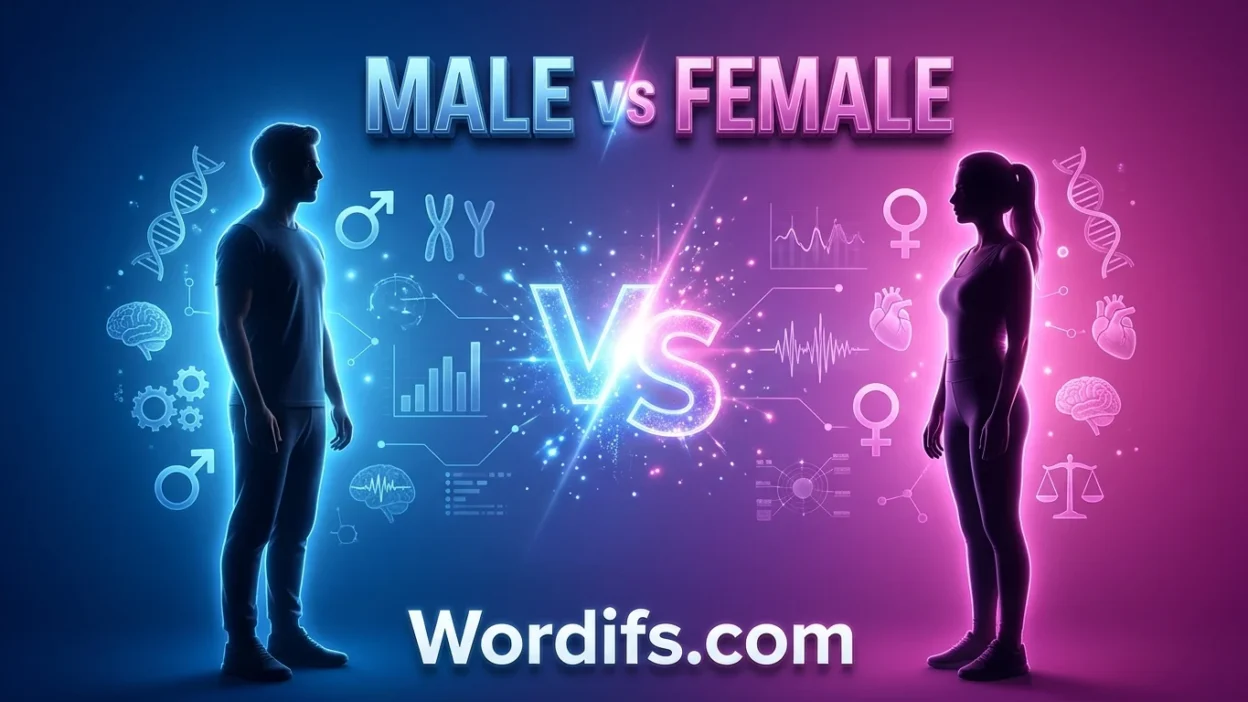
The terms male vs female are commonly used in English to describe biological sex in humans and animals. They are also used in biology, healthcare, education, official documents, and everyday conversations. Although these words are often used together, their meanings and uses depend on the context.
In simple English, male and female usually describe biological sex categories associated with different reproductive functions. However, human development involves many factors, including chromosomes, genes, hormones, reproductive anatomy, and sex characteristics. Most people develop typical male or female characteristics, but natural biological variations also occur.
It is also important to understand the difference between biological sex and gender identity. Biological sex relates to physical and reproductive characteristics, while gender identity refers to a person’s internal understanding of their gender.
Terms such as cisgender, transgender, non-binary, masculine, feminine, and gender diversity describe different aspects of identity or expression and should not be confused with biological sex.
This guide explains the meaning of male and female, their biological differences, how sexual development occurs, how gender identity relates to sex, and how to use these words correctly in English. It also covers common questions, examples, related terminology, and mistakes to avoid.
Quick Answer: What Is the Difference Between Male and Female?
Male vs female generally refers to two biological sex categories commonly found in humans and many other animals.
- Male: A biological sex category typically associated with sperm production and reproductive development involving testes.
- Female: A biological sex category typically associated with egg production and reproductive development involving ovaries.
- Biological sex: A classification based on a combination of reproductive anatomy, chromosomes, hormones, gonads, and other sex characteristics.
- Gender identity: A person’s internal understanding of their gender.
- Gender expression: How a person expresses or presents their gender through clothing, behavior, appearance, or other characteristics.
These definitions describe related but different concepts. A person’s biological sex, gender identity, and gender expression should not automatically be treated as interchangeable.
What Does Male Mean?
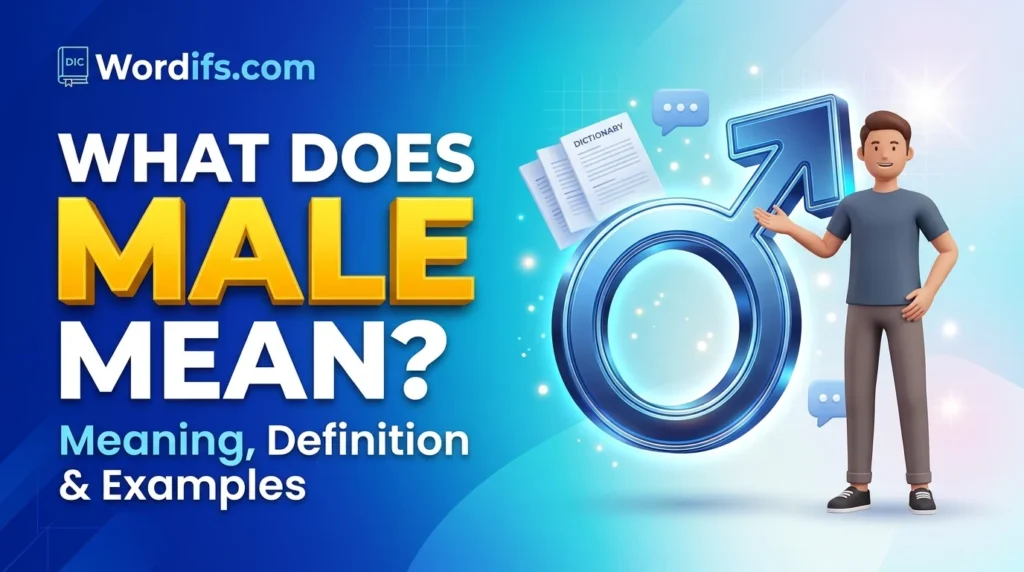
Male describes a biological sex category generally associated with producing sperm. In typical human male development, the reproductive system includes testes, which produce sperm and hormones such as testosterone.
The word male can function as either a noun or an adjective. Its meaning depends on the sentence and the context in which it appears.
Male as a Noun
As a noun, male refers to a person or animal belonging to the male sex category.
Examples:
- The male is larger than the female in this species.
- The research included 100 male participants.
- The veterinarian examined the male.
- The male entered the enclosure.
When referring to people in everyday English, man or boy is often more natural, depending on age and context.
Male as an Adjective
As an adjective, male describes a person, animal, organ, or characteristic associated with the male sex.
Examples:
- He is a male student.
- The male lion rested under a tree.
- The doctor explained the male reproductive system.
- Researchers studied male participants.
Simple meaning: Male generally describes a biological sex category associated with sperm production and typical male reproductive development.
What Does Female Mean?
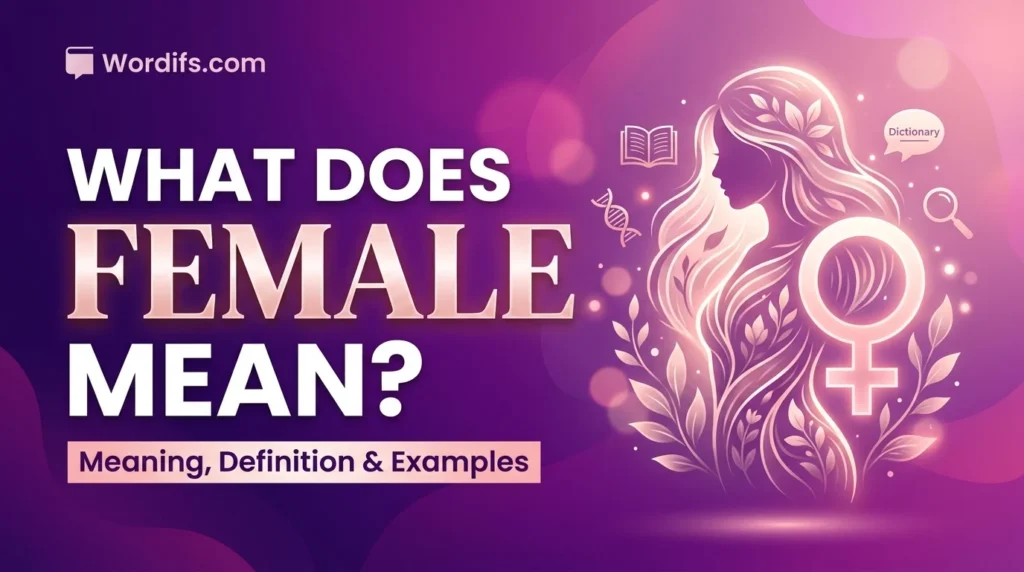
Female describes a biological sex category generally associated with producing eggs. In typical human female development, the reproductive system includes ovaries, which contain or release eggs and produce hormones such as estrogen and progesterone.
Like male, the word female can be used as a noun or an adjective.
Female as a Noun
As a noun, female refers to a person or animal belonging to the female sex category.
Examples:
- The female is caring for her offspring.
- The study included 150 female participants.
- The researchers observed the female.
- The female entered the enclosure.
When talking about an adult person in everyday conversation, woman is often more natural than female as a noun.
Female as an Adjective
As an adjective, female describes a person, animal, organ, or characteristic associated with the female sex.
Examples:
- She is a female student.
- The female elephant walked with her calf.
- The researcher studied the female reproductive system.
- The hospital offers services for female patients.
Simple meaning: Female generally describes a biological sex category associated with egg production and typical female reproductive development.
Male vs Female: Biological Differences
The biological differences between male and female humans involve several related characteristics. These include reproductive anatomy, chromosomes, hormones, gonads, reproductive cells, and other biological characteristics.
The following table summarizes common patterns.
| Feature | Typical male pattern | Typical female pattern |
| Reproductive role | Associated with sperm production | Associated with egg production |
| Common sex chromosomes | XY | XX |
| Typical gonads | Testes | Ovaries |
| Important hormones | Testosterone and others | Estrogen, progesterone, and others |
| Reproductive anatomy | Often includes a penis, scrotum, and related structures | Often includes a vulva, vagina, uterus, and ovaries |
| Reproductive cells | Sperm | Eggs |
| Common puberty changes | Facial hair, voice deepening, and changes in muscle mass | Breast development and changes in body fat distribution |
| Common adult terms | Men | Women |
| Common child terms | Boys | Girls |
These are typical patterns, not universal rules. Hormone levels, anatomy, chromosomes, and other sex characteristics vary between individuals. Some people are born with intersex variations, which involve natural differences in sex characteristics.
No single characteristic explains every person’s biological development.
What Is Biological Sex?
Biological sex refers to a collection of physical and developmental characteristics associated with reproduction. These may include:
- Sex chromosomes, which contain genetic information.
- Genes, which influence developmental processes.
- Gonads, such as testes or ovaries.
- Hormones, including testosterone and estrogen.
- Reproductive anatomy, including internal and external structures.
- Secondary sex characteristics, such as facial hair, breast development, or voice changes.
Biological sex is therefore more complex than looking at a single feature. Chromosomes are important, but genes, hormonal signals, reproductive anatomy, and developmental pathways also contribute to a person’s sex characteristics.
What Is the Difference Between Male and Female Chromosomes?
Chromosomes are structures containing DNA and genes. Most human body cells contain 46 chromosomes arranged in 23 pairs.
One pair is commonly known as the sex chromosomes. Most females have XX chromosomes, while most males have XY chromosomes. However, other chromosome patterns also occur.
Egg cells typically carry an X chromosome, while sperm cells carry either an X or a Y chromosome. When an X-carrying sperm fertilizes an egg, the embryo typically has XX chromosomes. When a Y-carrying sperm fertilizes an egg, the embryo typically has XY chromosomes.
In typical XY development, a gene called SRY, usually located on the Y chromosome, helps initiate testis development. Many other genes and biological signals contribute to further development.
This means that chromosomes are an important part of understanding male and female biological development, but they do not explain every variation in human sex characteristics.
What Are Gonads, Sperm, and Eggs?
Three important biological concepts help explain typical reproductive development.
- Gonads: Reproductive organs that produce sex cells and hormones. Testes are the typical male gonads, while ovaries are the typical female gonads.
- Sperm: Reproductive cells that can fertilize an egg.
- Eggs: Reproductive cells that can be fertilized by sperm.
Most human body cells contain two sets of chromosomes, while mature sperm and eggs normally contain one set of 23 chromosomes. These reproductive cells develop through a type of cell division called meiosis.
During fertilization, sperm and egg combine their genetic material to form a new set of chromosomes in the resulting embryo.
How Do Male and Female Characteristics Develop Before Birth?
Human sexual development begins early in embryonic development. Initially, embryos have precursor structures that can develop along different reproductive pathways.
The process involves several stages:
- Early development: The embryo develops precursor cells and structures that contribute to the reproductive system.
- Gene activity: Genes, including SRY in typical XY development, help direct gonad development.
- Gonad development: The gonads typically develop into testes or ovaries, although variations can occur.
- Hormonal signals: Hormones and other biological signals influence internal and external reproductive anatomy.
- Further development: Reproductive organs continue developing before birth, with additional changes occurring during puberty.
Typical male and female development involves interacting genes, hormones, and developmental signals. The process is not controlled by a single factor, and natural variations can affect different stages.
Male vs Female: Sex, Gender, and Gender Identity
One common source of gender confusion is the assumption that biological sex, gender identity, and gender expression all mean the same thing. They are related concepts, but each has a different definition.
Biological Sex vs Gender
Biological sex generally refers to physical and developmental characteristics, including chromosomes, hormones, reproductive anatomy, and other sex characteristics.
Gender can refer to identity, social roles, cultural expectations, and the ways societies understand masculinity, femininity, and other gender categories. Its precise meaning depends on context.
For example, a biology textbook may use sex when discussing reproductive development, while a social science article may use gender when discussing social expectations or identity.
Understanding the difference between sex and gender helps people choose accurate terminology when discussing biology, healthcare, personal identity, or society.
What Is Gender Identity?
Gender identity is a person’s internal understanding of their gender. A person may identify as a man, a woman, both, neither, or another gender.
Gender identity is not the same as gender expression, which describes how someone presents themselves through clothing, hairstyle, behavior, voice, or other outward characteristics.
For example:
- A person may express themselves in a traditionally masculine way.
- A person may prefer a feminine style of clothing.
- A person may use a combination of masculine and feminine styles.
- A person may not feel that traditional masculine or feminine categories describe them.
These examples illustrate gender diversity. Appearance, hobbies, clothing, or personality alone do not determine a person’s gender identity.
What Does Cisgender Mean?
Cisgender, sometimes shortened to cis, describes a person whose gender identity aligns with the sex they were assigned at birth.
For example, a person who was assigned female at birth and identifies as a woman may describe herself as cisgender.
The term describes the relationship between assigned sex assignment and gender identity. It does not describe a person’s personality, interests, or sexual orientation.
What Does Transgender Mean?
Transgender, sometimes shortened to trans, describes a person whose gender identity differs from the sex they were assigned at birth.
For example, a person who was assigned male at birth and identifies as a woman may describe herself as transgender. A person assigned female at birth who identifies as a man may describe himself as transgender.
Transgender people have diverse identities and experiences. The term does not tell you a person’s appearance, medical history, or sexual orientation.
What Does Non-Binary Mean?
Non-binary is a gender identity term for people whose gender does not fit exclusively within the categories of man or woman.
Some non-binary people describe their gender as a combination of folks, neither gender, a different gender, or something that changes over time. Others use the term without choosing a more specific label.
Non-binary people may have different gender expressions, pronouns, and personal experiences. There is no single appearance or behavior that defines every non-binary person.
What Is the Difference Between Masculine, Feminine, Masculinity, and Femininity?
Masculine and feminine describe qualities, styles, or characteristics that a culture traditionally associates with men or women.
- Masculine: Traditionally associated with men or boys.
- Feminine: Traditionally associated with women or girls.
- Masculinity: The collection of qualities and social expectations associated with being masculine.
- Femininity: The collection of qualities and social expectations associated with being feminine.
These concepts can be influenced by culture, time, and individual preferences. They do not automatically determine someone’s biological sex or gender identity.
For example, a woman may have a masculine style, and a man may have a feminine style. Their clothing or behavior does not, by itself, establish their gender identity.
What Does Bisexual or Bi Mean?
Bisexual, often shortened to bi, generally describes a sexual orientation involving attraction to more than one gender.
Bisexuality is different from gender identity. Gender identity concerns a person’s understanding of their own gender, while sexual orientation concerns patterns of attraction.
Therefore, bisexual does not mean both folks, and it does not mean that a person identifies as both male and female. A bisexual person may be cisgender, transgender, non-binary, or have another gender identity.
Keeping these concepts separate makes discussions about sex, gender, and identity more accurate.
Gender Exploration and Questioning Your Identity
Some people are confident about their gender identity, while others spend time exploring what different gender terms mean to them. Gender exploration, self-exploration, and identity exploration can involve learning about terminology, reflecting on personal feelings, and considering which descriptions feel appropriate.
A person who is not sure about their gender identity may read articles, visit websites, or look at information sites to understand terms such as cisgender, transgender, and non-binary. They may find that some definitions seem familiar, while others do not describe their experience.
This process is sometimes called gender identity questioning or questioning identity. It does not automatically mean that something is wrong or that a person must choose a label immediately.
How Can Someone Begin Understanding Their Gender?
There is no single test that determines a person’s gender identity. Personal exploration may involve reflecting on questions such as:
- Which gender terms, if any, feel comfortable when I use them for myself?
- Do common gender categories describe my experience?
- How do I feel about the gender labels other people use for me?
- Does my gender identity feel consistent, uncertain, or different in different situations?
- Would learning more about gender diversity help me understand my feelings?
These questions are prompts for reflection, not a diagnostic test. There is no required way to feel or behave in order to be male, female, cisgender, transgender, or non-binary.
Gender Uncertainty, Confusion, and Discovery
Gender uncertainty means a person is unsure how to describe their gender. People of all genders questioning describes the process of exploring that uncertainty. Some people experience confusion, while others simply want a clearer understanding of gender terminology.
The words gender discovery, gender awareness, and self-understanding may describe different parts of this personal process. However, each person’s experience is individual. Some people eventually choose a label, while others do not find a label necessary.
A person’s gender experience can be understood through their own feelings and self-description. Reading reliable gender-related information can help, but online descriptions cannot decide someone’s identity for them.
If a person finds the process stressful, talking with a trusted, supportive person or a qualified professional who respects their autonomy may be helpful. There is no need to rush a decision.
Gender Labels and Gender Categories
Common gender labels include man, woman, transgender, cisgender, and non-binary. Some terms describe a person’s gender directly, while others describe the relationship between gender identity and sex assigned at birth.
It is useful to remember that:
- Cisgender and transgender describe how a person’s gender identity relates to their sex assignment at birth.
- Non-binary describes a gender identity that does not fit exclusively within the categories of man or woman.
- Masculine and feminine generally describe expression, qualities, or cultural associations rather than specific gender identities.
- Bisexual describes sexual orientation, not a gender category.
Not every person uses a label, and no label should be assumed based on someone’s appearance or behavior.
Male vs Female: Gender Roles and Gender Differences
Gender roles are social expectations about how people are expected to behave based on gender. These expectations can influence clothing, careers, family responsibilities, communication, and other aspects of daily life.
For example, a culture may traditionally expect men to be assertive and women to be nurturing. These are social expectations, not rules that every man or woman follows.
Gender differences can refer to differences in social experiences, behavior, or outcomes that researchers observe between groups. When discussing such differences, it is important to distinguish biological factors from social influences and individual variation.
Similarly, gender classification and gender categories describe ways of organizing or naming gender. Different societies and contexts may use different systems, so no single set of social expectations describes every individual.
Understanding gender diversity helps avoid assumptions that all men share the same characteristics or that all women think, act, or feel in the same way.
Male vs Female: Comparison Table for English Learners
The words also have important grammatical uses in English.
| Feature | Male | Female |
| Part of speech | Noun or adjective | Noun or adjective |
| Adjective example | Male student | Female student |
| Animal example | Male horse | Female horse |
| Scientific example | Male reproductive health | Female reproductive health |
| Common adult term | Man | Woman |
| Common child term | Boy | Girl |
| Formal usage | Male patient | Female patient |
Words such as stallion, mare, rooster, hen, buck, and doe describe particular animals. They are not interchangeable with male and female in every species.
When Should You Use Male or Female?
Use male or female when biological sex is relevant or when a formal, scientific, medical, or statistical description is needed.
Examples:
- The veterinarian examined a male dog.
- The study included 200 male participants.
- The doctor explained female reproductive health.
- The researcher recorded the sex of each animal.
When talking about people in ordinary conversation, man, woman, boy, or girl may sound more natural, depending on the context and the person’s age.
Should You Say Male or Man?
Male is common in scientific, medical, formal, and statistical contexts. Man usually refers to an adult human male in everyday English, while boy usually refers to a male child.
Compare:
- Formal: The male patient is waiting outside.
- Everyday: The man is waiting outside.
- Referring to a child: The boy is waiting outside.
All three can be correct in the appropriate context.
Should You Say Female or Woman?
The same principle applies to females and women.
- Formal: The female patient arrived early.
- Everyday: The woman arrived early.
- Referring to a child: The girl arrived early.
When referring to an adult person, woman is often more natural than a female as a noun. However, female is appropriate as an adjective, as in female athlete, female patient, and female researcher.
15 Examples of Male vs Female in Sentences
These examples demonstrate how the terms are used in everyday English, biology, healthcare, and animal descriptions.
- Male: The male lion rested under a tree.
- Female: The female lion watched over her cubs.
- Male: The veterinarian examined a male dog.
- Female: The veterinarian examined a female dog.
- Male: The researcher interviewed male participants.
- Female: The researcher interviewed female participants.
- Male: The doctor explained the male reproductive system.
- Female: The doctor explained the female reproductive system.
- Male: The male bird sang from a branch.
- Female: The female bird collected material for its nest.
- Male: The study examined male reproductive cells.
- Female: The study examined female reproductive cells.
- Both: The researchers compared male and female animals.
- Gender identity: The article explains the difference between biological sex and gender identity.
- Gender expression: A person’s clothing style does not necessarily determine their gender identity.
More Examples From Everyday Life
- The school maintains records for male and female students.
- Both male and female employees attended the meeting.
- The scientist studied how sex chromosomes influence development.
- The doctor explained the differences between sperm and eggs.
- The researcher recorded biological sex when it was relevant to the study.
- The article discusses gender diversity and personal identity.
- The student is exploring the meanings of different gender labels.
Common Mistakes When Using Male and Female
1. Using Male Instead of Man in Every Sentence
Less natural: A male is standing outside my house.
More natural: A man is standing outside my house.
Why? Although male can be used as a noun, man is usually more natural when referring to an adult person in everyday conversation.
2. Using Female Instead of Woman in Every Sentence
Less natural: A female is waiting for the bus.
More natural: A woman is waiting for the bus.
Why? Woman is generally more natural as a noun for an adult human female in ordinary English. Female remains appropriate in formal and scientific contexts.
3. Confusing Biological Sex With Gender Identity
Biological sex relates to physical and developmental characteristics, while gender identity describes a person’s internal understanding of their gender. These terms are related but not identical.
4. Assuming Chromosomes Explain Every Case
XX and XY are the most common human sex chromosome patterns, but other patterns occur. Genes, hormones, and developmental processes also influence sex characteristics.
5. Assuming Every Person Has Identical Reproductive Characteristics
Most people develop typical male or female reproductive characteristics, but natural variations also occur. Intersex variations involve differences in sex characteristics and demonstrate why biological development should not be reduced to a single rule.
6. Confusing Gender Expression With Gender Identity
A person’s hairstyle, clothing, voice, or behavior does not necessarily reveal their gender identity. Masculine and feminine expression can vary between individuals.
7. Confusing Bisexuality With Gender Identity
Bisexuality concerns sexual orientation, not whether someone is male, female, both, or neither. A bisexual person can have any gender identity.
Male vs Female in American and British English
The words male and female have the same basic meanings and spellings in American English and British English. There is no major regional difference in their definitions.
| Context | American English | British English |
| Biological classification | Male / female | Male / female |
| Adult human male | Man | Man |
| Adult human female | Woman | Woman |
| Male child | Boy | Boy |
| Female child | Girl | Girl |
| Medical description | Male patient / female patient | Male patient / female patient |
| Scientific writing | Male and female development | Male and female development |
The main difference is not regional. It is whether a formal or conversational term best fits the situation.
Related Terms: Male, Female, Masculine, Feminine, and More
Understanding related terminology makes it easier to discuss sex and gender accurately.
- Man vs woman: Usually refers to adult people.
- Boy vs girl: Usually refers to children.
- Male sex vs female sex: Refers to biological sex categories.
- Male gender vs female gender: May be used in discussions of identity or social categories, depending on context.
- Cis identity: A gender identity that aligns with sex assigned at birth.
- Trans identity: A gender identity that differs from sex assigned at birth.
- Non-binary identity: A gender identity that does not fit exclusively within the categories of man or woman.
- Bisexual identity: An identity related to sexual orientation, not biological sex or gender identity.
- Gender expression: How a person expresses or presents their gender.
- Gender incongruence: A term used in some clinical and health contexts when a person’s experienced gender differs from sex assigned at birth. Its meaning depends on the framework being used.
- Gender spectrum: A way of describing the diversity of gender identities and experiences beyond a simple two-category model.
- Personal identity: How a person understands and describes themselves.
- Self-identity: A person’s understanding of who they are.
- Sense of self: A person’s broader understanding of themselves, including their values, experiences, and identity.
These terms have different meanings. Choosing a precise definition helps prevent misunderstandings when discussing gender concepts and biological characteristics.
Frequently Asked Questions
1. What is the main difference between male and female?
Male and female generally describe biological sex categories associated with different reproductive functions. Typical male reproductive development is associated with sperm production, while typical female reproductive development is associated with egg production. Chromosomes, genes, hormones, and reproductive anatomy contribute to these patterns.
2. What does male mean in simple English?
Male means belonging to the male biological sex category. In humans and many other animals, typical male reproductive development is associated with testes and sperm production. The word can be used as a noun or an adjective.
3. What does female mean in simple English?
Female means belonging to the female biological sex category. In humans and many other animals, typical female reproductive development is associated with ovaries and egg production. The word can also be used as a noun or an adjective.
4. What is the difference between biological sex and gender identity?
Biological sex refers to physical and developmental characteristics such as reproductive anatomy, chromosomes, and hormones. Gender identity is a person’s internal understanding of their gender. The concepts are related, but they are not interchangeable.
5. What does cisgender mean?
Cisgender describes someone whose gender identity aligns with the sex they were assigned at birth. The term does not determine their personality or sexual orientation.
6. What does transgender mean?
Transgender describes someone whose gender identity differs from the sex they were assigned at birth. Transgender people have varied identities, experiences, and expressions.
7. What does non-binary mean?
Non-binary describes a gender identity that does not fit exclusively within the categories of man or woman. Some non-binary people identify with more than one gender, neither gender, or another gender description.
8. Does bisexual mean both male and female?
No. Bisexual generally describes a sexual orientation involving attraction to more than one gender. It does not mean that a person identifies as both male and female.
9. Can someone be masculine or feminine regardless of gender?
Yes. Masculine and feminine describe qualities or styles traditionally associated with people of all genders. They do not automatically determine someone’s biological sex or gender identity.
10. What if someone is not sure about their gender identity?
A person who is unsure may explore gender terminology, reflect on their personal feelings, and learn about different identities. There is no requirement to choose a label immediately. Gender questioning is a personal process, and people may understand themselves differently over time.
11. Do chromosomes always determine whether someone is male or female?
Chromosomes contribute to typical patterns of sexual development, but they are not the only factor. Genes, hormones, reproductive anatomy, and developmental processes also influence sex characteristics. Natural variations occur.
12. Are male and female the same in American and British English?
Yes. The words have the same basic meanings and spellings in both varieties of English. Differences usually relate to context and tone rather than definition.
Final Verdict:
The meaning of male vs female depends on context. In biology, the terms generally describe sex categories associated with different reproductive functions. Typical male development is associated with testes and sperm production, while typical female development is associated with ovaries and egg production.
Human development also involves chromosomes, genes, hormones, reproductive anatomy, and other biological characteristics. Most people follow typical developmental patterns, but natural variations in sex characteristics also occur.
It is equally important to understand gender identity, gender expression, and gender diversity. Terms such as cisgender, transgender, and non-binary describe aspects of gender identity, while bisexual describes sexual orientation. Masculinity and femininity generally refer to qualities or expressions associated with cultural ideas about gender.
In English, male and female can function as nouns and adjectives. Use them when biological sex or formal classification is relevant. In everyday conversation, man, woman, boy, and girl are often more natural choices.
The key is to understand the meaning, characteristics, and context of each term rather than treating every related word as a synonym.