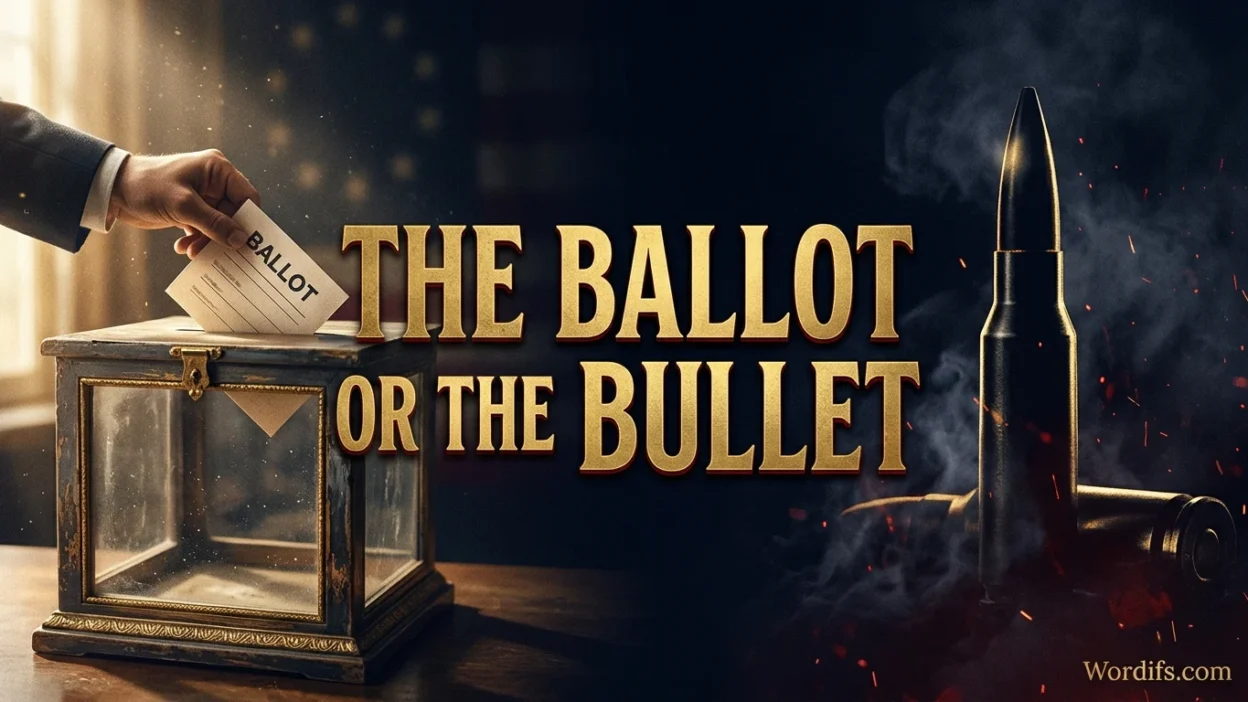
The phrase “The Ballot or the Bullet” is closely associated with Malcolm X, a prominent African American activist, human rights activist, and influential public speaker of the 20th century. In his famous 1964 public speech, Malcolm X addressed racial discrimination, political oppression, voting rights, and the struggle for full equality among Black Americans in the United States.
The phrase presents a powerful contrast between the ballot, which symbolizes voting and democratic participation, and the bullet, which represents armed resistance and the danger of escalating conflict when people are denied justice. Through this expression, Malcolm X challenged the American government and political leaders to address the gap between the country’s democratic ideals and the lived experiences of African Americans.
This guide explains The Ballot or the Bullet meaning, the literal difference between a ballot and a bullet, Malcolm X’s original message, the historical background of the speech, its major themes, and its importance in American history. It also explores voting rights, racial equality, political equality, civil rights, public speaking techniques, and frequently asked questions about this influential historical speech.
What Does The Ballot or the Bullet Mean?
The Ballot or the Bullet means that people facing injustice must be able to achieve meaningful political change through voting and democratic participation; otherwise, continued oppression may increase the risk of confrontation and resistance.
The phrase became famous through Malcolm X’s speech delivered in 1964 during the Civil Rights Movement. Malcolm X argued that Black Americans needed political power, equal rights, and greater control over decisions affecting their communities.
The two words have both literal and symbolic meanings:
- Ballot: A vote or a method of recording a choice in an election. In the speech, it symbolizes voting rights, political participation, democratic power, and peaceful political change.
- Bullet: A projectile fired from a firearm. Symbolically, it represents armed resistance, the possibility of violence, and the consequences of continued political exclusion.
- The Ballot or the Bullet: A forceful expression of the urgent struggle for racial justice, political freedom, and equality.
Malcolm X used this contrast to challenge political leaders who claimed to support democracy while allowing racial discrimination and unequal access to political power to continue.
The phrase should not be reduced to a simple endorsement of violence. Its historical significance lies in the warning that denying people meaningful opportunities to achieve justice can deepen frustration and make conflict more likely.
Why Is The Ballot or the Bullet Important?
People study this phrase in American speeches, political history, literature courses, and discussions of human rights because it connects voting, political representation, and resistance to oppression.
Malcolm X questioned whether a country could genuinely call itself democratic if some of its citizens were prevented from exercising their rights equally. He urged Black Americans to recognize their shared political interests, organize collectively, and hold elected officials accountable.
The speech remains relevant to discussions about:
- Voting rights and voting access
- Political participation and representation
- Racial equality and social justice
- Democratic rights and equality under the law
- Government discrimination and restrictions
- Political freedom and self-determination
- The relationship between civil rights and human rights
These ideas help explain why The Ballot or the Bullet is more than a memorable phrase. It is also an important example of political rhetoric and persuasive public oratory.
What Does Ballot Mean?
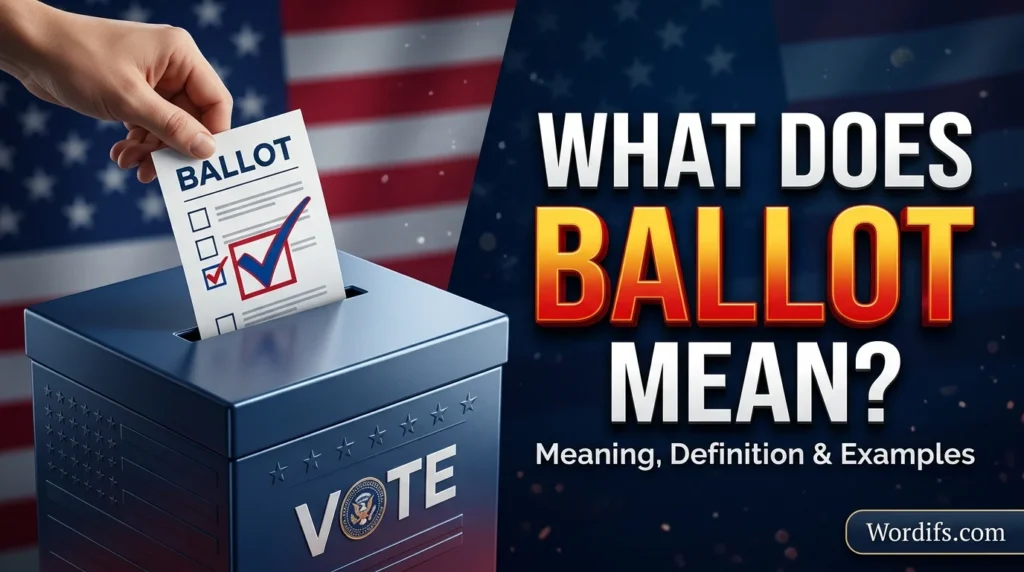
A ballot is a vote or a method of recording a person’s choice in an election or formal decision-making process. It allows eligible voters to express their preferences and participate in choosing political representatives.
Ballot Meaning in Simple English
In simple English, a ballot is a way to vote.
For example, citizens may cast their ballots to elect a president, choose members of a legislature, or decide a public issue. A secret ballot helps protect the privacy of a voter’s decision.
In Malcolm X’s speech, the ballot represents much more than a piece of paper. It symbolizes the right to vote, political representation, democratic participation, and the ability to influence public policy.
Malcolm X emphasized that voting could help Black Americans challenge politicians who ignored their concerns. By organizing voters and using elections strategically, communities could demand accountability and seek meaningful political change.
Common Expressions Related to Ballot
- Cast a ballot: To vote in an election.
- Secret ballot: A voting method that protects a voter’s privacy.
- Ballot box: A container used to collect paper ballots.
- Voting rights: Legal protections and rights that allow eligible people to participate in elections.
- Political representation: Having elected officials who represent a community’s interests.
- Judicious voting: Voting carefully after considering candidates, policies, and likely consequences.
These expressions help explain the relationship between a ballot and the broader concepts of democracy, political equality, and the right to participate in elections.
What Does Bullet Mean?
A bullet is a projectile fired from a firearm. The word also appears in everyday English expressions, including “bite the bullet,” “dodge a bullet,” and “bullet point.”
In the phrase “The Ballot or the Bullet,” however, the word has a symbolic political meaning. It represents armed resistance, the possibility of violence, and the danger of conflict when peaceful efforts to obtain justice are repeatedly blocked.
Malcolm X used the word to communicate urgency. He warned that continued racial injustice, political exclusion, and the denial of equal rights could intensify frustration among Black Americans.
The speech emerged during a period of intense debate about how to confront racism and achieve freedom. Malcolm X emphasized self-determination and the right of Black people to defend themselves against violence, while demanding that political institutions take their grievances seriously.
Common Expressions Related to Bullet
- Bite the bullet: To face a difficult or unpleasant situation.
- Dodge a bullet: To avoid a serious problem or danger.
- Bullet point: A symbol used to organize information in a list.
- Armed resistance: Opposition involving weapons or the threat of armed force.
- Political resistance: Actions taken to oppose political control, injustice, or oppression.
The literal meaning of a bullet differs from its symbolic use in Malcolm X’s speech. Understanding this distinction helps readers interpret the phrase in its historical context.
Ballot vs. Bullet: What Is the Difference?
Although the words ballot and bullet have different dictionary meanings, they represent contrasting approaches to political struggle in Malcolm X’s speech.
| Feature | Ballot | Bullet |
| Literal meaning | A vote or voting method | A projectile fired from a firearm |
| Symbolic meaning | Democratic participation and political change | Armed resistance and the possibility of violence |
| Main association | Voting rights and political representation | The danger of escalating conflict |
| Method or idea | Elections, organizing, and political action | Confrontation involving force |
| Central message | Use political participation to pursue change | Continued oppression can increase the risk of conflict |
The central contrast is between the possibility of achieving change through political participation and the danger that arises when people are denied meaningful access to justice.
Malcolm X argued that voting equality must be more than a promise. People must be able to exercise their rights and influence the decisions that affect their lives.
Who Was Malcolm X?
Malcolm X was an influential African American Muslim minister, political activist, and public speaker. He became one of the most recognizable voices in the struggle against racism, segregation, and the political and economic exclusion of Black Americans.
As a leading figure in African American history, Malcolm X criticized the unequal treatment of Black communities and challenged the idea that formal citizenship automatically guaranteed genuine equality.
His approach differed from that of civil rights leaders who emphasized nonviolent protest as their principal strategy. Malcolm X placed strong emphasis on Black self-determination, political independence, community empowerment, and the right to self-defense.
His views developed throughout his life. In 1964, his public statements increasingly addressed international human rights, colonialism, political organization, and the connections between racial injustice in the United States and struggles for freedom elsewhere.
Malcolm X was assassinated in February 1965. His speeches remain influential in discussions of racial justice, political rights, social equality, identity, and the responsibilities of democratic governments.
Historical Context of The Ballot or the Bullet
To understand the historical context of The Ballot or the Bullet, readers must consider the racial and political conditions of the United States during the 1960s.
Despite constitutional guarantees and the country’s democratic ideals, Black Americans continued to face segregation, discrimination, unequal opportunities, and barriers to political participation. In many places, discriminatory practices made it difficult for African Americans to register to vote or exercise their voting rights freely.
The Civil Rights Movement challenged these conditions through demonstrations, legal action, voter registration campaigns, community organizing, and other forms of political activism. Activists demanded an end to segregation and sought equal treatment under the law.
Malcolm X argued that the struggle was not limited to formal civil rights legislation. He emphasized that Black Americans also needed political power, economic opportunity, community control, and meaningful representation.
He challenged the government to fulfill the democratic principles it claimed to represent. In his view, a country could not achieve genuine social justice while allowing racial discrimination and political exclusion to persist.
When and Where Was the Speech Delivered?
Malcolm X delivered versions of The Ballot or the Bullet at important public gatherings in 1964.
- April 3, 1964 — Cleveland, Ohio: Malcolm X delivered the speech at Cory Methodist Church.
- April 12, 1964 — Detroit, Michigan: He delivered another version at King Solomon Baptist Church.
Both occasions are associated with the speech and its historical importance. When studying a particular transcript or recording, it is useful to identify the date and venue because versions of the address may differ in wording and delivery.
These speeches took place during a critical period in the American civil rights history, when voting access, racial discrimination, political representation, and equality were major national issues.
Summary of The Ballot or the Bullet
In The Ballot or the Bullet, Malcolm X argues that Black Americans must recognize their shared experiences of injustice and work together to secure political, economic, and social equality.
He emphasizes unity, urging people not to let differences in religion, political affiliation, or personal beliefs prevent them from addressing common problems. He argues that collective organization can help communities become more effective in demanding their rights.
Malcolm X also questions whether American democracy provides equal opportunities to all citizens. He highlights the contradiction between the country’s promises of freedom and the racial discrimination experienced by Black Americans.
Another major part of the speech concerns political participation. Malcolm X presents voting as a way to influence elections, challenge unresponsive politicians, and pursue change. However, he warns that voting alone cannot guarantee equality if people are denied access to the political system or if elected officials refuse to respond to their needs.
The speech also connects civil rights with human rights. Malcolm X encourages his audience to understand racial discrimination as a matter of justice and equal human dignity, rather than simply a local political disagreement.
Ultimately, the speech is a call for political awareness, collective action, self-determination, and accountability. Malcolm X insists that promises of equality must be matched by real changes in people’s lives.
Main Themes of The Ballot or the Bullet
Several themes explain the political message and lasting significance of Malcolm X’s speech.
1. Racial Discrimination
Racial discrimination is one of the speech’s central concerns. Malcolm X describes the unequal treatment experienced by Black Americans in political, economic, and social life.
He challenges the contradiction between America’s stated commitment to freedom and the reality of racial inequality. His argument emphasizes that democracy cannot be fully realized when people are prevented from enjoying equal rights and opportunities.
2. Voting Rights and Political Participation
The ballot symbolizes the opportunity to influence government through elections. Malcolm X argues that Black Americans should exercise the right to vote and use political participation to challenge officials who ignore their concerns.
He emphasizes that voters can organize, evaluate candidates, and demand that political leaders address their communities’ needs.
However, the speech also raises an important point: voting rights have limited practical value when access to elections is restricted or when elected representatives fail to respond to the people they serve.
3. Political Equality and Representation
Political equality means that people should have fair opportunities to participate in political life and influence decisions affecting them.
Malcolm X challenges political systems that claim to represent all citizens while excluding or marginalizing Black Americans. He emphasizes the importance of political representation, voter participation, and accountability.
His message is that meaningful citizenship requires more than formal recognition. People must be able to exercise their rights and have a genuine voice in government.
4. Economic Exploitation and Social Justice
Malcolm X argues that racial injustice is not limited to elections or legal rights. It also affects access to employment, wealth, resources, and economic opportunities.
Economic exploitation describes unfair treatment in which people or communities are disadvantaged for another party’s benefit. In the speech, this issue forms part of a wider criticism of the conditions faced by Black Americans.
His argument connects economic opportunity with political freedom and social justice, showing that equality must address more than one area of public life.
5. Black Unity and Collective Action
Malcolm X emphasizes that people who face similar injustices can become more effective when they organize around shared goals.
He encourages African Americans to recognize common interests and work together, even when they disagree about religion, political strategy, or other matters.
Unity, in this context, does not require everyone to hold identical beliefs. It means identifying shared challenges and coordinating efforts to achieve meaningful change.
6. Self-Determination and Political Freedom
Self-determination means having the ability to make decisions about one’s own political, social, and economic future.
Malcolm X argues that Black Americans should not depend entirely on political leaders who may have little incentive to protect their interests. He encourages community organization, political independence, and greater control over decisions affecting Black communities.
This theme is closely connected to political freedom, equality, and the ability to participate fully in democratic life.
7. Government Discrimination and Political Oppression
The speech challenges political institutions that fail to protect citizens from unequal treatment. Malcolm X criticizes the gap between democratic promises and the experiences of people who encounter discrimination.
Government discrimination and political oppression are important concepts for understanding his criticism of the political system. His argument calls for fair treatment, access to political institutions, and accountability from those in power.
8. The Possibility of Resistance
The phrase “The Ballot or the Bullet” warns that prolonged injustice can increase the danger of confrontation.
Malcolm X uses the contrast to communicate urgency. His speech reflects debates about voting, nonviolent protest, self-defense, and political resistance during the 1960s.
The phrase should be interpreted in context: it presents a challenge to a political system that denies people equality and meaningful routes to change, while warning of the consequences that continued exclusion may produce.
9. Equality Under the Law
Equality under the law means that people should receive equal legal protection and treatment.
Malcolm X questions whether American democratic ideals are meaningful when Black Americans face racial discrimination and unequal access to rights. This theme connects the speech to wider discussions of civil rights, democratic principles, and legal protections.
10. Human Rights and Racial Justice
Malcolm X connects the struggle of Black Americans to the broader principles of human rights and racial justice.
His message suggests that racial discrimination should not be treated merely as an internal political issue. It is also a question of human dignity, equal treatment, and the right of people to participate in decisions affecting their lives.
What Does “American Nightmare” Mean in the Speech?
Malcolm X contrasts the idea of the American Dream with what he describes as an American nightmare.
The American Dream is commonly associated with freedom, opportunity, prosperity, and the possibility of improving one’s life. Malcolm X argues that these ideals do not reflect the experiences of Black Americans who continue to face racism and unequal treatment.
The phrase “American nightmare” highlights the distance between the country’s promises and its social realities. It strengthens his criticism of a political system that claims to value equality while allowing discrimination to continue.
This contrast is an important example of political rhetoric. It encourages listeners to examine the difference between a nation’s public image and the lived experiences of its citizens.
Literary Devices and Public Speaking Techniques in The Ballot or the Bullet
Malcolm X’s speech is an important example of public speaking, persuasive speech delivery, and political oratory. He uses several rhetorical techniques to communicate his argument and encourage his audience to reflect on injustice.
1. Repetition
Repetition occurs when a speaker repeats words or phrases to emphasize an important idea.
The title phrase “The Ballot or the Bullet” reinforces the speech’s central contrast. Its memorable structure gives the address a strong rhetorical focus and communicates urgency.
2. Metaphor and Symbolism
A metaphor communicates an idea by describing it through another concept. Symbolism gives an object or image a broader meaning.
The ballot and bullet function as symbols of different responses to oppression: political participation and the possibility of armed resistance. This contrast helps the audience understand the speech’s central argument.
3. Contrast
Contrast places opposing ideas together to emphasize their differences.
Malcolm X contrasts America’s democratic ideals with the racial discrimination experienced by Black Americans. He also contrasts peaceful political action with the danger of escalating conflict.
These comparisons reveal the tension between the country’s stated values and the conditions Malcolm X describes.
4. Rhetorical Questions
A rhetorical question encourages an audience to think rather than simply provide an answer.
Malcolm X challenges listeners to examine the meaning of citizenship, political equality, and democracy. This technique invites the audience to reflect on its experiences and consider what meaningful freedom should involve.
5. Emotional Appeal
An emotional appeal uses language that evokes feelings such as frustration, hope, anger, or determination.
Malcolm X speaks forcefully about discrimination and unequal treatment to communicate the seriousness of the issue. His language encourages listeners to recognize the human consequences of injustice.
6. Analogy
An analogy explains an idea through a comparison with a familiar situation.
Malcolm X uses the image of being present at a table without receiving food to challenge the idea that simply living in a country guarantees equal participation in its opportunities. The comparison makes the difference between physical presence and genuine inclusion easier to understand.
Together, these techniques make the address a significant example of persuasive speech, public oratory, and political rhetoric in 20th-century American history.
The Ballot or the Bullet in American Public Address
An American public address is a speech delivered to an audience on a public, political, social, or cultural issue. Malcolm X’s address is studied as an influential example of political communication because it combines historical argument, emotional appeal, and a clear call for change.
The speech belongs to the tradition of 20th-century American speeches that shaped public debate about democracy, citizenship, and civil rights.
It is also included in discussions of influential American speeches and rankings of major examples of public address. The American Rhetoric website’s well-known list of the Top 100 American Speeches of the 20th Century has ranked The Ballot or the Bullet at 7th place. The ranking is associated with a survey involving 137 leading scholars in the field of American public address.
Such recognition reflects the speech’s significance for the study of public speaking, rhetoric, political persuasion, and African American history. Rankings, however, are evaluations rather than objective measures of a speech’s importance.
Why Is The Ballot or the Bullet Important in American History?
The speech is significant because it reflects the debates, frustrations, and demands of the 1960s Civil Rights Movement.
During this period, Black Americans and their allies challenged segregation, racial discrimination, and barriers to voting. Activists used demonstrations, legal challenges, voter registration campaigns, community organizing, and other methods to seek equality.
Malcolm X offered a distinctive perspective by emphasizing self-determination, political independence, and the need for the government to be held accountable.
The address also connects civil rights to broader questions of human rights. It asks whether a democracy can fulfill its ideals when some citizens face unequal treatment and lack meaningful access to political power.
Its continuing relevance lies in its questions about democratic rights, political participation, voting access, racial justice, and the consequences of ignoring demands for equality.
Examples of Ballot and Bullet in Sentences
These examples demonstrate how the words are used in everyday English and in discussions of Malcolm X’s speech.
Examples Using Ballot
- Every eligible voter should have a fair opportunity to cast a ballot.
- Citizens used their ballots to choose their political representatives.
- A secret ballot protects the privacy of a voter’s choice.
- Political participation allows citizens to influence public policy through voting.
- Malcolm X presented the ballot as a potential tool for political change.
- Protecting voting rights is essential to a functioning democracy.
- People should carefully evaluate candidates before they exercise the right to vote.
- Fair elections help strengthen political representation.
- Citizens can use their votes to demand greater accountability from the government.
- Equal voting access is an important part of democratic participation.
Examples Using Bullet
- A bullet is a projectile fired from a firearm.
- The investigation examined the damage caused by a bullet.
- The teacher used bullet points to summarize the lesson.
- The phrase The Ballot or the Bullet became associated with Malcolm X’s political message.
- The speech warns that continued injustice can increase the danger of political conflict.
- Students studied the address to understand debates about civil rights and political resistance.
These examples distinguish the literal meanings of the words from their symbolic meanings in political discussion.
Common Misunderstandings About The Ballot or the Bullet
Mistake 1: Thinking the Phrase Only Refers to Voting and Firearms
The words have literal meanings, but together they communicate a broader political argument about equality, resistance, and the consequences of continued oppression.
Mistake 2: Assuming Malcolm X Discussed Only Violence
The speech also addresses voting rights, political organization, economic inequality, self-determination, and government accountability. Its meaning cannot be understood by focusing on the word “bullet” alone.
Mistake 3: Confusing a Ballot With Political Power Itself
A ballot is a means of participating in an election. Meaningful political power also depends on fair access to voting, effective representation, and institutions that respond to citizens’ concerns.
Mistake 4: Ignoring the Historical Context
The speech emerged during a period of widespread racial discrimination and intense debate about civil rights. Understanding this background is essential to interpreting Malcolm X’s words accurately.
Mistake 5: Treating the Speech as a Neutral Description
The Ballot or the Bullet is a persuasive political address. Malcolm X presents a clear argument and uses strong rhetoric to challenge his audience and the political establishment.
Memory Trick: How to Remember Ballot or Bullet
Use this simple association:
- Ballot = Vote = Political participation
- Bullet = Projectile = The possibility of armed conflict
For Malcolm X’s speech, remember these three connected ideas:
Equality → Political Power → Accountability
The speech argues that equality requires more than promises, political power requires meaningful participation, and political leaders must be held accountable for their actions.
American vs. British English: Ballot and Bullet
The words ballot and bullet have the same basic meanings in American and British English.
| Feature | American English | British English |
| Ballot | A vote or voting method | A vote or voting method |
| Bullet | A projectile fired from a firearm | A projectile fired from a firearm |
| Ballot paper | A document used to record a vote | A commonly used term for a voting document |
| Ballot box | A container for collecting ballots | A container for collecting ballots |
| Bullet point | A symbol used in a list | A symbol used in a list |
Malcolm X’s speech specifically addresses the history and political conditions of the United States. Although the vocabulary is also used in British English, the speech’s references to American citizenship, racial discrimination, and voting rights must be understood within American history.
Similar Words and Related Concepts
Understanding related vocabulary helps readers interpret Malcolm X’s speech more accurately.
Political and Civil Rights Vocabulary
- Civil rights: Rights that protect individuals from discrimination and support equal treatment under the law.
- Human rights: Basic rights and freedoms that belong to all people.
- Voting rights: Rights that allow eligible people to participate in elections.
- Democracy: A system of government in which people have a role in political decision-making.
- Political equality: Fair opportunities to participate in political life.
- Social equality: Equal dignity, status, and opportunities within society.
- Racial equality: Equal rights and opportunities regardless of race.
- Political representation: Having elected officials who represent a community’s interests.
- Self-determination: The ability to make decisions about one’s own future.
- Oppression: The unjust or cruel exercise of power over people.
- Political freedom: The ability to participate in political life and exercise political rights.
- Political resistance: Action taken to oppose control, injustice, or oppression.
- Economic exploitation: The unfair use of people or their work for another party’s benefit.
- Racial justice: Fair treatment and the removal of racial discrimination.
- Political activism: Organized action intended to influence political decisions or bring about social change.
Ballot and Bullet Vocabulary
- Vote: A choice expressed in an election or decision-making process.
- Election: A process for choosing representatives or deciding an issue.
- Referendum: A direct public vote on a particular question.
- Projectile: An object launched or fired through the air.
- Ammunition: Materials used in firearms.
- Political violence: Violence connected with political power, disputes, or resistance.
These terms help explain both the literal vocabulary and the wider political ideas associated with The Ballot or the Bullet.
Frequently Asked Questions
1. What does The Ballot or the Bullet mean?
The Ballot or the Bullet is a phrase associated with Malcolm X’s 1964 speech. It contrasts voting and peaceful political action with the possibility of armed resistance when injustice and political exclusion continue.
2. Who gave the speech The Ballot or the Bullet?
Malcolm X, an influential African American Muslim minister, activist, and public speaker, delivered versions of the speech in 1964.
3. When was The Ballot or the Bullet delivered?
Malcolm X delivered a version at Cory Methodist Church in Cleveland, Ohio, on April 3, 1964, and another version at King Solomon Baptist Church in Detroit, Michigan, on April 12, 1964.
4. What is the main idea of The Ballot or the Bullet?
The main idea is that Black Americans should organize politically and demand meaningful equality. Malcolm X emphasizes voting rights, collective action, self-determination, and accountability while warning about the consequences of continued oppression.
5. What does the ballot symbolize in Malcolm X’s speech?
The ballot symbolizes voting, political participation, representation, and the opportunity to bring change through democratic processes.
6. What does the bullet symbolize in Malcolm X’s speech?
The bullet symbolizes armed resistance, violence, and the danger of escalating conflict when people are denied equality and meaningful political influence.
7. What are the major themes of The Ballot or the Bullet?
Major themes include racial discrimination, voting rights, political equality, economic exploitation, Black unity, self-determination, human rights, and resistance to oppression.
8. What rhetorical devices does Malcolm X use?
Malcolm X uses repetition, metaphor, symbolism, contrast, rhetorical questions, emotional appeals, and analogy. These techniques reinforce his message and make his political argument more persuasive.
9. Why is The Ballot or the Bullet important?
The speech remains important because it raises enduring questions about democracy, racial equality, political representation, civil rights, and the responsibility of governments to address injustice.
10. Is The Ballot or the Bullet a persuasive speech?
Yes. It is a persuasive political speech that uses rhetorical techniques and historical arguments to challenge the audience and encourage political awareness and action.
11. What does Malcolm X mean by political equality?
In this context, political equality means having fair opportunities to vote, participate in public life, influence political decisions, and receive equal consideration from political institutions.
12. What is the difference between civil rights and human rights in the speech?
Civil rights generally concern protections and equal treatment within a particular legal and political system. Human rights refer to basic rights and freedoms that belong to all people. Malcolm X connects the struggle of Black Americans to both concepts.
Final Verdict:
The main message of “The Ballot or the Bullet” is that Black Americans must demand genuine political, economic, and social equality rather than accept promises without meaningful change.
Malcolm X argues that voting and political organization can provide important ways to challenge discrimination, but he warns that continued exclusion and injustice can increase the risk of confrontation.
The speech emphasizes unity, self-determination, voting rights, political accountability, racial justice, and human rights. Its title captures the urgency of the argument: a society that claims to value democracy must provide people with meaningful opportunities to participate and pursue change.
Conclusion
The Ballot or the Bullet remains an important speech in American history because it challenges the gap between democratic ideals and the lived experiences of Black Americans. Through his powerful public address, Malcolm X argues that voting rights, political representation, and economic equality are essential to genuine freedom.
The phrase contrasts the ballot, which represents democratic participation and political change, with the bullet, which represents the danger of escalating conflict when peaceful avenues are blocked.
By examining its historical context, central themes, and rhetorical techniques, readers can better understand Malcolm X’s argument and the continuing importance of equality, political accountability, and human rights.
If studied as a historical speech, a persuasive public address, or an important work of political rhetoric, The Ballot or the Bullet encourages readers to consider what democracy requires in practice: meaningful participation, equal rights, fair representation, and action against discrimination.

Orvian Treloux works on the Wordifs site developing structured blogs coordinating via wordifs@gmail.com to ensure accuracy originality clarity usefulness engagement and long term trust among global readers across digital platforms.