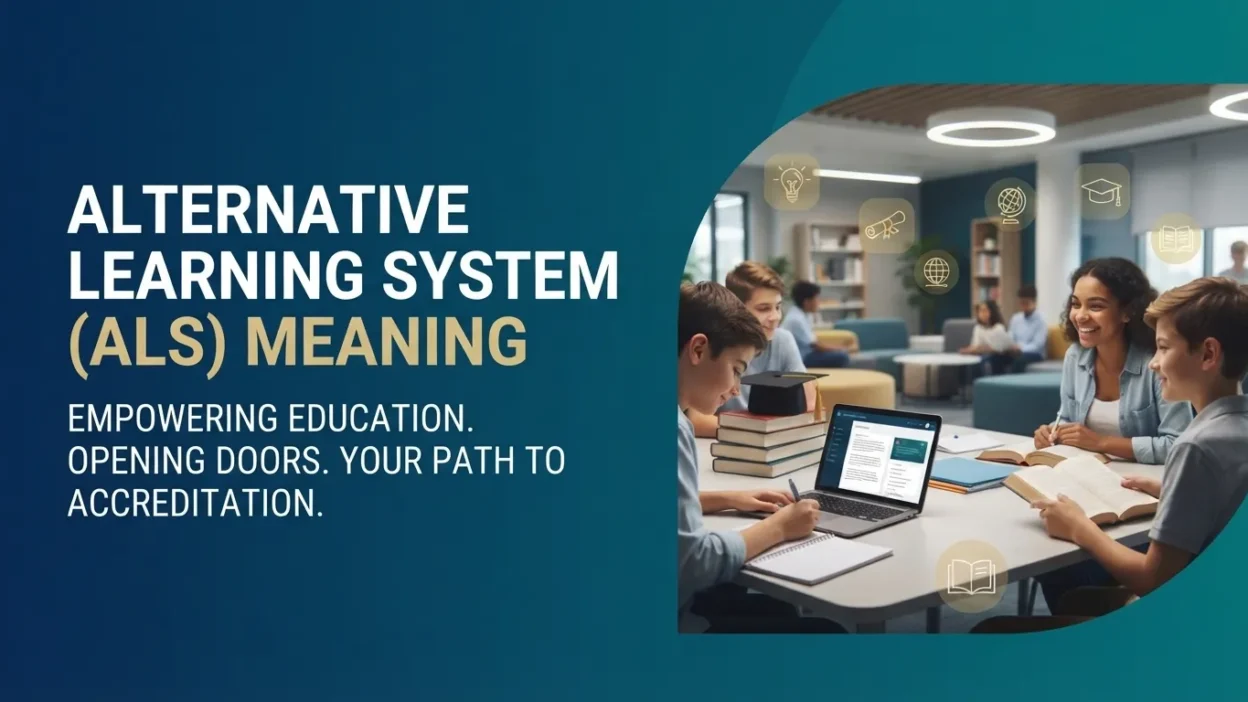
Alternative Learning System (ALS) Meaning starts with a simple idea: a second path to education for Filipinos who can’t stay in regular schools. The Alternative Learning System, better known as ALS, is a parallel learning system in the Philippines, and its meaning is easy to explain.
It is a practical option for people who can’t attend schools or who dropped out along the way. It follows an existing school route side by side, so it runs parallel, and nobody has to start over or feel left behind. Volunteers often describe ALS as an alternative path, never a lesser one. Think of it as one more route: an alternative to the existing setup, a path with every option open to learners.
Without access to formal education, ALS acts as an alternate or a substitute. The word formal points to the usual classroom track, with fixed schedules and daily formal instruction. Anyone who has watched a classroom like that knows the schedules can feel rigid, with the same fixed hours, the same daily school routine, and a strict regular pace.
That is hard for a working teenager, a farmer’s child, or an adult who left early, and each may need a different option. A teenager, a farmer, or any child can struggle with formal instruction. This system lets learning bend around real life, because education does not end at the school gate, and the instruction is flexible.
ALS includes both non-formal and informal sources of knowledge. Non-formal learning is organized learning that happens outside school, like lessons at a community learning center, where the community meets at the center and the lessons stay organized around real needs. It is not a regular school.
Informal learning is what you pick up from daily life, work, and family. Educators in this field say these sources, and the knowledge they carry, give learners real skills they can use right away. Those practical skills often matter more than a certificate.
Quick Answer:
The Alternative Learning System (ALS) is a free, non-formal education program run by the Philippines’ Department of Education. It lets out-of-school youth and adults finish elementary or high school equivalency without attending regular classes. Learners study through modules and learning centers, then take the A&E Test to earn an officially recognized certificate.
What Is the Alternative Learning System?
ALS is a parallel learning pathway to formal schooling. It exists for people who could not start school, dropped out, or had to work, care for family, or move before finishing. Instead of a fixed daily schedule, ALS adapts to the learner’s time, location, and life situation.
Alternative Learning System Meaning in Simple Terms
Think of ALS as “school on your own terms.” You learn the same core competencies as a regular student, but through flexible delivery. You can study in a barangay hall, community center, or home-based setting, depending on what your local program offers.
ALS Full Form and Who Runs It
ALS stands for Alternative Learning System. It is managed by DepEd through its Bureau of Alternative Learning System, along with regional offices, schools divisions, and district ALS coordinators.
A Quick Look at Its Legal Basis
ALS grew out of the Philippines’ push for inclusive basic education. Republic Act 9155 (2001) recognized non-formal and informal learning within the basic education system. Later, the ALS Act (Republic Act 11510, signed in 2020) strengthened the program by institutionalizing it nationwide. Exact provisions and implementing rules can change, so always confirm current details with DepEd.
Who Can Join ALS?
ALS is designed for learners who are outside the formal school system. Typical participants include:
- Out-of-school youth who dropped out of elementary or high school
- Adults who never finished basic education
- Working students who cannot attend daytime classes
- Indigenous learners and people in remote areas
- Persons with disabilities who need flexible learning arrangements
- Learners in special situations, such as those in conflict-affected areas or in detention programs
Age requirements vary by level and by program announcements, so check with your local DepEd office or ALS district coordinator before enrolling.
The Two Main ALS Programs
Basic Literacy Program (BLP)
The Basic Literacy Program targets learners who cannot yet read, write, or do basic math. It builds foundational literacy and numeracy so learners can move on to higher levels.
Accreditation and Equivalency (A&E) Program
The A&E Program is for learners who have basic literacy and want formal recognition of what they know. It prepares them for the A&E Test, which measures learning equivalent to elementary or junior high school, and ALS also offers a path toward senior high school equivalency.
ALS Learning Strands: What Students Actually Study
ALS organizes its curriculum into learning strands rather than traditional school subjects. These cover:
- Communication Skills (English, Filipino, and communication)
- Problem Solving and Critical Thinking (math and reasoning)
- Sustainable Use of Resources and Productivity (livelihood and practical skills)
- Development of Self and a Sense of Community (values, civic life, and personal growth)
- Expanding One’s World Vision (broader social and global understanding)
This structure blends academic learning with life skills, which is one reason ALS is popular among adult learners.
How Does ALS Work? Step by Step
- Register. Contact your local DepEd school, district ALS coordinator, or community learning center.
- Get assessed. A facilitator checks your current skills to place you at the right level.
- Learn. Study with modules, group sessions, and learning facilitators, often called mobile teachers or instructional managers.
- Review. Join review sessions to prepare for the A&E Test.
- Take the test. Sit for the Accreditation and Equivalency Test on the scheduled date.
- Receive results. If you pass, you receive a certificate of completion for that level.
What Is the A&E Test?
The A&E Test is the ALS equivalency exam. It assesses competencies across the learning strands and, like many equivalency tests, includes a written component. Passing it gives you official certification, which you can use to enroll in the next level of education or apply for jobs that require basic education credentials.
Does an ALS Certificate Have Real Value?
Yes. DepEd recognizes ALS passers as having completed the equivalent level of basic education. ALS completers may continue to senior high school or higher education, subject to the admission rules of each school or university.
Benefits of the Alternative Learning System
- Free access: Public ALS programs are offered at no tuition cost.
- Flexible schedule: Learners can balance work, family, and study.
- Second chance: It reopens education for people who left school early.
- Practical focus: Life skills and livelihood training sit alongside academics.
- Community-based: Learning centers bring education closer to home.
Limitations to Know Before You Start
ALS requires self-discipline, since there is less daily structure than in a regular school. Resources and facilitator availability can differ by area. Some learners also face stigma, although recognition of ALS credentials has grown.
ALS vs. Formal Schooling vs. the U.S. GED
Many US readers search for this term while comparing it to systems they already know. The table below shows the main differences.
| Feature | ALS (Philippines) | Traditional High School | GED (United States) |
| Who runs it | DepEd | School districts or private schools | GED Testing Service, with state rules |
| Main audience | Out-of-school youth and adults | School-age students | Adults and out-of-school youth without a diploma |
| Format | Modules, facilitator-led sessions, equivalency test | Daily classroom attendance | Self-study or prep classes, then a four-subject exam |
| Outcome | Elementary or high school equivalency certificate | High school diploma | High school equivalency credential |
| Cost | Free in public programs | Free in public schools | Test fees vary by state |
| Flexibility | High | Low | High |
What Is the US Equivalent of the Alternative Learning System?
“Alternative learning system” is not an official US program name. The closest US options include:
- GED: A four-part exam covering Mathematical Reasoning, Reasoning Through Language Arts, Science, and Social Studies. The passing score is 145 on each section.
- HiSET: Another high school equivalency exam accepted in several states.
- Adult education programs: Community colleges and nonprofits often offer free or low-cost prep classes.
- Alternative high schools: Schools designed for students who need smaller classes or non-traditional schedules.
- Credit recovery and online high school: Options for students who fell behind on credits.
Availability, testing rules, and fees differ by state, so check your state’s department of education for current requirements.
Real-Life Examples of ALS in Action
Example 1: After leaving school at 17 to work on a family farm, one student joins weekend ALS sessions, passes the A&E Test, and enrolls in senior high school.
Example 2: At age 35, a parent who never finished elementary school starts with the Basic Literacy Program, gains confidence, and later earns a junior high equivalency certificate.
3 Example: For a Filipino American family wondering how a relative’s ALS certificate compares to a US diploma, the credential can be evaluated by a US credential evaluation service or the receiving school or employer.
Tips for Succeeding in ALS
- Set a weekly study schedule and stick to it.
- Attend review sessions, even when your schedule is tight.
- Practice with sample questions and past modules.
- Ask your learning facilitator for help early.
- Form a study group with other learners.
- Keep your registration and testing documents safe.
Frequently Asked Questions
What does ALS stand for in education?
ALS stands for Alternative Learning System. It is a DepEd program offering non-formal basic education to learners outside regular schools.
Is ALS the same as a high school diploma?
Not exactly. ALS passers receive a certificate of equivalency, which DepEd recognizes as equal to completing that level. It is separate from a diploma issued by a formal school.
Is ALS free?
Public ALS programs are free of tuition. Learners may still have small personal costs, such as transportation or school supplies.
Can ALS graduates go to college?
Yes. ALS passers can pursue further education, but each college or university sets its own admission requirements, so confirm with the school.
Who can take the A&E Test?
Eligibility depends on age and level. Learners who have prepared through ALS or are otherwise qualified can register through their local DepEd office.
Is the alternative learning system available in the United States?
Not under that name. US learners typically use the GED, HiSET, adult education programs, or alternative high schools instead.
How long does it take to finish ALS?
It varies. Completion depends on the learner’s starting level, study pace, and A&E Test schedule.
Final Thoughts
The alternative learning system gives people a real second chance at education. Its flexible, community-based design helps learners who cannot follow a regular school schedule, and its equivalency certificate opens doors to further study and work.
If you are in the Philippines, start with your local DepEd office or ALS coordinator. If you are in the US, explore the GED, HiSET, or adult education programs in your state. In every case, confirm current rules with official sources before you enroll.

Kalven Driost works on the Wordifs site producing reliable content while communicating through wordifs@gmail.com to support research editing publishing consistency transparency and audience focused knowledge sharing practices for modern readers.