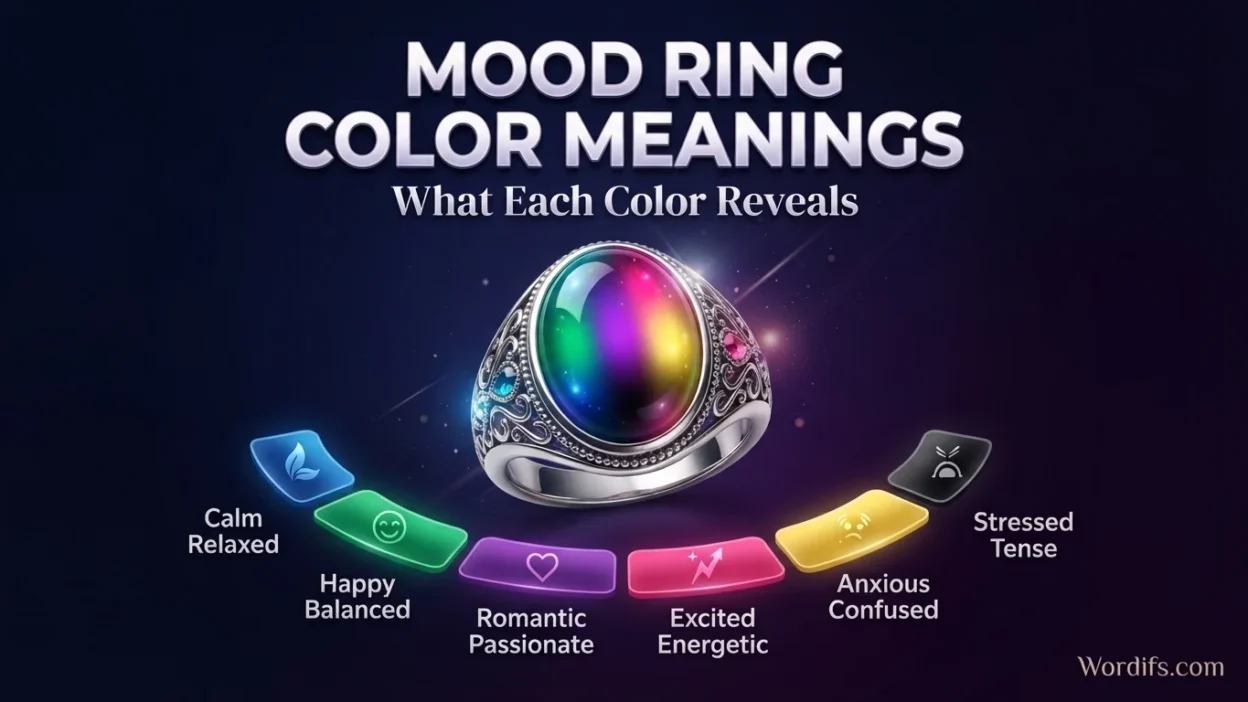
Mood ring color meanings are commonly associated with different emotions, from happiness and excitement to calmness, stress, and relaxation. A mood ring changes color in response to temperature changes in the skin, and each color is traditionally linked to a particular emotional state. For example, blue is often associated with calmness, green with balance, and black with stress or tension.
Although these color associations make mood rings fun and interesting, they are not scientifically reliable indicators of your feelings. Mood rings typically contain temperature-sensitive liquid crystals that respond to changes in skin temperature.
Your emotions can influence your body’s temperature, but so can the weather, circulation, and physical activity. Understanding the meaning of each mood ring color helps you enjoy this popular accessory while knowing what its colors can and cannot tell you.
Quick Answer: What Do Mood Ring Colors Mean?
Mood ring colors are traditionally associated with different emotional states. Blue often represents calmness, green suggests balance, purple symbolizes excitement or affection, yellow indicates alertness, and black is linked to stress or tension. However, these meanings are symbolic interpretations, not scientifically proven readings of your emotions.
What Is a Mood Ring?
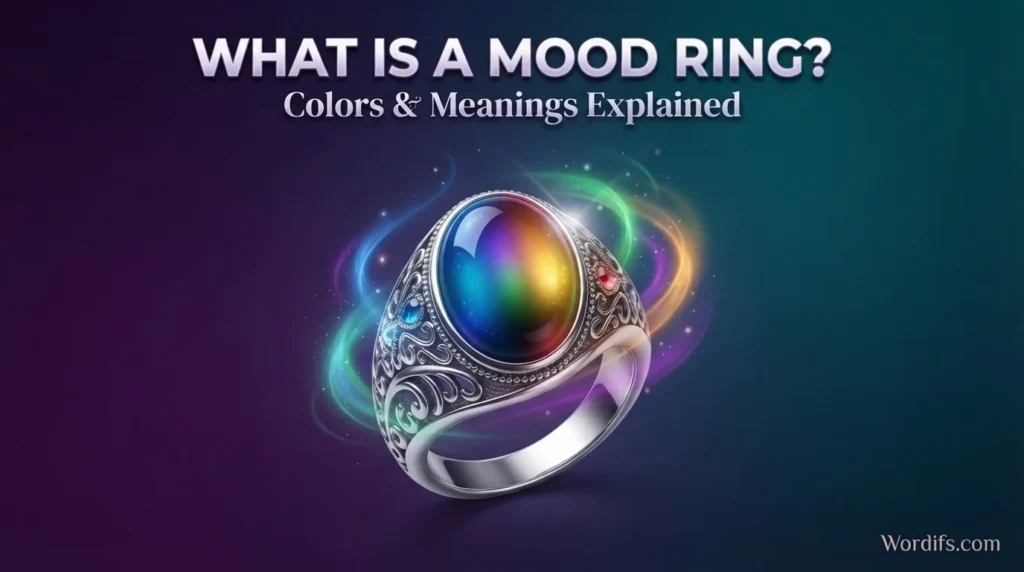
A mood ring is a type of jewelry designed to change color in response to temperature variations. It usually features a special material containing thermochromic liquid crystals that react to changes in temperature.
Mood rings became especially popular in the 1970s and have remained a recognizable fashion accessory. People wear them because they are colorful, entertaining, and often marketed as a way to explore their emotions.
The basic idea is simple: your fingers experience small temperature changes throughout the day, and the liquid crystals in the ring respond by displaying different colors.
How Does a Mood Ring Work?
Most traditional mood rings contain temperature-sensitive liquid crystals beneath a protective transparent covering.
These crystals change how they reflect light as their temperature changes. This creates visible colors ranging from dark shades to blue, green, yellow, and purple.
A typical process looks like this:
- You put the mood ring on your finger.
- The ring adjusts to the temperature of your skin.
- Temperature-sensitive crystals respond to that temperature.
- The ring displays a color associated with a particular temperature range.
- A traditional mood ring color chart assigns an emotional meaning to the displayed color.
The important distinction is that the ring directly responds to temperature, not emotions themselves.
Complete Mood Ring Color Meanings Chart
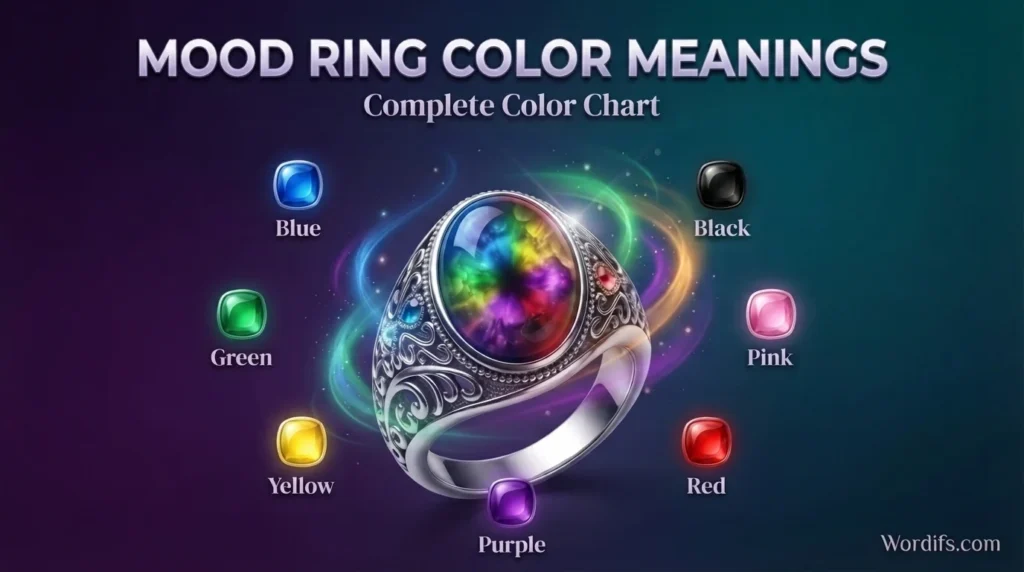
Different mood rings can use slightly different color ranges and temperature calibrations. The following chart explains common traditional interpretations rather than universal or scientifically established emotional meanings.
| Mood ring color | Traditional meaning | Common symbolic association |
| Black | Stress, tension, or nervousness | Pressure or discomfort |
| Gray | Anxiety or uncertainty | Uneasiness or confusion |
| Brown | Restlessness or mixed feelings | Worry or instability |
| Amber or orange | Nervousness or emotional energy | Alertness or excitement |
| Yellow | Curiosity or changing emotions | Mental activity |
| Green | Balanced or normal mood | Harmony and stability |
| Blue-green | Relaxation and contentment | Peacefulness |
| Blue | Calmness and happiness | Comfort and tranquility |
| Dark blue | Deep relaxation or affection | Emotional comfort |
| Purple | Excitement, romance, or passion | Strong positive feelings |
| Pink | Affection, tenderness, or sensitivity | Warmth and caring |
| Red | Energy, passion, or excitement | Intensity and action |
| White | Confusion or mixed emotions | Uncertainty or change |
Not every mood ring displays all these colors. Some products have only a few distinct shades, while others use broader gradients.
What Does Each Mood Ring Color Mean?
Understanding individual mood ring colors can help you interpret the symbolism commonly associated with them.
1. Black Mood Ring Meaning
<text color=”default” weight=”medium”>Traditional meaning: Stress, tension, or nervousness</text>
Black is commonly associated with stress, discomfort, or emotional tension on traditional mood ring charts.
If your ring turns black, it does not automatically mean you are upset or anxious. A black appearance can occur when the ring is cold, when its liquid crystals are outside their intended operating temperature range, or when the material is not functioning properly.
Symbolically, black represents a low-energy or uncomfortable emotional state in many mood ring interpretations.
2. Gray Mood Ring Meaning
<text color=”default” weight=”medium”>Traditional meaning: Anxiety, uncertainty, or nervousness</text>
Gray is often associated with uncertainty, mild stress, or emotional discomfort.
On some mood ring charts, gray appears between black and more colorful shades. It may be interpreted as a transitional state, suggesting that emotions are changing.
However, the color is determined by temperature. It cannot confirm whether you feel worried, confused, or overwhelmed.
3. Brown Mood Ring Meaning
<text color=”default” weight=”medium”>Traditional meaning: Restlessness or mixed emotions</text>
Brown is sometimes interpreted as a sign of nervousness, restlessness, or emotional instability.
Because brown shades can be difficult to distinguish from amber or dark orange, the interpretation varies between products.
If you notice a brown shade, consider it an interesting color change rather than proof of a particular emotional state.
4. Amber or Orange Mood Ring Meaning
<text color=”default” weight=”medium”>Traditional meaning: Nervousness, alertness, or excitement</text>
Amber and orange shades are commonly linked to heightened energy, curiosity, or nervous anticipation.
For example, someone might associate an orange mood ring with the excitement of meeting friends or preparing for an important event.
These associations are symbolic. Your ring may turn orange because your finger is within the temperature range associated with that color, regardless of whether you feel excited.
5. Yellow Mood Ring Meaning
<text color=”default” weight=”medium”>Traditional meaning: Curiosity, alertness, or changing emotions</text>
Yellow is often associated with mental activity, curiosity, and a sense of anticipation.
Its bright appearance makes it easy to connect with energetic or active feelings.
Some mood ring charts interpret yellow as nervousness, while others associate it with creativity or excitement. Always consider the specific chart supplied with your ring.
6. Green Mood Ring Meaning
<text color=”default” weight=”medium”>Traditional meaning: Balance, stability, or an ordinary mood</text>
Green is one of the most recognizable colors on a mood ring chart. It is commonly associated with balance, emotional stability, and a comfortable state of mind.
Some charts describe green as a neutral or normal mood rather than a particularly happy or sad one.
Green is also a frequent middle color in mood rings because it appears within a typical operating temperature range for many products.
If your ring turns green, enjoy the color without assuming it provides a precise reading of your emotions.
7. Blue-Green Mood Ring Meaning
<text color=”default” weight=”medium”>Traditional meaning: Relaxation and contentment</text>
Blue-green, sometimes called turquoise, is often associated with peacefulness, satisfaction, and emotional comfort.
It sits between the traditional green and blue categories, so some charts interpret it as a transition from balance to relaxation.
The exact interpretation depends on the manufacturer’s temperature scale and color guide.
8. Blue Mood Ring Meaning
<text color=”default” weight=”medium”>Traditional meaning: Calmness, happiness, and relaxation</text>
Blue is one of the most popular mood ring colors because it is commonly associated with calmness and comfort.
A blue mood ring is traditionally interpreted as a sign of a relaxed or positive emotional state. Lighter blue shades may be associated with peacefulness, while deeper blues may suggest stronger relaxation or affection.
Nevertheless, blue does not prove that you are happy. Room temperature, skin temperature, and the ring’s design all influence the color.
9. Dark Blue Mood Ring Meaning
<text color=”default” weight=”medium”>Traditional meaning: Deep relaxation, happiness, or affection</text>
Dark blue is often interpreted as a deeper version of the traditional blue mood ring meaning.
Depending on the chart, it may represent contentment, emotional comfort, or affection.
Some products use dark blue as their warmest color, while others use purple for that position. There is no universal standard that applies to every mood ring.
10. Purple Mood Ring Meaning
<text color=”default” weight=”medium”>Traditional meaning: Passion, romance, or excitement</text>
Purple is frequently associated with strong positive emotions, romance, affection, and excitement.
In popular interpretations, purple can symbolize feeling special, emotionally engaged, or attracted to someone.
For this reason, purple mood rings are sometimes discussed in the context of love and relationships.
However, a purple ring cannot determine whether you are in love or whether someone else has romantic feelings for you.
11. Pink Mood Ring Meaning
<text color=”default” weight=”medium”>Traditional meaning: Affection, tenderness, or emotional sensitivity</text>
Pink is commonly associated with warmth, sweetness, affection, and caring.
Some mood ring charts describe pink as a sign of romantic interest or a gentle emotional state.
Pink may also be marketed as a feminine or playful color, but these are cultural and design associations rather than scientific interpretations.
12. Red Mood Ring Meaning
<text color=”default” weight=”medium”>Traditional meaning: Energy, passion, or excitement</text>
Red is often connected with intense emotions, enthusiasm, passion, and action.
In popular symbolism, red can represent a strong emotional response or a burst of energy.
Some mood rings display red as a distinct shade, while others transition directly from orange to purple. If your ring includes red, use its accompanying chart to understand the manufacturer’s intended interpretation.
13. White Mood Ring Meaning
<text color=”default” weight=”medium”>Traditional meaning: Confusion, uncertainty, or mixed feelings</text>
White is sometimes associated with confusion, emotional change, or uncertainty.
Not all mood rings display white, and some products may appear pale because of lighting, surface reflections, or their construction.
If your ring turns white unexpectedly, check whether the product is designed to show that shade before assigning it an emotional meaning.
Why Do Mood Ring Colors Change?
Mood ring colors change because temperature-sensitive materials respond to their surrounding temperature.
The liquid crystals inside many traditional mood rings have structures that reflect different wavelengths of light at different temperatures. As the temperature changes, the reflected colors change too.
Several factors can affect the result.
Skin Temperature
Your fingers naturally experience temperature changes throughout the day. Blood circulation, activity, and environmental conditions can all affect skin temperature.
Since the ring rests against your skin, these changes can influence its appearance.
Weather and Room Temperature
Cold weather may make your fingers cooler, while a warm room may increase their temperature.
As a result, a mood ring may display different colors when you are outdoors in winter compared with sitting inside a warm building.
Physical Activity
Exercise and movement can change circulation and skin temperature. Your mood ring may respond to those changes even if your emotional state remains the same.
Ring Quality and Design
Different products use different temperature ranges, materials, and color scales. Some rings change colors gradually, while others display more limited shades.
A ring that changes color slowly or shows fewer colors is not necessarily measuring your emotions differently. Its behavior may simply reflect its design and condition.
Are Mood Ring Colors Scientifically Accurate?
Mood ring colors are not scientifically validated measurements of specific emotions.
Although emotional states can sometimes influence physiological responses, skin temperature alone cannot reliably distinguish happiness from anxiety, love from excitement, or calmness from boredom.
For example, your fingers may become cooler because of cold weather or changes in circulation. A mood ring could then display a color traditionally associated with stress, even when you feel perfectly comfortable.
Similarly, a warm finger might produce a color associated with relaxation while you are actually nervous.
Mood rings are best understood as novelty jewelry rather than diagnostic tools or reliable emotional assessments.
If you enjoy using a mood ring as a conversation starter or a reminder to check in with yourself, it can still be fun and meaningful.
Mood Ring Color Meanings for Love and Relationships
Mood rings are often marketed as accessories that symbolize romance and attraction. Certain colors have become associated with love because of their traditional meanings.
| Color | Common romantic interpretation |
| Pink | Affection and tenderness |
| Purple | Passion and romantic excitement |
| Dark blue | Comfort and emotional closeness |
| Blue | Calmness and contentment |
| Red | Intensity and passion |
| Green | Balance and stability |
| Yellow | Curiosity or excitement |
These interpretations can make mood rings playful gifts for partners, friends, or loved ones.
However, a ring cannot reveal another person’s true feelings or determine whether a relationship is healthy. Communication and behavior are much more meaningful ways to understand a person’s emotions.
How to Read Your Mood Ring Correctly
If you want to understand the colors your mood ring displays, follow these practical tips.
- Check the manufacturer’s color chart. Different rings may assign different meanings to similar shades.
- Allow the ring to adjust to your skin. Give it a little time after putting it on before interpreting the color.
- Notice your surroundings. Cold hands, warm rooms, and outdoor temperatures can influence the result.
- Compare colors under consistent lighting. Lighting can affect how shades appear to your eyes.
- Avoid treating colors as facts about your emotions. Use the meanings as playful symbolism rather than reliable measurements.
- Take care of the ring. Avoid damaging its temperature-sensitive surface or exposing it to conditions that the manufacturer advises against.
For a more reflective experience, you can note the ring’s color and ask yourself how you actually feel. This turns a novelty accessory into a personal reminder to pause and reflect, without assuming the jewelry knows your emotional state.
Frequently Asked Questions
1. What is the happiest mood ring color?
Blue is commonly associated with happiness, calmness, and relaxation. Some charts associate purple with excitement or passion. However, these meanings are traditional interpretations, not scientifically proven indicators of happiness.
2. What does a black mood ring mean?
A black mood ring is traditionally associated with stress, tension, or nervousness. However, black can also result from low temperatures or a ring operating outside its intended color range.
3. What does green mean on a mood ring?
Green commonly symbolizes balance, stability, or an ordinary emotional state. On many rings, it is a middle color in the temperature scale. It does not guarantee that you are emotionally balanced.
4. What does purple mean on a mood ring?
Purple is often associated with romance, passion, affection, or excitement. Some manufacturers assign slightly different meanings, so the chart supplied with your ring is the best reference for its intended symbolism.
5. What does blue mean on a mood ring?
Blue traditionally represents calmness, happiness, relaxation, or contentment. The ring displays blue because of its temperature-sensitive material, not because it directly detects those feelings.
6. Can a mood ring tell if you are in love?
No. A mood ring cannot reliably detect love or romantic attraction. Purple, pink, and red are sometimes associated with romance, but these meanings are symbolic and cannot reveal your actual feelings or someone else’s intentions.
7. Why does my mood ring keep changing colors?
Your ring may change colors because of variations in skin temperature, weather, circulation, physical activity, or room temperature. Some rings also shift gradually between colors as their temperature changes.
8. Do all mood rings have the same color meanings?
No. Mood ring color charts vary by manufacturer, and some rings display shades that others do not. Use the chart that comes with your specific ring instead of assuming every product follows the same color scale.
Final Thoughts
Mood ring color meanings offer a fun way to explore the symbolism of colors and enjoy a distinctive piece of jewelry. Blue is commonly associated with calmness, green with balance, purple with passion, pink with affection, and black with stress or tension.
Remember that these interpretations are not universal, and a mood ring responds primarily to temperature rather than directly measuring emotions. Your ring’s color can change with the weather, skin temperature, and physical activity.
Enjoy your mood ring as a colorful accessory, a conversation starter, or a reminder to reflect on how you feel. For understanding your emotions, your own experiences and self-awareness are far more reliable than any color chart.

Kalven Driost works on the Wordifs site producing reliable content while communicating through wordifs@gmail.com to support research editing publishing consistency transparency and audience focused knowledge sharing practices for modern readers.