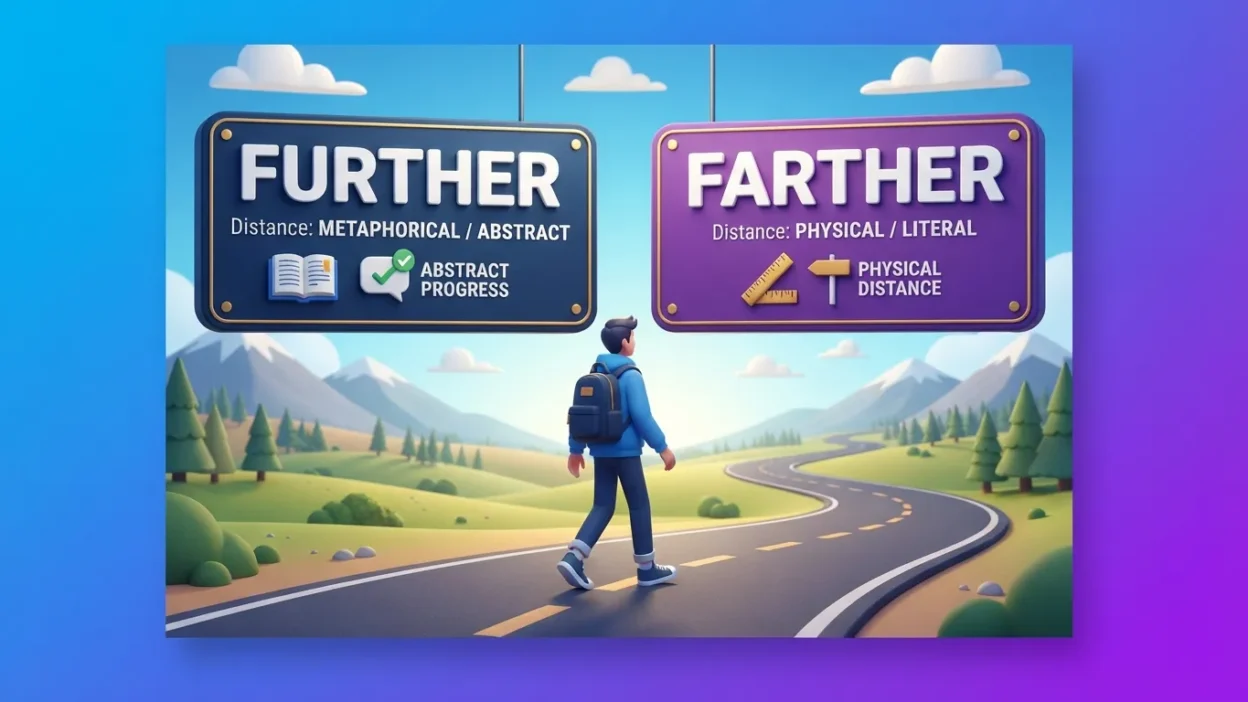
Further vs Farther is clearer when farther describes physical distance, while further often means figurative distance, extra information, or progress. These commonly confused words have a simple distinction, but the rule is not absolute.
Farther commonly points to physical distance, while further can express figurative distance, extra information, or progress. Usage guides, including Merriam-Webster, explain that these words have historically been interchangeable in some uses of distance.
Therefore, the preferred choice can depend on the exact context, rather than one fixed rule. Looking closely at these words makes their word meaning easier to understand and also shows why English has some useful exceptions.
The word further has several roles in grammar. As an adverb, its adverb meaning can express moreover or a greater extent. As an adjective, its adjective sense can mean additional, while as a verb, it can mean to advance something, as in further one’s career or support further career development.
Farther is more closely associated with measurable physical space, although further also appears in physical distance usage. This distinction becomes easier when we separate physical and figurative meanings instead of treating X and Y as completely different words.
Historically, these pairs of words, further and farther, have caused questioning because their meanings can overlap. When the difference is inspected closer, distance usage does not always create a strict dividing line. The adverb, adjective, and verb usage of further gives it a wider range, while farther can give readers a clearer sense of actual distance.
From my experience teaching English learners, this practical distinction is easier to remember than trying to memorize every rule: use farther for clear physical distance and further for additional or figurative meaning, while remembering that language naturally allows some overlap.
Quick Answer
Farther usually refers to physical or measurable distance: “The park is farther away.” Further usually means additional, more, or to a greater extent: “We need further discussion.” When talking about physical distance, farther is the safest traditional choice.
Why People Confuse It
People confuse further and farther because both words are connected to the idea of going beyond something. They also sound similar and can sometimes be used interchangeably in modern English.
The easiest distinction is:
- Farther = physical or measurable distance
- Further = additional, figurative, or abstract distance
For example:
- “The second village is farther away.” → physical distance
- “We need further information.” → additional information
However, this is a useful guideline rather than an absolute rule. In everyday English, especially American English, further can also be used for physical distance.
First Word: Further
Further can mean additional, more, or to a greater degree. It is often used when the idea is not about a physical distance that can be measured.
Examples of Further
- We need further information.
- Please contact us for further details.
- The teacher explained the topic further.
- Nothing could be further from the truth.
- We need to discuss this further.
Further can also work as a verb:
“The new policy could further improve education.”
Here, further means to advance, promote, or help something develop.
Second Word: Farther
Farther traditionally refers to a greater physical distance. If you can imagine measuring the distance between two places, farther is usually the appropriate choice.
Examples of Farther
- My house is farther from the station.
- We walked farther than we planned.
- The blue car traveled farther than the red car.
- How much farther is the airport?
- The mountain is farther away than I expected.
A simple test is to ask: Can I measure the distance?
If the answer is yes, farther is often the natural choice.
Further vs Farther: Comparison Table
| Word | Main meaning | Typical use | Example |
| Further | Additional or more | Ideas, information, progress, discussion | We need further information. |
| Farther | Greater physical distance | Places, travel, measurable distance | The store is farther away. |
| Further | To a greater extent | Abstract situations | Let’s discuss this further. |
| Farther | Beyond a physical point | Movement or location | We walked farther down the road. |
When to Use Each
Use Further for Additional Information
Use further when you mean “additional” or “more.”
Please provide further details.
Here, you are not talking about physical distance. You are asking for more details.
Use Farther for Physical Distance
Use farther when talking about measurable physical distance.
The next town is farther than this one.
The distance between the towns can be measured, so farther fits naturally.
Use Further for Abstract Ideas
Use further with concepts, discussions, explanations, research, and progress.
We need to investigate the matter further.
You cannot measure the “distance” of an investigation in miles or kilometers. The word means to a greater extent.
Use Further for “Additional”
A very common use is:
For further information, contact the office.
Here, further information means additional information.
10+ Examples of Further vs Farther
- The library is farther from my house than the school.
- We need further evidence before making a decision.
- How much farther do we have to walk?
- Let’s discuss the problem further.
- She lives farther away than I do.
- Please read the report for further details.
- The runner went farther than everyone expected.
- We cannot go any farther without stopping.
- The teacher gave us further instructions.
- His argument could not be further from the truth.
- The bus stop is farther down the street.
- The company plans to further improve its services.
Common Mistakes
Mistake 1: Using Farther for Additional
Incorrect:
We need farther information.
Correct:
We need further information.
“Information” is not physical distance, so further is the natural choice.
Mistake 2: Using Further for Every Physical Distance
While modern English often accepts further for physical distance, farther remains a clear traditional choice.
We walked farther than yesterday.
This makes the physical-distance meaning immediately clear.
Mistake 3: Confusing “Further Details”
Further details means additional details, not details that are physically farther away.
For further details, please contact the office.
Mistake 4: Thinking the Rule Has No Exceptions
The distinction is useful, but real English usage is flexible. Further can sometimes describe physical distance, particularly in everyday modern English.
Memory Trick
Use this simple trick:
Farther = Far + physical distance
Both far and farther are strongly associated with physical distance.
Further = More
If you can replace the word with additional, more, or to a greater extent, choose further.
For example:
We need further explanation.
= We need more explanation.
The hotel is farther away.
= The hotel is at a greater physical distance.
American vs British English
The distinction between further and farther is generally recognized in both American and British English.
The traditional guideline is similar in both varieties: farther is associated with physical distance, while further is preferred for additional or figurative meanings.
However, further is also widely used for physical distance in modern English. This means you may encounter sentences such as:
“Nothing could be further from the truth.”
and physical-distance uses such as:
“We traveled further north.”
So, if you are learning English, the traditional rule is a useful starting point, but you should also recognize that actual usage can be more flexible.
Similar Words
Several words are related to further and farther:
- Far — at or to a great distance
- Further — additional or to a greater extent
- Farther — at or to a greater physical distance
- Furthermore — in addition; also
- Additional — extra or more
- Beyond — farther than or outside a particular limit
- Advance — to move forward or make progress
- Extend — to make something longer or larger
Remember that furthermore is a separate word. It means “in addition” and is not a comparative form of farther.
Final Verdict
The simplest traditional distinction is this:
Farther is mainly used for physical or measurable distance, while further is mainly used for additional, abstract, or figurative meanings.
When you are unsure, ask yourself whether you are talking about actual distance. If you are, farther is usually the clearest choice. If you mean “more,” “additional,” or “to a greater extent,” choose further.
FAQs
Is farther only used for physical distance?
Traditionally, farther is used for physical or measurable distance. For example, “The airport is farther away.” This is the clearest use of the word.
Is further correct for physical distance?
Yes. Further is commonly used for physical distance in modern English, although farther is often preferred when you want to clearly emphasize measurable physical distance.
What is the difference between further and farther?
Farther traditionally refers to physical distance, while further usually refers to additional information, greater extent, progress, or abstract distance.
Is it further information or farther information?
The correct expression is further information. Here, “further” means additional or more information.
Is it farther away or further away?
Both expressions occur in English. Farther away is traditionally preferred when referring specifically to physical distance, while further away is also widely used.
Which is correct: further discussion or farther discussion?
Further discussion is correct. It means additional discussion or continuing the discussion.
Can further and farther be interchangeable?
Sometimes, particularly when referring to physical distance. However, they are not interchangeable in every context. Further information and further discussion are standard expressions.
Is farther more formal than further?
No. The difference is mainly about meaning and usage, not formality. Both words are normal English words used in formal and informal writing.
Remember This
Farther = physical distance
Further = additional or abstract meaning
Think:
Farther → far → physical distance
Further → further information → more/additional
This simple distinction will help you choose the right word in most everyday situations.
Conclusion
The difference between further vs farther becomes easier once you focus on meaning. Use farther when you are talking about physical or measurable distance, and use further when you mean additional information, greater extent, progress, or an abstract idea.
Modern English does allow some overlap, especially with physical distance, so you may see further used where traditional grammar would prefer farther. For clear writing, however, the traditional distinction is a useful and dependable guideline.

Kalven Driost works on the Wordifs site producing reliable content while communicating through wordifs@gmail.com to support research editing publishing consistency transparency and audience focused knowledge sharing practices for modern readers.