Then vs Than can be confusing because both words have a similar spelling, but their meanings and uses are different.
The words Then and Than are frequently confused because they are only one letter apart and may be pronounced in the same way.
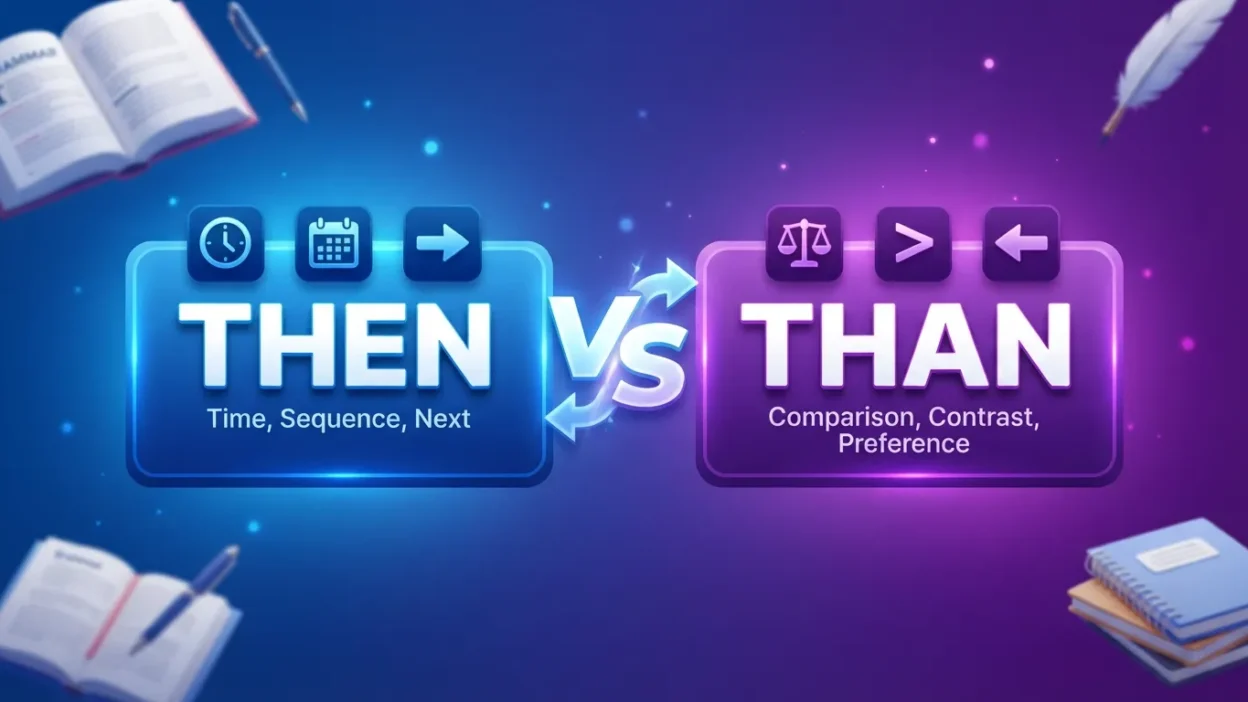
Still, they should be distinguished by their role in a sentence. Then is connected with time, while Than is used for comparison and comparisons.
For example, younger than I am and taller than me are phrases that compare people. From my experience teaching English, I have found that learners understand this difference more easily when they connect each word with its main purpose.
Back then, someone may have lived in Idaho, and we’ll wait until then before discussing that time again. These words look similar, but they serve a different purpose.
A useful way to remember them is to notice the phrases and identify whether they show a comparison or describe when something happened.
When you are talking about time, Then is the natural choice. This simple distinction keeps these commonly confused words clear.
Quick Answer
Then is used mainly for time, sequence, and results: “We ate dinner, then went home.” Than is used for comparisons: “This book is better than that one.” Remember: then = when/next, while than = comparison.
Why Do People Confuse Then and Than?
People often confuse then vs than because the words look and sound very similar, especially in fast speech. Both are short, common words, and the difference between them is just one letter.
Their meanings, however, are different:
- Then = at that time, next, afterward, or in that case
- Than = used to compare two or more things
A useful way to identify the correct word is to look at the meaning of the sentence. If you are talking about time or order, choose then. If you are making a comparison, choose than.
What Does “Then” Mean?
Then is an adverb that commonly refers to a particular time, sequence, or consequence. It can mean “at that time,” “next,” or “in that case,” depending on the sentence.
Examples of “Then”
- I was living in London then.
- First, wash your hands, then eat.
- We finished the meeting and then went home.
- If you are ready, then we can begin.
- She was younger then.
In these examples, then does not compare two things. Instead, it gives information about when something happened, what happens next, or what follows from a condition.
What Does “Than” Mean?
Than is mainly used to introduce the second part of a comparison. It commonly appears after comparative words such as better, bigger, smaller, faster, taller, older, more, and less.
Examples of “Than”
- My car is faster than yours.
- This test is easier than the last one.
- Ali is taller than his brother.
- I would rather walk than wait.
- She has more experience than I do.
When you see a comparison between two people, objects, qualities, quantities, or actions, than is usually the correct choice.
Then vs Than: Comparison Table
| Word | Main Meaning | Common Use | Example |
| Then | At that time, next, afterward | Time, sequence, result | Finish this, then call me. |
| Than | Used for comparison | Comparing people or things | She is taller than me. |
The easiest distinction is then = time or sequence and than = comparison.
When Should You Use “Then”?
Use then when you are talking about:
1. A sequence
- First, read the question, then write your answer.
- Take a shower, then get dressed.
2. A past or specific time
- I lived there then.
- Things were different then.
3. A result or consequence
- If you know the answer, then tell us.
- If you finish early, then you can leave.
4. The next event
- We had lunch and then went shopping.
- She called me and then sent an email.
When Should You Use “Than”?
Use than when you are making a comparison.
1. Comparing people
- John is older than David.
- Emma runs faster than her sister.
2. Comparing things
- This phone is cheaper than that one.
- Winter is colder than autumn.
3. Comparing amounts
- I have more books than you.
- There were fewer students than expected.
4. Comparing actions or choices
- I would rather stay home than go outside.
- She works harder than I do.
10+ Examples of Then vs Than
- Finish your work, then take a break.
- My brother is taller than me.
- We went to the store and then came home.
- This problem is harder than the first one.
- I was much younger then.
- Sarah has more books than Tom.
- First, add the flour, then mix the ingredients.
- Today is warmer than yesterday.
- If you are tired, then go to bed.
- She arrived earlier than I expected.
- He ate dinner and then watched a movie.
- This road is longer than the other road.
- I would rather study than fail the exam.
- We talked for a while and then left.
- Your new laptop is faster than your old one.
Notice the pattern: sentences about order or time use then, while sentences involving comparison use than.
Common Mistakes With Then and Than
One of the most common mistakes is using then after a comparative adjective.
❌ She is taller then me.
✅ She is taller than me.
Another common mistake is using than when describing what happens next.
❌ First, finish your homework than go outside.
✅ First, finish your homework, then go outside.
A quick check can help: ask yourself whether the sentence involves comparison. If yes, use than. If it describes time, order, or a result, use then.
Memory Trick for Then vs Than
Use this simple memory trick:
THEN = T for Time
If the sentence is about time, sequence, or what happens next, think then.
THAN = A for comparison
If you are comparing two things, think than.
For example:
- First this, then that.
- Bigger than this.
- Earlier then, but faster than before.
Then vs Than in American and British English
The basic distinction between then and than is the same in both American and British English. Both varieties use then for time or sequence and than for comparisons.
For example, both American and British speakers would write:
- “She is older than her brother.”
- “We ate dinner and then went home.”
The difference is therefore not a matter of American versus British spelling. It is a difference in meaning and grammatical use.
Similar Words to Then and Than
Several related words can appear in similar contexts, but they do not have exactly the same meaning.
Words related to “Then”
- Next — refers to what follows
- Afterward — means after something happens
- Later — refers to a subsequent time
- Previously — refers to an earlier time
Words related to “Than”
- Compared with — introduces a comparison
- Rather than — expresses a preference or alternative
- More than — expresses a greater amount or degree
- Less than — expresses a smaller amount or degree
Understanding these related expressions can make the difference between then and than easier to recognize.
Final Verdict:
Choose then when your sentence is about time, sequence, what happens next, or a consequence. Choose than when your sentence compares two people, things, amounts, qualities, or actions.
The simplest rule is: then = time/order; than = comparison. Once you connect each word with its main purpose, choosing the correct one becomes much easier.
Frequently Asked Questions
Is it “better then” or “better than”?
The correct expression is “better than” because it compares two things or situations. For example: “This book is better than the other one.”
Is it “first then” or “first than”?
The correct phrase is “first, then” when describing a sequence. For example: “First, finish your homework, then clean your room.”
What is the easiest way to remember then vs than?
Remember THEN = time and THAN = comparison. If you can replace the word with “next” or “at that time,” then is probably correct. If you are comparing something, use than.
Is “than” only used with adjectives?
No. Than can be used in comparisons involving adjectives, adverbs, quantities, nouns, and choices. For example, “She has more books than I do” and “I would rather walk than drive.”
Can “then” mean “in that case”?
Yes. Then can introduce a result or consequence. For example: “If you already finished, then you can leave.”
Is “then” a comparison word?
No. Then is generally used for time, sequence, or consequence. The standard comparison word is than.
Why do then and than sound so similar?
They have similar spellings and are pronounced similarly in many varieties of English, especially in quick speech. Their meanings and grammatical functions are what distinguish them.
Remember This
Then = time, sequence, or result.
Than = comparison.
Think:
First → then → next
Bigger → than → smaller
If you are talking about when or what happens next, use then. If you are comparing two things, use than.
Conclusion
The difference between then and than is simple once you focus on meaning. Then connects ideas involving time, order, or consequences, while than introduces comparisons. These words may look and sound similar, but they perform different jobs in a sentence.
When you are unsure, stop and ask what your sentence is doing. If it shows what happened next or refers to a time, choose then. If it compares people, objects, amounts, or actions, choose than. With this quick test and a little practice, you can avoid this common English mistake.

Orvian Treloux works on the Wordifs site developing structured blogs coordinating via wordifs@gmail.com to ensure accuracy originality clarity usefulness engagement and long term trust among global readers across digital platforms.