There vs Their vs They’re can confuse English language learners, new students, and other learners because these words are tricky, puzzling, and sound alike when spoken aloud.
These homophones, sometimes discussed with homonyms, have different meanings and spelling, so learners may mix up them even when their pronunciation sounds the same.
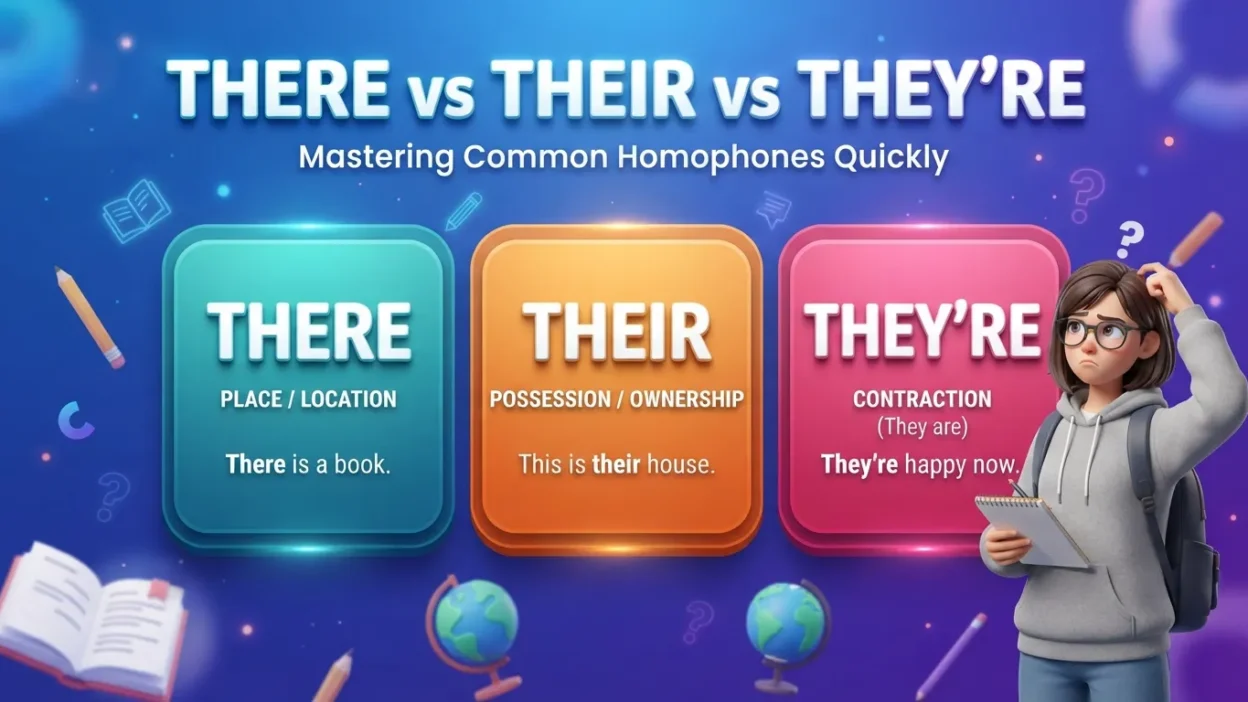
In my experience teaching English grammar, the easiest approach is to focus on the differences between each word and understand its specific role. There usually relates to a place, their shows possession, and they’re is a contraction meaning “they are”.
This simple connection helps students identify the correct form and understand the language more naturally. These commonly confused words are also commonly misspelled words, which can lead to confusion, frequent mistakes, and even linguistic blunders that become grammar pet peeves.
As a comprehensive resource, this explanation gives learners a clear way to recognize these misused words without making English grammar unnecessarily difficult.
Quick Answer
There refers to a place or introduces something: “Put it over there.” Their shows that something belongs to them: “That is their house.” They’re is short for “they are”: “They’re ready.” If you can replace the word with “they are,” use they’re.
Why People Confuse It
The main reason people confuse there, their, and they’re is that all three words are pronounced the same in standard English. Because they sound alike, it is easy to choose the wrong spelling when writing.
Their meanings are completely different:
- There → place or sentence introduction
- Their → possession or ownership
- They’re → “they are”
For example:
- “The students are there.” → refers to a place.
- “The students brought their books.” → shows ownership.
- “They’re studying.” → means “they are studying.”
What Does “There” Mean?
There is commonly used to talk about a place. It can also be used to introduce or point out something in a sentence.
There for a Place
Use there when you mean a particular location.
Examples:
- Your bag is over there.
- We waited there for an hour.
- She lives there.
- Please sit there.
- I left my phone there.
A useful test is to ask: “Does this sentence refer to a place?”
If yes, there may be the correct choice.
There to Introduce Something
“There” can also appear at the beginning of sentences such as:
- There is a problem.
- There are three students outside.
- There was a loud noise.
- There will be a meeting tomorrow.
In these sentences, there does not mean a specific physical place. It helps introduce the existence or presence of something.
What Does “Their” Mean?
Their is a possessive determiner. It shows that something belongs to, is connected with, or is associated with they/them.
Examples:
- The students opened their books.
- The children finished their homework.
- The team celebrated their victory.
- They brought their own food.
- The workers returned to their office.
Think of their as answering the question: “Whose?”
For example:
The students brought their bags.
Whose bags? Their bags.
Their Can Refer to One Person
In modern English, their can also be used with a singular person when the person’s gender is unknown, irrelevant, or when that person uses they/them pronouns.
For example:
- Someone left their umbrella.
- Every student should bring their ID.
- If a customer has a question, their request should be answered.
What Does “They’re” Mean?
They’re is a contraction of “they are.”
The apostrophe replaces letters from the two-word expression.
They are → They’re
Examples:
- They’re happy. → They are happy.
- They’re coming soon. → They are coming soon.
- They’re ready. → They are ready.
- They’re my friends. → They are my friends.
- They’re working today. → They are working today.
The Easy Test for They’re
Replace they’re with they are.
If the sentence still makes sense, they’re is correct.
They’re going home.
Replace it:
They are going home.
The sentence works, so they’re is correct.
There vs Their vs They’re Comparison Table
| There | A place or existence | Location or introduction | Your shoes are over there. |
| Their | Belonging to them | Possession | They forgot their keys. |
| They’re | They are | Contraction | They’re waiting outside. |
The simplest way to remember the difference is:
There = place
Their = possession
They’re = they are
When to Use Each Word
Use “There” for a Place
Use there when you are pointing to or talking about a location.
The restaurant is over there.
You can also use it in expressions such as:
There are many options.
Use “Their” for Possession
Use their when something belongs to or is associated with someone.
The players wore their uniforms.
Ask yourself:
Whose uniforms? Their uniforms.
Use “They’re” for “They Are”
Use they’re when you mean they are.
They’re very excited.
Test it:
They are very excited.
It works, so they’re is correct.
10+ Examples of There, Their, and They’re
- Please put the books over there.
- The students are doing their homework.
- They’re waiting for the teacher.
- Look over there.
- The children brought their lunches.
- They’re planning a trip.
- There is a new shop nearby.
- The players packed their equipment.
- They’re ready to begin.
- We stayed there until evening.
- The workers returned to their offices.
- They’re interested in the new project.
- There are several reasons for the change.
- The birds built their nest in the tree.
- They’re going to arrive soon.
Common Mistakes With There, Their, and They’re
Mistake 1: Using “Their” for a Place
Incorrect:
Put your shoes over their.
Correct:
Put your shoes over there.
The word refers to a location, so use there.
Mistake 2: Using “There” for Possession
Incorrect:
The students opened there books.
Correct:
The students opened their books.
The books belong to the students, so use their.
Mistake 3: Using “Their” Instead of “They’re”
Incorrect:
Their going to the park.
Correct:
They’re going to the park.
Here, the meaning is “They are going,” so they’re is required.
Mistake 4: Forgetting the Apostrophe
Their and they’re are not interchangeable.
- their = belonging to them
- they’re = they are
The apostrophe in they’re is an important clue that the word is a contraction.
Memory Trick for There vs Their vs They’re
Use this three-part trick:
There → Here
Both there and here can refer to places.
Their → Heir
An heir can inherit something, so think about ownership.
They’re → They are
The apostrophe tells you that two words have been shortened.
So remember:
If you remember only one rule, remember the “they are” test. Whenever you see they’re, replace it with they are. If the sentence still makes sense, you have the right word.
American vs British English
The distinction between there, their, and they’re is essentially the same in American English and British English. All three spellings have the same basic grammatical functions in both varieties.
For example, both American and British English use:
- There for location or existence.
- Their for possession.
- They’re as the contraction of “they are.”
Pronunciation can vary somewhat by speaker or region, but the spelling distinction remains important in written English.
Similar Words
There, their, and they’re belong to a larger group of commonly confused English words.
Some related examples include:
- Your / You’re — possession vs. “you are”
- Its / It’s — possession vs. “it is” or “it has”
- Then / Than — time/order vs. comparison
- To / Too / Two — direction/infinitive vs. “also” vs. number
- Who’s / Whose — “who is” vs. possession
- Affect / Effect — commonly confused words with different grammatical uses
Learning these pairs and groups can make everyday writing much more accurate.
Final Verdict
The difference is simple once you focus on meaning:
- There is mainly about place or introducing something.
- Their is about possession or belonging to them.
- They’re means they are.
When you are unsure, ask yourself: Is it a place? Use there. Does something belong to them? Use their. Can I replace it with “they are”? Use they’re.
Frequently Asked Questions
Is “there” the same as “their”?
No. There usually refers to a place or introduces something, while their shows possession. For example, “The car is over there” refers to a location, while “That is their car” shows ownership.
Is “they’re” short for “their”?
No. They’re is short for “they are.” Their is a possessive word. For example, “They’re happy” means “They are happy,” while “Their house is large” shows possession.
How can I remember there, their, and they’re?
Remember: there = place, their = possession, and they’re = they are. You can also use the “they are” test whenever you are unsure about they’re.
What is the difference between “their” and “they’re”?
Their indicates possession, while they’re means “they are.” Compare: “They brought their bags” and “They’re carrying bags.”
Can “there” mean something besides a place?
Yes. There can introduce the existence or presence of something, as in “There is a problem” or “There are two books on the table.”
Is “their” always plural?
Not necessarily. Their can refer to a group of people, and it can also be used with a singular person in appropriate contexts, such as “Someone forgot their phone.”
Are there, their, and they’re homophones?
Yes. They are commonly treated as homophones because they have the same or very similar pronunciation in standard English, while their meanings and spellings differ.
Remember This
There = place → “The store is over there.”
Their = possession → “They lost their keys.”
They’re = they are → “They’re coming.”
If you can remember these three lines, you can avoid most mistakes involving there vs their vs they’re.
Conclusion
There, their, and they’re sound alike, but each word has a different purpose. Use there for a place or to introduce something, their to show possession, and they’re when you mean they are. Understanding the role of each word is more useful than trying to memorize isolated examples.
The fastest way to check your choice is to look at the meaning of the sentence. If it involves a location, think there. If something belongs to someone, think their. If you can substitute they are, choose they’re. With regular practice, this common English confusion becomes much easier to handle.

Zevran Callix works on the Wordifs site creating clear informative articles while collaborating through wordifs@gmail.com to maintain consistency quality research readability and reader focused blogging standards worldwide digital content platform.