
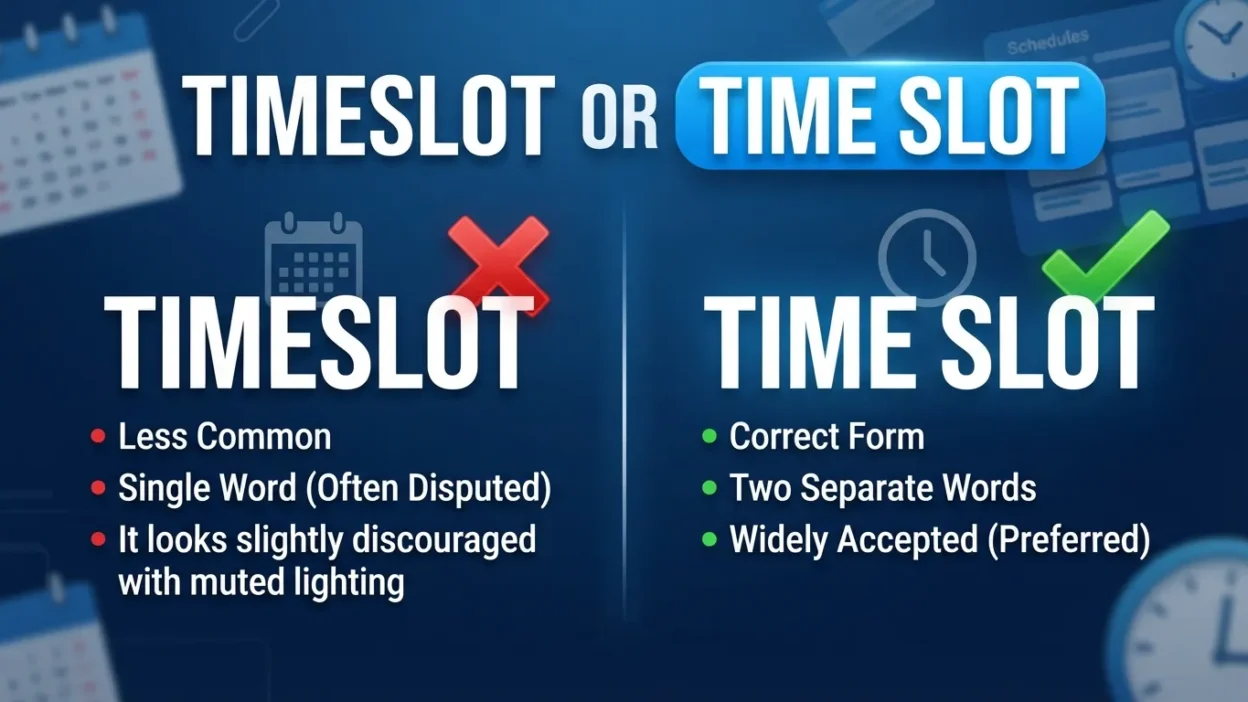
If you have ever paused while writing a calendar invitation, appointment notice, or work email to wonder whether timeslot or time slot is correct, you are not alone. Both forms appear in modern English, but one is much more widely accepted in standard writing.
The good news is simple: time slot is the safest and most widely recognized choice, especially in formal and professional English. Timeslot is also used, particularly in some technology, scheduling, and informal contexts, but it is generally less preferred as a standard spelling.
Quick Answer
Time slot is the standard two-word spelling and the best choice for most writing.
- Preferred: time slot
- Also seen: timeslot
- Meaning: A specific period of time reserved for an activity, appointment, event, or task
- Plural: time slots
- Example: “Please choose a time slot for your appointment.”
If you are writing an email, article, business document, school assignment, or professional message, time slot is the safest option.
What Does Time Slot Mean?
A time slot is a particular period of time set aside for something. It can refer to an appointment, meeting, television program, work task, class, interview, delivery, or another scheduled activity.
For example, a doctor’s office may offer several time slots during the day. A television station may have a particular time slot for a program. Similarly, a company might reserve a time slot for a team meeting.
The word slot suggests a designated opening or space. When combined with time, it describes a specific opening in a schedule.
For example:
“I booked a 2:00 p.m. time slot for my appointment.”
Here, time slot refers to the specific period reserved for the appointment.
Timeslot vs Time Slot: What’s the Difference?
The main difference is spelling rather than meaning. Both timeslot and time slot can refer to a scheduled period.
However, time slot is more established in general standard English and is the form most writers should choose.
| Form | Usage | Recommended? | Example |
| time slot | Standard two-word form | Yes | “Choose a time slot.” |
| timeslot | Closed compound form | Sometimes used | “Select your timeslot.” |
| time-slotted | Compound adjective/verb form in some contexts | Context-dependent | “The program was time-slotted for Friday.” |
The important point is that seeing timeslot online does not automatically make it the preferred spelling. English compounds often evolve from separate words into closed compounds, but dictionaries, style guides, and common usage do not always move at the same pace.
For everyday writing, time slot remains the clearer choice.
Why Is “Time Slot” Usually Preferred?
There are several reasons time slot works well in standard writing.
First, it is immediately understandable. Readers naturally recognize time and slot as two separate words describing a scheduled period.
Second, it is widely used in professional communication. You will commonly see it in appointment systems, calendars, customer-service messages, business correspondence, and scheduling instructions.
Third, it avoids unnecessary uncertainty. If you are unsure whether your audience prefers timeslot, using time slot is unlikely to cause confusion or look unusual.
For example:
Preferred:
“Please select an available time slot.”
Less conventional:
“Please select an available timeslot.”
Both communicate the same basic idea, but the first is generally the better choice for polished writing.
Timeslot or Time Slot in a Sentence
Here are some natural examples using time slot:
- “I reserved a time slot for the interview.”
- “Which time slot works best for you?”
- “The appointment time slot is no longer available.”
- “Please select your preferred time slot.”
- “We have an open time slot at 3 p.m.”
- “Each student was assigned a time slot.”
- “Can we move the meeting to another time slot?”
- “The delivery service gave me a two-hour time slot.”
- “There are only three time slots available today.”
- “Please arrive five minutes before your scheduled time slot.”
These examples show how naturally time slot fits into everyday and professional English.
When Should You Use “Timeslot”?
Although time slot is the safer standard form, timeslot does appear in real-world English.
It is particularly common in contexts involving technology, scheduling software, databases, and digital products. Some organizations may use timeslot as a preferred interface label or terminology.
For example, a scheduling application might internally use terms such as:
- available timeslot
- booking timeslot
- timeslot ID
- timeslot configuration
This does not necessarily mean that timeslot is the best choice everywhere. Software terminology can develop its own conventions.
If you are following a company’s internal style guide, use the spelling that the organization officially specifies. Otherwise, time slot is the more broadly suitable choice.
American vs British English: Timeslot or Time Slot
There is no major American-versus-British distinction that requires one variety of English to use timeslot and the other to use time slot.
In both American and British English, time slot is widely understandable and commonly used.
For example, American English might use:
“I need to find a time slot for the meeting.”
British English can use:
“I need to find a time slot for the meeting.”
The wording and spelling remain essentially the same.
Differences can arise because particular industries, publications, companies, or software systems adopt their own terminology. Therefore, regional English is usually less important here than context and house style.
Common Mistakes With Time Slot
1. Writing “timeslot” in formal writing
While timeslot is understandable, it may look less conventional in formal prose.
Better:
“Please choose a time slot.”
2. Using “time slot” when you mean an exact time
A time slot is usually a period or reserved window, not necessarily one exact moment.
For example:
- “The meeting starts at 2 p.m.” = exact time
- “The meeting has a 2–3 p.m. time slot.” = scheduled period
Using the correct term makes your scheduling information more precise.
3. Confusing “time slot” with “timeframe”
These words are related but not identical.
A time slot usually refers to a specific scheduled opening.
A timeframe generally refers to a broader period during which something is expected to happen.
For example:
“The interview has a 30-minute time slot.”
But:
“We expect the project to be completed within a three-month timeframe.”
4. Making the plural “times slots”
The plural of time slot is time slots, not “times slots.”
Correct:
“Several time slots are available.”
Incorrect:
“Several times slots are available.”
Time Slot vs Timeframe vs Appointment
These expressions are sometimes used interchangeably, but they have slightly different meanings.
Time slot means a designated period reserved for an activity.
Timeframe means a period within which something is expected or allowed to happen.
Appointment usually means an arranged meeting or visit at a particular time.
For example:
“Please select a time slot for your appointment.”
This sentence is perfectly natural because the appointment is the scheduled event, while the time slot is the period assigned to it.
How to Remember the Correct Spelling
A simple way to remember the preferred form is to think of time slot as two familiar words working together.
A slot can be an opening or designated space. A time slot is simply an opening in a schedule.
So when you are writing a sentence and hesitate between timeslot or time slot, choose:
time + slot = time slot
This is especially useful for formal emails, business communication, websites, academic writing, and customer instructions.
Is “Timeslot” Wrong?
Not necessarily.
Calling timeslot completely wrong would be too absolute because the closed form appears in contemporary English, especially in technical and organizational contexts.
The more useful distinction is standard preference versus contextual usage.
If your goal is clear, polished, broadly accepted English, use time slot.
If you are working with a specific software platform, company terminology, or publication that consistently uses timeslot, following that established terminology may be appropriate.
In other words, timeslot can be encountered in legitimate usage, but time slot is the better default.
FAQs
Is “time slot” one word or two?
Time slot is normally written as two words. It is the preferred form for most standard English writing.
Is “timeslot” grammatically correct?
Timeslot is used as a closed compound in some contexts, particularly technical and informal ones. However, time slot is generally the safer standard choice.
Which is correct: timeslot or time slot?
Both can be found in modern usage, but time slot is the more widely accepted and recommended form for general writing.
What is the plural of time slot?
The plural is time slots. For example: “Several time slots are available.”
Should I write “time slot” in a formal email?
Yes. Time slot is an excellent choice for formal emails, business documents, appointment notices, and professional communication.
Is “time slot” American or British English?
Time slot is used in both American and British English. There is no important regional spelling difference requiring one variety to use timeslot.
What is another word for time slot?
Depending on context, alternatives include scheduled period, appointment window, allotted time, available period, booking window, or simply scheduled time.
Is “timeslot” more common in technology?
It can be. Software, scheduling platforms, and technical documentation sometimes use timeslot as a closed compound. However, usage varies by product and organization.
Final Summary
When choosing between timeslot or time slot, time slot is the best default. It clearly describes a designated period reserved for an appointment, meeting, activity, broadcast, delivery, or other scheduled event. It is widely understood and works naturally in both American and British English.
Timeslot is not an incomprehensible or meaningless form; it appears in modern technical, digital, and organizational usage. However, unless a particular style guide or platform specifically prefers it, choose time slot for polished and broadly accepted English.
Actionable Takeaway
When you’re unsure, use time slot:
“Please choose an available time slot.”
It is clear, natural, professional, and appropriate for most situations.

Zevran Callix works on the Wordifs site creating clear informative articles while collaborating through wordifs@gmail.com to maintain consistency quality research readability and reader focused blogging standards worldwide digital content platform.