
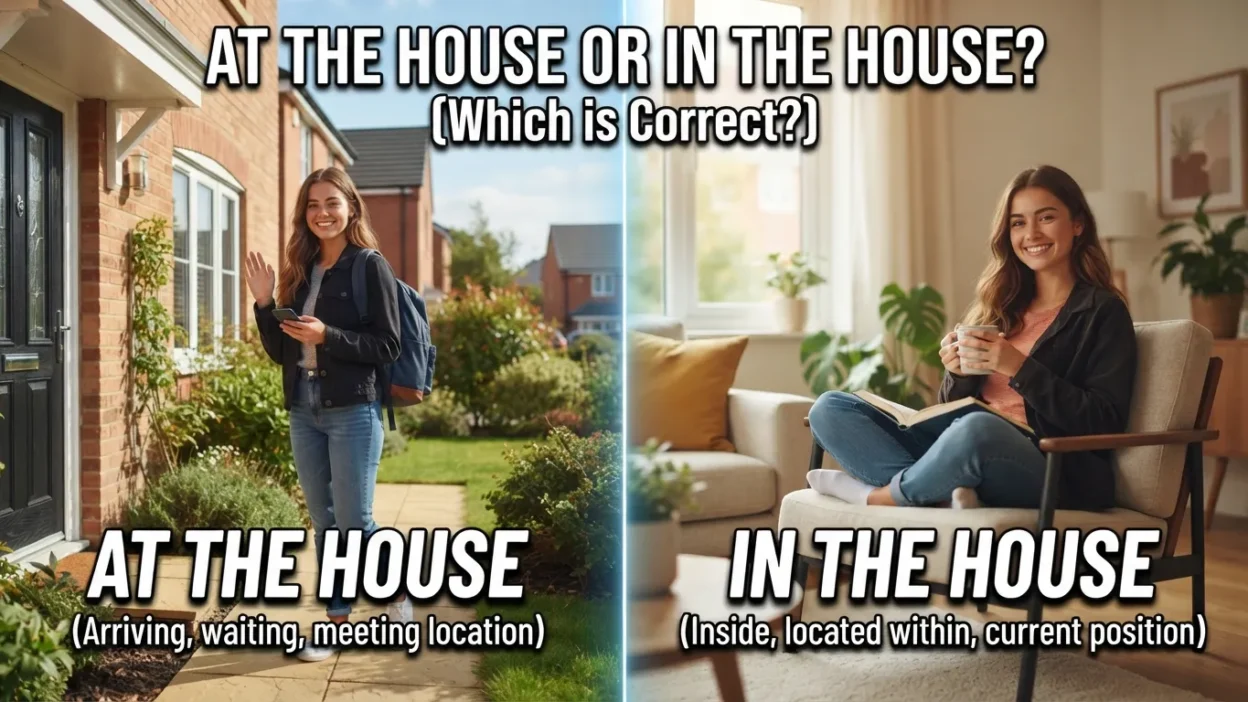
Choosing between “at the house” and “in the house” can be confusing because both expressions are grammatically correct. The difference is mainly about location and context. One usually points to a person’s location at or around a particular home, while the other specifically places someone or something inside the building.
The good news is that the distinction is easy to remember once you understand how English speakers use these phrases in everyday conversation. Whether you are writing an email, sending a text, or trying to improve your English grammar, this guide will help you choose the natural expression every time.
Quick Answer
Use “at the house” when you mean someone is at a particular house or its location, without emphasizing that they are physically inside the building.
Use “in the house” when you mean someone or something is inside the house.
- I’m at the house. → I am at that house/location.
- I’m in the house. → I am inside the house.
- She is waiting at the house. → She is at the property or location.
- She is waiting in the house. → She is inside the building.
In many situations, “at the house” is broader, while “in the house” gives a more specific idea of being indoors.
What Does “At the House” Mean?
“At the house” refers to being at a particular house, property, or residential location. It does not necessarily tell us whether the person is inside the building.
For example:
John is at the house.
This could mean John is inside, standing outside, working in the yard, sitting on the porch, or simply somewhere on the property.
The preposition “at” commonly identifies a general point or location. That is why English speakers use it for places such as:
- at home
- at school
- at work
- at the office
- at the house
- at the store
The focus is generally on where someone is, rather than their exact position within the location.
Examples of “At the House”
- My brother is at the house right now.
- We will meet at the house around six.
- The electrician is at the house today.
- I left my keys at the house.
- She is staying at her parents’ house.
- There are several people at the house.
Notice that none of these sentences necessarily emphasizes the inside of the building.
What Does “In the House” Mean?
“In the house” means inside the house or within the building. The preposition “in” is used when something or someone is enclosed by or physically within a space.
For example:
John is in the house.
This clearly suggests that John is inside the building rather than outside in the yard or driveway.
The expression can describe people, animals, objects, sounds, and activities.
Examples of “In the House”
- My children are in the house.
- There is someone in the house.
- I left my phone in the house.
- The dog is in the house.
- It is warm in the house.
- We heard a strange noise in the house.
- Everyone is in the house because it is raining.
Here, the important idea is inside the physical structure.
At the House vs. In the House: Comparison
| Expression | Main Meaning | Focus | Example |
| At the house | At the house/location | General location | I’m at the house. |
| In the house | Inside the house | Interior location | I’m in the house. |
| At my house | At my home/location | General location | Come meet me at my house. |
| In my house | Inside my home | Interior space | There are guests in my house. |
A useful rule is:
At = general location
In = inside a space
This is not an absolute rule for every use of at and in, but it works very well for this particular distinction.
When Should You Use “At the House”?
Choose “at the house” when the exact indoor or outdoor position does not matter.
For example:
“The plumber is at the house.”
The sentence tells us that the plumber has arrived at the property. We do not need to know whether the plumber is currently in the kitchen, on the porch, or outside near the driveway.
Similarly:
“I’ll see you at the house.”
This means the house is the meeting location. It does not specifically say that you will meet inside.
You can also use “at the house” when talking about an activity connected with a particular property:
- The workers are at the house.
- We are having a party at the house.
- Someone is waiting at the house.
- The police arrived at the house.
When Should You Use “In the House”?
Use “in the house” when being inside is important to the meaning.
For example:
“The kids are in the house.”
This distinguishes them from children who might be outside.
Likewise:
“I think I left my wallet in the house.”
The speaker believes the wallet is somewhere inside the building.
More examples include:
- There is food in the house.
- Nobody is in the house.
- We stayed in the house all afternoon.
- I heard music in the house.
- The cat is sleeping in the house.
The expression is particularly useful when contrasting inside and outside.
The children are playing outside, but their parents are in the house.
“At the House” vs. “At Home”
Another common source of confusion is the difference between “at the house” and “at home.”
“At home” normally refers to someone being in their own home or usual residence.
- I’m at home.
- She stayed at home today.
“At the house” usually identifies a particular house, often one that has already been mentioned or is understood from context.
- I’m at the house.
- I’m at my grandmother’s house.
For example, imagine a contractor asks where you are. You might say:
I’m at the house.
This can mean you are at a particular property where work is taking place.
If someone asks whether you have returned from work, you might naturally say:
I’m at home.
The context determines which expression sounds most natural.
Common Mistakes to Avoid
Mistake 1: Thinking “At” Always Means Outside
It is incorrect to assume that “at the house” means someone must be outside.
At identifies a location broadly. Someone can be inside a house and still be described as being at the house.
For example:
The contractor is at the house.
The contractor could be working inside.
Mistake 2: Thinking “In the House” Is Always Better
“In the house” is not a universal replacement for “at the house.”
If you are describing a meeting point or someone’s general location, “at the house” may be more natural.
Compare:
- Meet me at the house. → The house is the meeting location.
- Meet me in the house. → Meet me inside the building.
The second sentence is more specific.
Mistake 3: Confusing “In the House” With “At Home”
These expressions are related but not identical.
At home focuses on someone’s home or residence.
In the house focuses on being physically inside a house.
For instance:
I’m at home, but I’m sitting in the garden.
The speaker is at home but not necessarily inside the house.
American vs. British English
The distinction between “at the house” and “in the house” generally works the same way in American and British English.
Both varieties use at for a general location and in for an interior location.
However, there can be differences in how frequently certain phrases are used depending on the situation, region, and speaker.
In everyday American English, “at the house” is common when referring to a particular property or meeting location:
I’ll be at the house this afternoon.
British English speakers can use the same construction:
I’ll be at the house this afternoon.
There is therefore no major American-versus-British grammar rule that makes one phrase correct and the other incorrect. Context is more important than dialect.
More Real-Life Examples
Here are some examples showing how a small change in preposition changes the meaning:
1. “She is at the house.”
She is at that location, but we do not know exactly where.
2. “She is in the house.”
She is specifically inside the building.
3. “We met at the house.”
The house was the meeting location.
4. “We met in the house.”
The meeting happened inside the building.
5. “There are workers at the house.”
Workers are present at the property.
6. “There are workers in the house.”
The workers are inside the building.
7. “He is waiting at the house.”
He is waiting at that location.
8. “He is waiting in the house.”
He is waiting indoors.
How to Remember the Difference
Think of “at” as a point on a map and “in” as being inside a container.
If you are identifying the house as a location, use at:
I’m at the house.
If you are identifying the interior of the house, use in:
I’m in the house.
This simple mental picture makes the distinction much easier.
You can apply the same idea to other expressions:
- at the building → general location
- in the building → inside the building
- at the office → at the workplace
- in the office → inside the office
- at the store → at the store/location
- in the store → inside the store
Frequently Asked Questions
Is “at the house” grammatically correct?
Yes. “At the house” is grammatically correct and commonly used when referring to a particular house or property as a location.
Is “in the house” grammatically correct?
Yes. “In the house” is also grammatically correct. It specifically indicates that someone or something is inside the house.
What is the difference between “at the house” and “in the house”?
“At the house” describes a general location, while “in the house” specifically means inside the building.
Can someone be “at the house” and “in the house” at the same time?
Yes. If someone is physically inside a particular house, they can accurately be described as being at the house and in the house. The first is broader; the second is more specific.
Should I say “at my house” or “in my house”?
It depends on what you mean. Use “at my house” for the general location and “in my house” when emphasizing the interior.
- Come to my house.
- There is a strange smell in my house.
Is “at the house” the same as “at home”?
Not necessarily. “At home” usually means at your own residence, while “at the house” generally refers to a particular house or property.
Which phrase is more common: “at the house” or “in the house”?
Neither is universally more correct. They serve different purposes. “At the house” is used for a general location, while “in the house” specifies an interior location.
Does American English use these phrases differently from British English?
The basic distinction is essentially the same in both varieties. American and British English both use at for a general location and in for an interior space.
Summary
The choice between “at the house” and “in the house” depends on the location you want to communicate. “At the house” gives a broader sense of being at a particular property or location, while “in the house” clearly places someone or something inside the building.
When you are unsure, ask yourself what information matters. If you are simply identifying where someone is, use at. If you need to emphasize that the person or object is inside, use in. This distinction works naturally in everyday American and British English.
Actionable Takeaway
Remember this quick formula:
At the house = at the location
In the house = inside the building
So, say “I’m at the house” when the house is the general location, and say “I’m in the house” when you specifically mean that you are indoors.


