
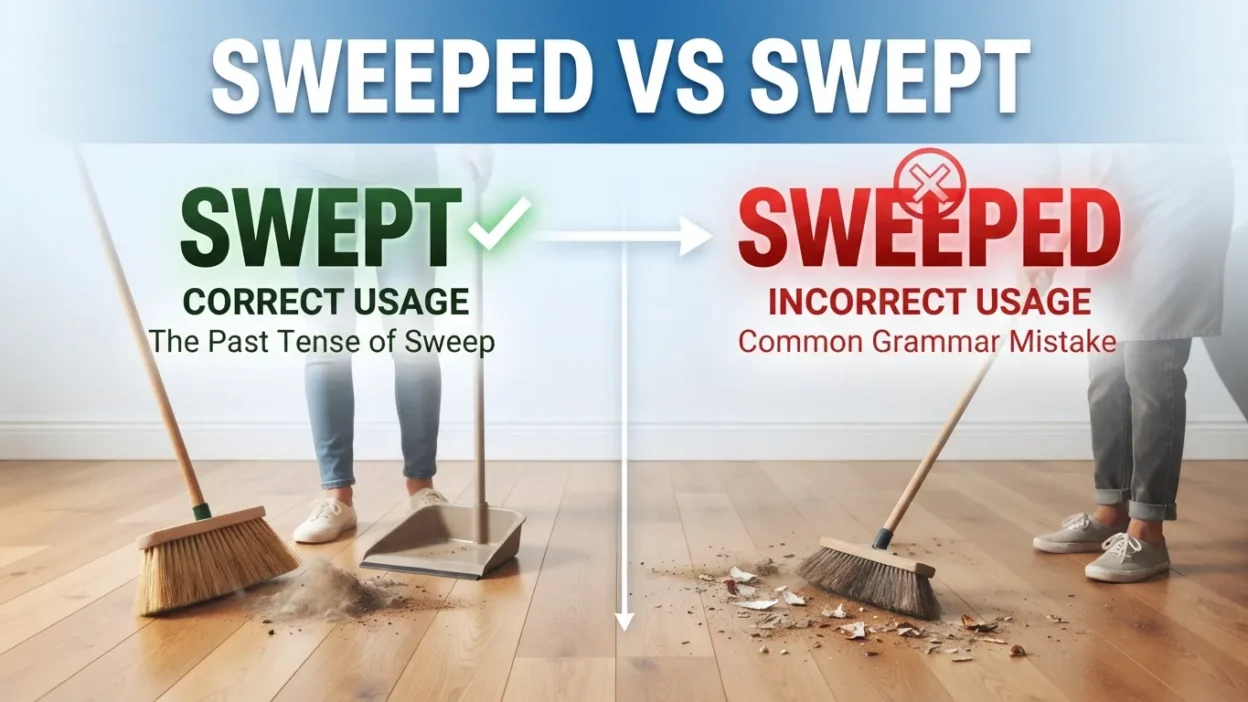
If you are unsure whether to say “sweeped” or “swept,” you are not alone. The confusion happens because many English verbs form their past tense by adding -ed, while sweep follows a different pattern.
The correct past tense and past participle of sweep is swept, not sweeped. Once you learn this irregular verb pattern, the difference becomes easy to remember and use naturally in everyday English, writing, and conversation.
Quick Answer
Swept is the correct past tense and past participle of sweep.
- Present: sweep
- Past: swept
- Past participle: swept
- Incorrect: sweeped
Examples:
- I swept the kitchen floor this morning.
- She has swept the entire hallway.
- The wind swept the leaves across the yard.
Although “sweeped” may seem logical because many regular verbs take -ed, it is not standard English.
Sweeped vs Swept: The Main Difference
The key difference is grammatical correctness.
Swept is an irregular verb form. It does not follow the regular pattern of adding -ed to the base verb. Instead, sweep changes to swept when used in the past tense and past participle.
| Form | Correct Word | Example |
| Base form | sweep | I sweep the floor every day. |
| Simple past | swept | I swept the floor yesterday. |
| Past participle | swept | I have swept the floor. |
| Incorrect past form | sweeped | I sweeped the floor. ❌ |
So, whenever you need the past form of sweep, use swept.
What Does “Sweep” Mean?
The verb sweep generally means to clean a surface by moving dirt, dust, leaves, or other material with a broom or similar tool.
For example:
Please sweep the floor before dinner.
However, sweep has several other meanings depending on context.
It can describe something moving quickly across an area:
A strong wind swept through the town.
It can also mean to win every part of a competition or series:
The team swept the championship series.
Another common use describes something spreading rapidly:
A wave of excitement swept through the crowd.
In each of these situations, the past form remains swept.
Why Is “Swept” Correct?
Sweep is an irregular English verb. Irregular verbs do not always form their past tense by simply adding -ed.
For regular verbs:
- walk → walked
- clean → cleaned
- jump → jumped
- wash → washed
But irregular verbs behave differently:
- sweep → swept
- keep → kept
- sleep → slept
- feel → felt
- leave → left
The spelling pattern can make sweeped look reasonable, but English grammar requires swept.
A useful way to remember it is to connect sweep with keep and sleep:
- sweep → swept
- keep → kept
- sleep → slept
These verbs share a similar vowel-change pattern in their past forms.
Examples of “Swept” in Sentences
Here are practical examples showing how swept works in different contexts.
Cleaning
- I swept the living room before the guests arrived.
- Maria swept the kitchen floor after breakfast.
- He swept the garage yesterday.
- We swept the porch because it was covered with leaves.
Wind and Weather
- The wind swept across the open field.
- A powerful storm swept through the region.
- Cold air swept into the room when the door opened.
Movement
- The dancer swept across the stage.
- The boat was swept toward the shore by the current.
- The curtain swept across the window.
Competition
- The team swept the three-game series.
- The candidate swept all major districts.
- The defending champions swept their opponents.
Figurative Meaning
- A feeling of relief swept over me.
- Excitement swept through the audience.
- Panic swept across the city after the announcement.
These examples demonstrate that swept works whether sweep refers to cleaning, movement, weather, competition, or an emotional reaction.
Swept as a Past Tense Verb
Use swept when describing an action that happened in the past.
For example:
I swept the floor after lunch.
The action happened in the past, so swept is the appropriate form.
More examples:
- She swept the stairs.
- They swept the courtyard.
- He swept the dirt outside.
- The wind swept through the trees.
You should not write:
I sweeped the floor yesterday. ❌
Instead:
I swept the floor yesterday. ✅
Swept as a Past Participle
Swept is also the past participle of sweep. This means it can be used with helping verbs such as has, have, had, was, and were, depending on the sentence structure.
Examples:
- I have swept the floor.
- She has swept the entire room.
- They had swept the area before we arrived.
- The streets were swept clean.
- The leaves had been swept into a pile.
Notice that the form remains swept. There is no standard form such as sweeped.
Common Mistakes With Sweeped vs Swept
The most common mistake is treating sweep as a regular verb.
Mistake 1: Using “sweeped” as the past tense
Incorrect:
I sweeped my bedroom yesterday.
Correct:
I swept my bedroom yesterday.
Mistake 2: Adding “-ed” after already using an irregular form
Incorrect:
She has sweeped the floor.
Correct:
She has swept the floor.
Mistake 3: Confusing “sweep” and “swept”
Use sweep for the present or base form:
I sweep the floor every morning.
Use swept for the past:
I swept the floor this morning.
Use swept after appropriate helping verbs:
I have swept the floor.
Sweep vs Swept vs Sweeping
It is also helpful to understand the other forms of the verb.
Sweep is the base form:
I sweep the floor every Saturday.
Swept is the simple past and past participle:
I swept the floor yesterday.
Sweeping is the present participle or gerund:
She is sweeping the kitchen.
So the basic pattern is:
sweep → swept → swept → sweeping
There is no standard sweeped form.
American vs British English
There is no meaningful American-versus-British English difference when it comes to the past tense of sweep. Both American English and British English use swept.
For example, these are correct in both varieties:
- I swept the floor.
- She has swept the hallway.
- The storm swept across the country.
Likewise, sweeped is not the standard past tense in either American or British English.
You may encounter unusual or nonstandard uses online, but standard dictionaries and formal English recognize swept as the past form.
How to Remember “Swept”
If you frequently forget whether sweep becomes swept or sweeped, use a simple memory trick.
Think of this group:
keep → kept
sleep → slept
sweep → swept
All three have a similar spelling change from -eep to -ept.
You can also remember this short sentence:
Yesterday, I swept the floor.
Whenever you are talking about something that happened in the past, swept should immediately come to mind.
Is “Sweeped” Ever Correct?
In standard modern English, sweeped is generally considered incorrect when you mean the past tense or past participle of sweep.
The standard forms are:
- sweep
- swept
- swept
- sweeping
If you are writing an email, school assignment, article, professional document, or other formal content, use swept.
Quick Comparison: Sweeped vs Swept
| Feature | Sweeped | Swept |
| Standard English? | No | Yes |
| Present tense | No | No |
| Simple past | No | Yes |
| Past participle | No | Yes |
| Used in American English | Nonstandard | Standard |
| Used in British English | Nonstandard | Standard |
| Example | I sweeped the floor. ❌ | I swept the floor. ✅ |
Frequently Asked Questions
Is “sweeped” a real word?
You may occasionally see sweeped in informal writing or online content, but it is not the standard past tense or past participle of sweep. The correct form is swept.
Is “swept” the past tense of sweep?
Yes. Swept is the simple past tense of sweep.
Example:
She swept the floor yesterday.
What is the past participle of sweep?
The past participle is also swept.
Example:
They have swept the room.
Is it “I sweeped the floor” or “I swept the floor”?
The correct sentence is:
I swept the floor.
Because sweep is an irregular verb, its past tense is swept, not sweeped.
Is “swept” used in American English?
Yes. Swept is the standard past-tense and past-participle form in American English.
Is “swept” used in British English?
Yes. British English also uses swept. There is no standard British alternative called sweeped.
Can “swept” describe something other than cleaning?
Absolutely. Swept can describe wind, water, movement, emotions, trends, and victories.
For example:
A wave of excitement swept through the crowd.
What are the three main forms of sweep?
The principal forms are:
sweep – swept – swept
The -ing form is sweeping.
Summary
When choosing between sweeped vs swept, always choose swept for the standard past tense and past participle of sweep. Although sweeped may look correct because many English verbs form their past tense with -ed, sweep is an irregular verb and changes to swept.
Whether you are talking about cleaning a floor, a storm moving across a region, an emotion spreading through a crowd, or a team winning every game in a series, the past form stays the same: swept. American and British English both use this form, so there is no regional variation to worry about.
Actionable Takeaway
Remember this four-form pattern:
Sweep → Swept → Swept → Sweeping
If your sentence describes something that already happened, use swept. Avoid sweeped in standard English, especially in formal, academic, professional, or published writing.

Kalven Driost works on the Wordifs site producing reliable content while communicating through wordifs@gmail.com to support research editing publishing consistency transparency and audience focused knowledge sharing practices for modern readers.