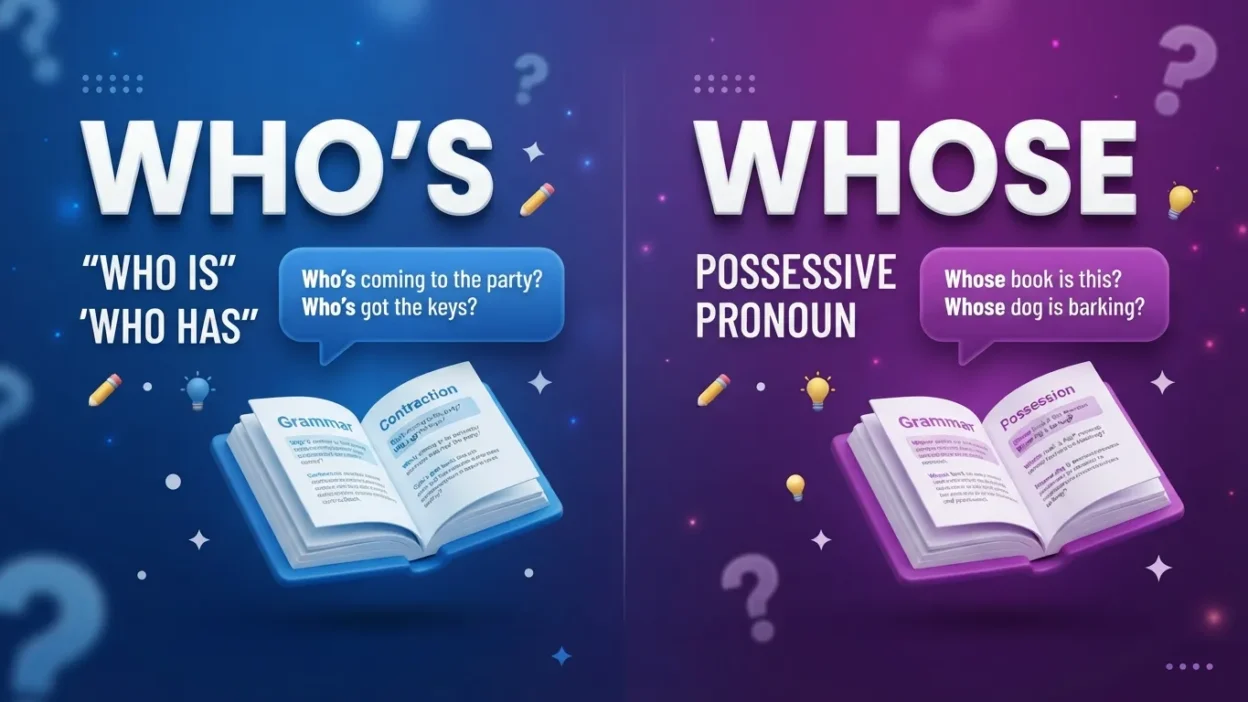
When learning Who’s vs Whose, start with a simple check: see whether who’s can become who is or who has in the sentence without changing its meaning. Who’s is a contraction, while whose is a possessive pronoun connected with possession and ownership.
For example, “Who’s calling your friend?” uses who is, while “Whose shoes are these?” is a question about belonging. Whose can also identify or specify a person or something, such as a doctor whose name I forget, or a book whose cover is torn.
In these examples, whose connects a person or thing with something related to them, while who’s describes who someone is or what they got.
A useful habit is to test the word before choosing it. If the sentence works with who is or who has, use who’s: “Who’s got the time?” means “Who has got the time?” If the sentence asks about ownership, identifying, or specifying who something belongs to, use whose.
This small test has helped me notice common mistakes, especially when someone writes quickly and hears both words as having the same sound.
Quick Answer
Who’s means who is or who has. Whose means belonging to whom or asks about ownership. Use “who’s” in sentences such as “Who’s ready?” and “Who’s finished?” Use “whose” in “Whose book is this?” and “Whose idea was it?”
Why Do People Confuse Who’s and Whose?
People often confuse these words because who’s and whose have very similar pronunciations. The apostrophe in “who’s” also makes it look like a possessive form, but it is actually a contraction.
The easiest way to separate them is to remember:
- Who’s = who is / who has
- Whose = possession or ownership
For example:
- Who’s at the door? → Who is at the door?
- Whose jacket is this? → The jacket belongs to whom?
First Word: Who’s
Who’s is a contraction. It can mean either who is or who has.
Who’s = Who Is
Use who’s when you can replace it with who is.
Examples:
- Who’s your teacher? → Who is your teacher?
- Who’s coming with us? → Who is coming with us?
- Who’s responsible for this? → Who is responsible for this?
Who’s = Who Has
“Who’s” can also mean who has, especially when “has” is helping form a verb.
Examples:
- Who’s finished the assignment? → Who has finished the assignment?
- Who’s seen my keys? → Who has seen my keys?
- Who’s already eaten? → Who has already eaten?
Second Word: Whose
Whose is used to show or ask about possession. It means belonging to whom.
Examples:
- Whose bag is this?
- Whose car is parked outside?
- Whose idea was that?
- Whose keys are on the table?
“Whose” can also appear without a noun when the meaning is already clear:
- Whose is this?
- Whose are these?
Who’s vs Whose: Comparison Table
| Word | Meaning | Main Use | Example |
| Who’s | Who is | Contraction | Who’s at the door? |
| Who’s | Who has | Contraction | Who’s finished the work? |
| Whose | Belonging to whom | Possession | Whose phone is this? |
| Whose | Belonging to whom | Possessive question | Whose is this? |
When Should You Use Who’s or Whose?
Use who’s when the sentence makes sense with who is or who has.
Who’s coming tonight?
Who is coming tonight?
Use whose when you are asking about ownership or possession.
Whose laptop is this?
The laptop belongs to whom?
A useful test is to remove the contraction:
- If who is works → use who’s.
- If who has works → use who’s.
- If you are asking about ownership → use whose.
10+ Examples of Who’s and Whose
- Who’s calling you?
- Who’s your best friend?
- Who’s coming to dinner?
- Who’s responsible for this project?
- Who’s been using my computer?
- Whose book is on the desk?
- Whose shoes are these?
- Whose phone is ringing?
- Whose car is blocking the driveway?
- Whose idea was this?
- Who’s already finished the test?
- Whose turn is it?
- Who’s going to help us?
- Whose name is written here?
Common Mistakes With Who’s and Whose
Mistake 1: Using “who’s” for possession
❌ Who’s bag is this?
✅ Whose bag is this?
The sentence asks who owns the bag, so whose is correct.
Mistake 2: Using “whose” instead of “who’s”
❌ Whose coming to the party?
✅ Who’s coming to the party?
Here, “who’s” means who is.
Mistake 3: Thinking the apostrophe always means possession
An apostrophe can indicate possession in many English words, but who’s is different. It is a contraction of who is or who has.
Memory Trick for Who’s vs Whose
Remember this simple rule:
Who’s = Who is / Who has
Whose = Ownership
If you can replace the word with who is or who has, choose who’s. If the question is about who owns something, choose whose.
For example:
Who’s there? → Who is there?
Whose coat is this? → Who owns this coat?
Who’s vs Whose in American and British English
The distinction between who’s and whose is the same in both American and British English. Both varieties use who’s as a contraction of “who is” or “who has” and whose for possession.
The main difference between American and British English may appear in vocabulary, spelling, or pronunciation in other words, but it does not change the basic rule for who’s vs whose.
Similar Words
Several English words have similar-looking forms that can cause confusion:
- Who — asks about a person.
- Whom — traditionally used as the object of a verb or preposition.
- Whose — asks about possession.
- Who’s — contraction of “who is” or “who has.”
- Who’s — the same word as “who’s”; capitalization depends on its position in a sentence.
Compare:
- Who called you?
- Whom did you call?
- Whose phone is this?
- Who’s calling?
Final Verdict
The difference between who’s and whose is simple once you focus on meaning. Who’s is a contraction meaning who is or who has, while whose is used to ask about ownership or possession.
When you are unsure, try expanding who’s. If “who is” or “who has” fits naturally, use who’s. If the sentence asks who something belongs to, use whose.
Frequently Asked Questions
Is “who’s” short for “whose”?
No. Who’s is a contraction of who is or who has. Whose is a possessive word used to ask who owns something or who something belongs to.
Is “whose” possessive?
Yes. Whose is used to express or ask about possession. For example, “Whose jacket is this?” asks who the jacket belongs to.
Is “who’s” a possessive word?
No. Who’s is not possessive. It is a contraction of who is or who has.
How can I remember who’s vs whose?
Remember who’s = who is/who has and whose = ownership. Try expanding “who’s” in your sentence. If “who is” or “who has” works, “who’s” is correct.
Which is correct: “Who’s book” or “Whose book”?
“Whose book” is correct because the sentence asks who owns the book.
Which is correct: “Who’s coming” or “Whose coming”?
“Who’s coming” is correct because it means “Who is coming?”
Can “who’s” mean “who has”?
Yes. For example, “Who’s finished the assignment?” can be expanded to “Who has finished the assignment?”
Remember This
Who’s = who is / who has
Whose = possession
If you mean “who is” or “who has,” use who’s. If you mean “belonging to whom,” use whose.
Conclusion
The difference between who’s and whose comes down to contraction versus possession. Who’s replaces “who is” or “who has,” while whose asks about ownership. Once you learn this basic distinction, choosing the correct word becomes much easier.
When writing, use the replacement test whenever you hesitate. Try who is or who has for “who’s.” If neither works and you are asking who owns something, whose is the right choice.

Orvian Treloux works on the Wordifs site developing structured blogs coordinating via wordifs@gmail.com to ensure accuracy originality clarity usefulness engagement and long term trust among global readers across digital platforms.