For English learners and native speakers, You’re vs Your can create confusion in writing because both words sound the same in everyday pronunciation.
This is common on social media, where people quickly mix up the wrong word. Learning the difference between your or you’re helps improve clarity, grammar accuracy, and professionalism in everyday English.
A practical way to understand the difference is to learn each word’s grammar role. You’re means “you are,” while your shows possession or connection.
When helping learners, I find that checking the complete sentence and asking a simple question whether “you are” fits gives a useful explanation and supports correct usage.
With practice, this distinction can become second nature, strengthening written English, language, and everyday communication.
Quick Answer
You’re means “you are” and is used before a description, action, or condition. Your shows possession or connection and is usually followed by a noun. For example, “You’re ready” means “You are ready,” while “Your bag is ready” refers to the bag associated with you.
Why Do People Confuse You’re and Your?
People confuse you’re and your because they are pronounced the same in standard English. They are homophones, meaning they have different spellings and meanings but the same pronunciation.
The confusion becomes especially common in quick messages and informal writing. Because both words sound like “yor,” it is easy to choose the wrong spelling without checking the sentence.
The key difference is grammatical:
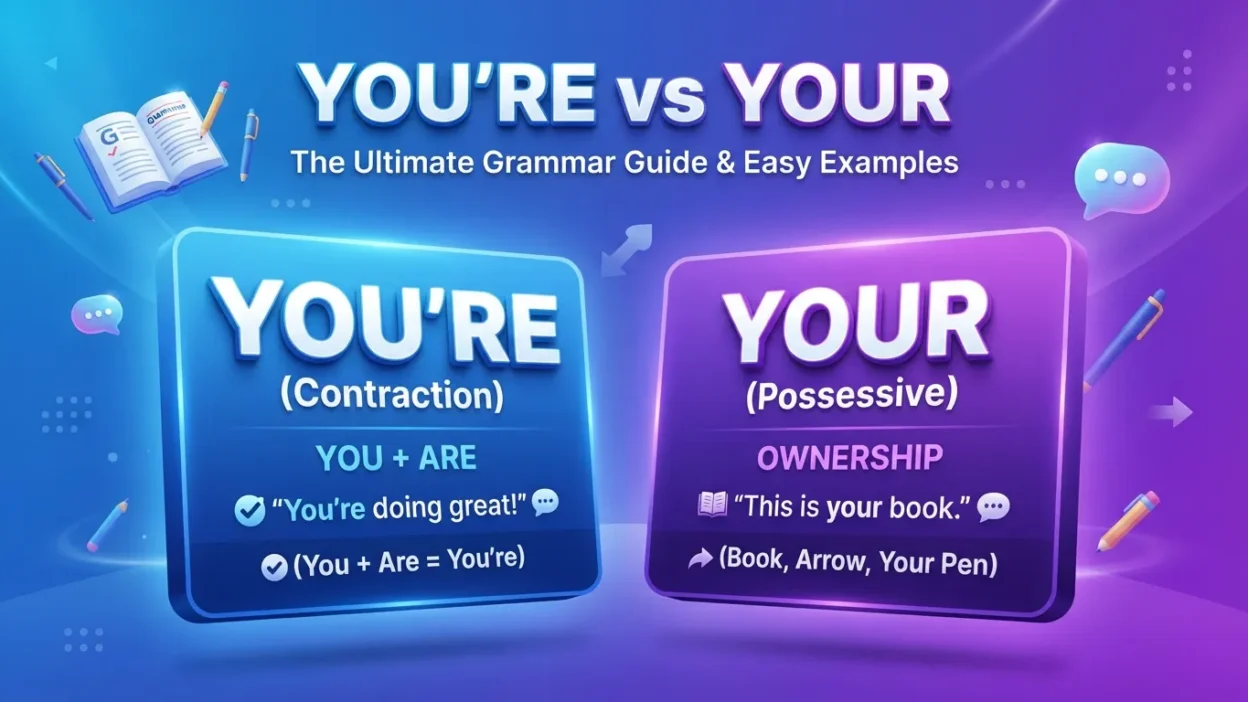
- You’re = you are
- Your = shows possession or connection
What Does “You’re” Mean?
You’re is the shortened form, or contraction, of you are.
It combines:
- you + are = you’re
Use you’re when you could replace it with you are without changing the meaning.
Examples
- You’re very helpful. → You are very helpful.
- You’re learning quickly. → You are learning quickly.
- You’re my best friend. → You are my best friend.
- You’re going to enjoy this movie. → You are going to enjoy this movie.
What Does “Your” Mean?
Your is a possessive adjective. It tells us that something belongs to, relates to, or is associated with the person being addressed.
It normally comes before a noun.
Examples
- Your phone is on the table.
- I like your idea.
- Where is your brother?
- Please bring your book.
In “your book,” the word your identifies whose book it is.
You’re vs Your: Comparison Table
| Word | Meaning | Grammar | Example |
| You’re | You are | Contraction | You’re very kind. |
| Your | Belonging or relating to you | Possessive adjective | I like your jacket. |
When Should You Use “You’re” or “Your”?
Use you’re when the sentence means you are.
You’re doing a great job.
You are doing a great job.
Use your when you are talking about something belonging to or connected with someone.
Your work is excellent.
A useful clue is what comes after the word. Your is commonly followed by a noun:
- your car
- your name
- your house
- your friend
- your answer
You’re, on the other hand, is often followed by an adjective, verb phrase, or other expression:
- you’re happy
- you’re running
- you’re correct
- you’re going home
10+ Examples of You’re and Your
- You’re doing really well.
- Is this your notebook?
- You’re always welcome here.
- I like your new shoes.
- You’re better at this than you think.
- What is your favorite color?
- You’re going to love this book.
- Please check your email.
- You’re the person I was looking for.
- I remember your name.
- You’re very good at explaining things.
- Where did you put your keys?
- You’re ready for the test.
- Everyone enjoyed your presentation.
Common Mistakes With You’re and Your
Mistake 1: Using “your” instead of “you’re”
Incorrect:
Your going to enjoy the trip.
Correct:
You’re going to enjoy the trip.
Why? “You’re” can be expanded to “you are”:
You are going to enjoy the trip.
Mistake 2: Using “you’re” before a noun
Incorrect:
I like you’re car.
Correct:
I like your car.
Here, your describes the noun “car.”
Mistake 3: Assuming “your” means “you are”
Remember that your does not mean “you are.” It shows possession or association.
Your answer is correct.
You cannot say:
You are answer is correct.
Therefore, your is the correct choice.
Memory Trick for You’re vs Your
Use the “you are” test.
Whenever you are unsure, replace the word with you are.
- You’re happy → You are happy ✓
- Your happy → You are happy ✗
Now try:
- Your car → You are car ✗
- You’re car → You are car ✗
Since neither sounds right, look at the intended meaning. If you mean a car belonging to or associated with someone, use your:
Your car is outside.
A simple rule to remember is:
You’re = you are
Your = belongs to you / relates to you
American vs British English
The distinction between you’re and your is the same in American and British English.
Both varieties use:
- you’re for you are
- your to show possession or association
The pronunciation is also generally the same, so the difference is primarily visible in writing.
Similar Words
You’re and your belong to a group of commonly confused English words.
Other examples include:
- they’re = they are
- their = belonging to them
- there = a place or position
- it’s = it is / it has
- its = belonging to it
- who’s = who is / who has
- whose = belonging to whom
Learning these pairs together can make English writing much easier.
Final Verdict
The difference is simple: you’re means “you are,” while your shows possession or a connection to someone.
When you can replace the word with “you are,” choose you’re. When the word describes something belonging to or associated with you, choose your.
Frequently Asked Questions
Is “you’re” the same as “your”?
No. You’re is a contraction of you are, while your is a possessive adjective used to show that something belongs to or is connected with you.
How can I remember the difference between you’re and your?
Use the “you are” test. If you can replace the word with “you are,” use you’re. Otherwise, if you are showing possession or association, use your.
Is “your” a possessive word?
Yes. Your is a possessive adjective. It indicates that something belongs to or is associated with the person being addressed, as in “your house” or “your opinion.”
Is “you’re” a contraction?
Yes. You’re is the contraction of you are.
Can “you’re” come before a noun?
Usually, you’re does not directly function as a possessive word before a noun. For example, “your car” is correct, not “you’re car.”
Are “you’re” and “your” pronounced the same?
Yes. In standard English, you’re and your are generally pronounced the same or very similarly, which is why they are frequently confused in writing.
Which is correct: “your welcome” or “you’re welcome”?
You’re welcome is correct. It means “you are welcome.”
Which is correct: “your right” or “you’re right”?
You’re right means “you are right.” Your right can be correct in a different context, such as “your right hand.”
Remember This
You’re = you are
Your = belongs to you / relates to you
If “you are” fits the sentence, use you’re. If you are describing something connected with or belonging to someone, use your.
Conclusion
Understanding you’re vs your becomes much easier once you focus on their grammatical roles rather than how they sound. You’re is simply a shortened form of “you are,” while your tells us that something belongs to or is associated with someone. Because the two words sound alike, checking the meaning of the sentence is more reliable than listening to the pronunciation.
Whenever you hesitate, try the “you are” test. If the sentence works with “you are,” choose you’re. If you are talking about a person’s possession, relationship, or connection to something, choose your. With regular practice, this common English confusion will become much easier to avoid.