While exploring online slang and digital communication trends like Cloud Symbolism, I remember the first time someone replied to a message with KMT, and I sat there staring at my phone, thinking, “wait, what went wrong?” I honestly thought it was a random typo, but I started seeing it everywhere across TikTok comments, Snapchat chats, Instagram replies, and group conversations.
Many people used it when they sounded annoyed or disappointed, which made me curious about its meaning. Then one day, I finally asked a friend what it meant because the confusion was driving me livid. She laughed and explained that it means kissing your teeth, basically showing that you are irritated, done with something, or unhappy about a situation.
Suddenly, everything made sense, and I realized why people use it in online conversations. From my experience studying internet slang, KMT works well when someone feels frustrated, is reacting to foolish behavior, or wants to express annoyance without typing a whole angry paragraph. It is the texting version of making that familiar tsk sound, helping users communicate emotions quickly and clearly.
What Does KMT Mean in Text?
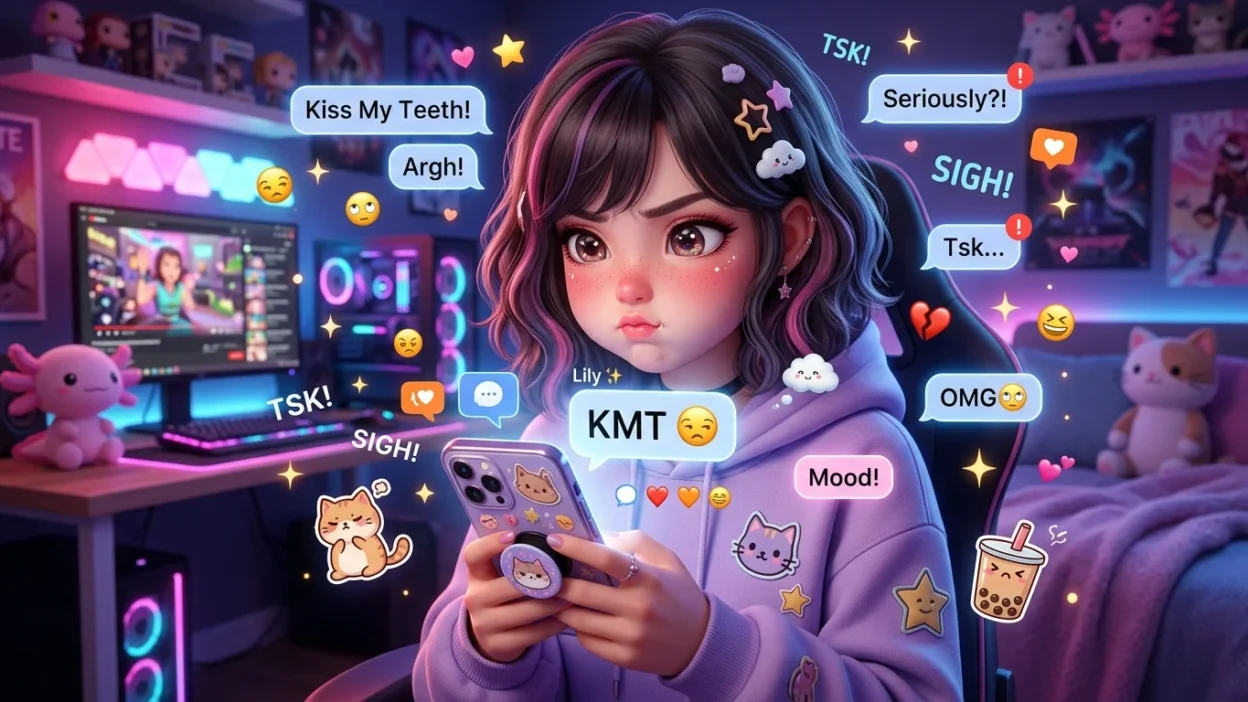
The most common KMT meaning in text is “Kiss My Teeth.”
The phrase comes from a real-life sound people make by sucking or clicking their teeth when they feel annoyed, frustrated, or disappointed. In many cultures, especially in Caribbean communities and parts of the United Kingdom, this sound is a common expression of irritation.
When used as a texting abbreviation, KMT allows someone to express those feelings without writing a long explanation.
People use KMT because it is quick, easy, and instantly communicates emotion.
Example:
“kmt, i can’t believe the bus left without me”
In this example, the sender feels frustrated and disappointed.
Bold Summary: KMT means “Kiss My Teeth” and is a texting abbreviation used to show annoyance, frustration, irritation, or disappointment.
Why Do People Use KMT?
Modern texting culture moves quickly. People often want to express feelings using as few words as possible.
Instead of writing a long angry message, someone can simply type KMT. The abbreviation instantly shows that they are unhappy about something.
Many users also prefer KMT because it feels more expressive than standard words like “annoyed” or “frustrated.” It adds personality and emotion to informal chat conversations.
As social media slang continues to evolve, abbreviations like KMT help users communicate reactions in a fast and natural way.
Where Is KMT Commonly Used?
KMT appears across many forms of online communication.
Text Messages
Friends often use KMT during everyday conversations when something goes wrong or becomes annoying.
Social Media Comments
You can often spot KMT in comments on platforms such as TikTok, Instagram, and Snapchat.
Direct Messages (DMs)
Private chats frequently include KMT when someone wants to express frustration casually.
Gaming Chats
Gamers use KMT after losing a match, experiencing lag, or dealing with an unexpected mistake.
Online Forums
Community discussions sometimes include KMT when users react negatively to news, updates, or opinions.
Tone of KMT
The tone is usually:
- Casual
- Informal
- Emotional
- Conversational
KMT is not considered formal language.
Real Conversation Examples
Here are some realistic examples of KMT in modern texting:
- “kmt i forgot my charger again”
- “the game crashed at the last second, kmt”
- “kmt why is traffic so bad today”
- “i waited an hour and they canceled, kmt”
- “kmt i just spilled coffee on my shirt”
- “you seriously ate my snacks? kmt”
- “kmt i thought today was friday”
- “my wifi stopped working again, kmt”
- “kmt that movie ending was disappointing”
- “i missed the train by one minute, kmt”
These examples show how KMT helps express irritation quickly and naturally.
When to Use KMT
Knowing when to use KMT makes your messages sound more natural.
Use KMT When
✅ You feel annoyed or frustrated.
✅ You are chatting with friends.
✅ You are commenting on social media.
✅ You want to react casually.
✅ The conversation is informal.
Do Not Use KMT When
❌ Writing business emails.
❌ Speaking with clients.
❌ Creating academic assignments.
❌ Writing professional reports.
❌ Communicating in formal situations.
Context Comparison Table
| Context | Example Phrase | Why It Works or Doesn’t Work |
|---|---|---|
| Friend Chat | “kmt i lost my keys again” | Natural and relatable |
| Social Media Comment | “kmt this update is terrible” | Casual reaction |
| Gaming Chat | “kmt that lag cost us the match” | Shows frustration clearly |
| Business Email | “kmt the project is delayed” | Too informal |
| School Report | “kmt this result is disappointing” | Not appropriate for formal writing |
Similar Slang Words and Alternatives
Several other slang terms communicate feelings similar to KMT.
| Slang | Meaning | When to Use |
| SMH | Shaking My Head | Disappointment or disbelief |
| SIGH | Expression of frustration | Mild annoyance |
| UGH | Annoyance or frustration | Everyday complaints |
| BRUH | Disbelief or irritation | Casual reactions |
| FR | For Real | Emphasis and agreement |
| NGL | Not Gonna Lie | Honest opinions |
| TBH | To Be Honest | Sharing thoughts honestly |
SMH
SMH is one of the closest alternatives to KMT. Both express disappointment, but SMH usually suggests disbelief as well.
UGH
UGH is useful when something is mildly annoying. It often feels less intense than KMT.
BRUH
BRUH can express frustration, confusion, surprise, or disappointment depending on context.
SIGH
SIGH works when someone feels tired, disappointed, or emotionally drained.
Why KMT Became Popular Online
KMT became popular because it captures a common emotion in a short and memorable way.
As texting abbreviation culture grew, people looked for quicker ways to communicate reactions. KMT solved that problem by turning a real-world expression into a chat shorthand term.
Social media helped spread the phrase even further. Users saw it in comments, copied it, and eventually made it part of everyday online chat meaning.
Today, KMT remains a recognizable piece of social media slang across many online communities.
Common Misunderstandings About KMT
Some people assume KMT is an insult. In reality, it is usually just an expression of frustration.
Others think it is always directed at another person. However, many people use KMT when reacting to situations rather than individuals.
Context always matters. Looking at the surrounding conversation can help determine the exact emotion behind the abbreviation.
Frequently Asked Questions
What does KMT mean in text?
KMT means “Kiss My Teeth,” a slang expression used to show annoyance, frustration, irritation, or disappointment.
Is KMT rude?
Not necessarily. It is informal and can sound negative, but it is usually used to express feelings rather than insult someone.
Who uses KMT the most?
Teenagers, young adults, social media users, and people familiar with texting culture often use KMT.
Is KMT popular on social media?
Yes. KMT appears frequently on social media platforms, comments, direct messages, and online discussions.
Can I use KMT in professional communication?
No. KMT is considered informal chat slang and should be avoided in professional settings.
Does KMT always mean “Kiss My Teeth”?
Most of the time, yes. However, online abbreviations can occasionally have different meanings depending on context.
Is KMT positive or negative?
KMT usually carries a negative emotion such as annoyance, frustration, or disappointment.
Final Thought
Understanding KMT Meaning in Text helps you navigate modern texting culture with confidence.
While the abbreviation may look confusing at first, its purpose is simple: it allows people to express irritation, frustration, disappointment, or annoyance quickly.
Whether you see it in a text message, social media comment, gaming chat, or direct message, KMT serves as a convenient way to communicate emotion without writing a long explanation.
As online communication continues to evolve, knowing slang terms like KMT can help you better understand digital conversations and connect more naturally with others.

Zevran Callix works on the Wordifs site creating clear informative articles while collaborating through wordifs@gmail.com to maintain consistency quality research readability and reader focused blogging standards worldwide digital content platform.