You’re typing a message and want to show you’re pondering something, not agreeing or disagreeing yet. Words can feel too heavy for that moment, and a small symbol does the job faster.
The emojis for thinking are some of the most useful on any keyboard. They help you signal doubt, curiosity, concentration, or a sudden idea without writing a full sentence. This guide covers the best options, what each one means, how they look on different devices, and how to avoid awkward mix-ups.
Quick Answer
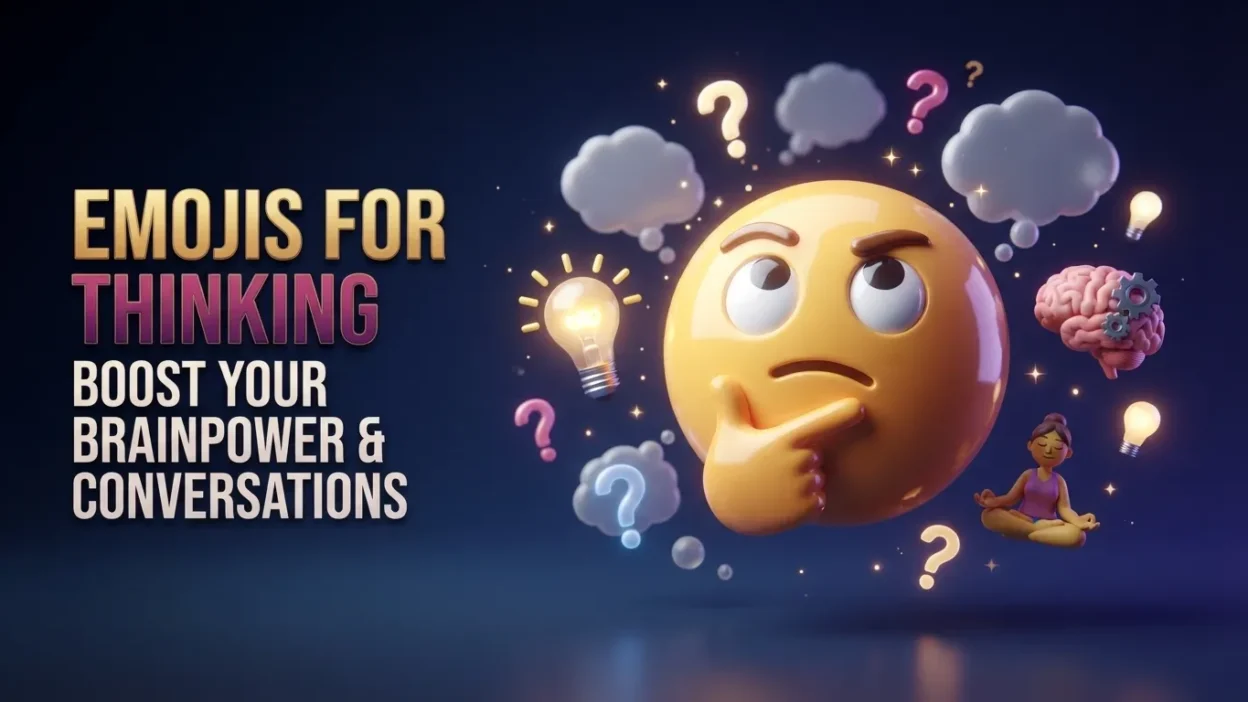
What is the best emoji for thinking? The thinking face emoji 🤔 is the standard choice. It shows a face with a hand on its chin and a raised eyebrow, and it works for pondering, doubt, or curiosity. Need to show a visual thought? Reach for the thought balloon 💭. The light bulb 💡 fits a sudden idea, while the brain 🧠 suits deep mental effort.
What Does the Thinking Face Emoji Mean?
The thinking face emoji 🤔 was approved as part of Unicode 8.0 and arrived on phones in 2015. Its official name is “Thinking Face.” It has become one of the most used emoji reactions in social media comments, group chats, and work messaging apps.
Its meaning depends on context. It can express:
- Deep thought: “Hmm, let me work this out.”
- Doubt: “I’m not sure that’s right.”
- Curiosity: “Interesting, tell me more.”
- Mild skepticism: “Are you sure about that?”
- Playful wondering: “What should I eat tonight?”
The same symbol can sound friendly in one chat and slightly sarcastic in another. Tone matters more than the image itself.
The Best Emojis for Thinking (With Meanings)
No single emoji covers every kind of thinking. The right one depends on whether you’re wondering, planning, doubting, or having a breakthrough.
Core Thinking Emojis
| Emoji | Name | Best used for |
| 🤔 | Thinking Face | General pondering, doubt, curiosity |
| 🧐 | Face with Monocle | Close inspection, careful analysis |
| 💭 | Thought Balloon | Inner thoughts, daydreams, “what if” ideas |
| 🧠 | Brain | Intelligence, mental effort, learning |
| 💡 | Light Bulb | New ideas, solutions, “aha” moments |
| 🤨 | Face with Raised Eyebrow | Suspicion, mild disbelief |
| 🤓 | Nerd Face | Playful intelligence, geeky enthusiasm |
| 🧩 | Puzzle Piece | Problem-solving, figuring things out |
| 🔍 | Magnifying Glass | Research, investigation, looking closer |
| ⏳ | Hourglass Not Done | Taking time to think, waiting for an answer |
Emojis That Show a Thinking Mood
Some emojis don’t show thinking directly but suggest a thoughtful or uncertain state:
- 😐 Neutral Face shows a blank, undecided reaction.
- 🫤 Face with Diagonal Mouth shows unsure or underwhelmed feelings.
- 🙄 Face with Rolling Eyes is often read as annoyance, not real thought.
- 🤷 Person Shrugging means “I don’t know” or “no idea.”
- 🤯 Exploding Head shows a mind-blown reaction after big realizations.
Thinking Emoji vs. Similar Emojis: What’s the Difference?
Mixing up similar symbols is a common reason messages land the wrong way.
🤔 Thinking Face vs. 🧐 Face with Monocle
The thinking face is casual and open. The monocle face feels more formal and analytical, like someone examining evidence. Use 🧐 when you want to sound curious about details.
🤔 Thinking Face vs. 🤨 Raised Eyebrow
The thinking face is neutral and can be friendly. The raised eyebrow leans toward suspicion or disbelief. If you don’t want to sound doubtful, choose 🤔.
💭 Thought Balloon vs. 💬 Speech Balloon
A thought balloon has a bubbly, cloud-like edge and represents silent thoughts. A speech balloon has a solid edge and represents spoken words. Use 💭 for inner ideas and 💬 for conversation.
💡 Light Bulb vs. 🧠 Brain
The light bulb is about a single idea or solution. The brain is about thinking in general, such as learning, memory, or intelligence. Pair them for a full effect: 🧠💡 suggests a smart idea.
How to Use Thinking Emojis in Real Life
Examples make the differences clear.
In Casual Chats
- “Should we order pizza or tacos? 🤔”
- “I might change my plans this weekend 💭”
- “Wait, I think I figured it out 💡”
In Work Messages
- “Looking into this now 🔍”
- “Let me think about the best approach 🤔”
- “Great suggestion, I’ll review the details 🧐”
Keep work messages light. One emoji is usually enough, and it should match your company’s communication style.
On Social Media
- Caption prompts: “What’s your take? 🤔”
- Quote posts: “Big idea to sit with 💭”
- Learning content: “Today I learned something new 🧠”
Thinking emojis often appear in posts that invite discussion, so they work well to start comment conversations.
In Study and Learning
Students and teachers use 🧠, 🧩, and 💡 to mark questions, hard problems, and key insights in notes and shared documents.
How Thinking Emojis Look on Different Platforms
The same emoji can look slightly different across devices. That is because each company designs its own artwork for the Unicode standard.
- Apple (iPhone, iPad, Mac): The 🤔 face shows a hand on the chin with a slightly raised eyebrow.
- Google (Android): A rounded, friendly design with a clear hand-to-chin pose.
- Samsung: A slightly different shape and expression, sometimes softer.
- Microsoft (Windows): A clean, flat style with simple shading.
- WhatsApp, X (Twitter), and Facebook: Each uses its own artwork or the device’s native version, depending on the app.
Because designs differ, a playful thinking face on your phone could look more serious on someone else’s. Avoid relying on subtle expressions for important messages.
How to Type or Copy Thinking Emojis
You can use thinking emojis in several simple ways:
- Phone keyboard: Open the emoji keyboard and search “thinking” or “think.”
- Windows: Press the Windows key + period (.) to open the emoji panel.
- Mac: Press Control + Command + Space.
- Copy and paste: Copy 🤔 💭 💡 🧠 directly from any trusted emoji list.
- Text shortcut: Many apps convert :thinking: into 🤔 automatically.
Common Mistakes to Avoid
Even a small symbol can cause confusion. Watch out for these:
- Using 🤔 to reply to serious news. It can sound dismissive or sarcastic.
- Sending it alone as a reply. Without words, people may not know whether you’re confused, doubtful, or just thinking.
- Overusing emojis in professional emails. One is fine; a row of them looks careless.
- Mixing up 🙄 with thinking. Rolling eyes show annoyance or disbelief, not thoughtfulness.
- Ignoring cultural context. Emoji meanings can shift between age groups, regions, and communities.
- Assuming everyone sees the same image. Platform differences can change the tone.
Practical Tips for Better Emoji Use
- Match your tone to the message. Use 🤔 for curiosity, 🧐 for detail-checking, and 💡 for solutions.
- Pair emojis with words. A short sentence plus an emoji is clearer than an emoji alone.
- Know your audience. A friend may enjoy playful use, while a client may prefer none.
- Limit yourself to one or two. Too many weaken the message.
- Combine for richer meaning. 💭➡️💡 can show a thought turning into an idea.
- Check how it looks on other platforms if the message is important.
Emoji Combinations for Thinking
Combinations add nuance without needing extra text:
| Combination | Possible meaning |
| 🤔💭 | Deep in thought, wondering |
| 🤔💡 | Thinking toward an idea |
| 🧠🔍 | Studying or analyzing closely |
| 🧩🤔 | Working through a problem |
| ⏳🤔 | Needs time to decide |
| 🤔❓ | Confused or asking for clarity |
Why Thinking Emojis Matter in Digital Communication
Face-to-face talk includes facial expressions, tone, and pauses. Text lacks all of that. Emojis help fill the gap by adding emotional context and nonverbal cues to written messages.
A thinking emoji tells the reader you are processing, not ignoring. It softens a pause and signals engagement. That can make online communication feel more human and less abrupt.
Frequently Asked Questions
What is the main emoji for thinking?
The thinking face 🤔 is the main one. It shows a hand on the chin and a raised eyebrow, and it is recognized on nearly every platform.
What does 🤔 mean in a text?
It usually means someone is pondering, doubting, or curious. The exact meaning depends on the conversation and tone.
Is the thinking emoji rude or sarcastic?
Not by default. However, in debates or after surprising claims, it can read as skeptical. Add a few words if you want your intent to be clear.
What emoji shows a thought or idea?
Use 💭 for a thought and 💡 for a new idea or solution. Together, 💭💡 can show an idea forming.
What is the difference between 🤔 and 🧐?
🤔 is general pondering. 🧐 suggests closer, more careful examination, like inspecting details through a monocle.
Which emoji means “I’m not sure”?
🤔, 🤷, and 🫤 all work. 🤷 is the most direct for “I don’t know,” while 🤔 sounds more thoughtful.
Do thinking emojis look the same on iPhone and Android?
No. Each company designs its own version of the Unicode emoji, so expressions and styles vary slightly between devices.
Can I use thinking emojis in professional messages?
Yes, in moderation. One well-placed emoji, such as 🤔 or 🔍, is acceptable in many workplaces, but follow your team’s norms.
Conclusion
Emojis for thinking give your messages tone, personality, and clarity. The thinking face 🤔 is the most versatile, while 💭, 💡, 🧠, and 🧐 each add a more specific shade of meaning. Choosing the right one helps readers understand whether you’re curious, uncertain, analyzing, or inspired.
Keep your use simple and intentional. Pair emojis with a few clear words, consider your audience, and remember that designs vary across devices. Used this way, thinking emojis make digital conversations warmer, clearer, and easier to follow in 2026 and beyond.

Zevran Callix works on the Wordifs site creating clear informative articles while collaborating through wordifs@gmail.com to maintain consistency quality research readability and reader focused blogging standards worldwide digital content platform.