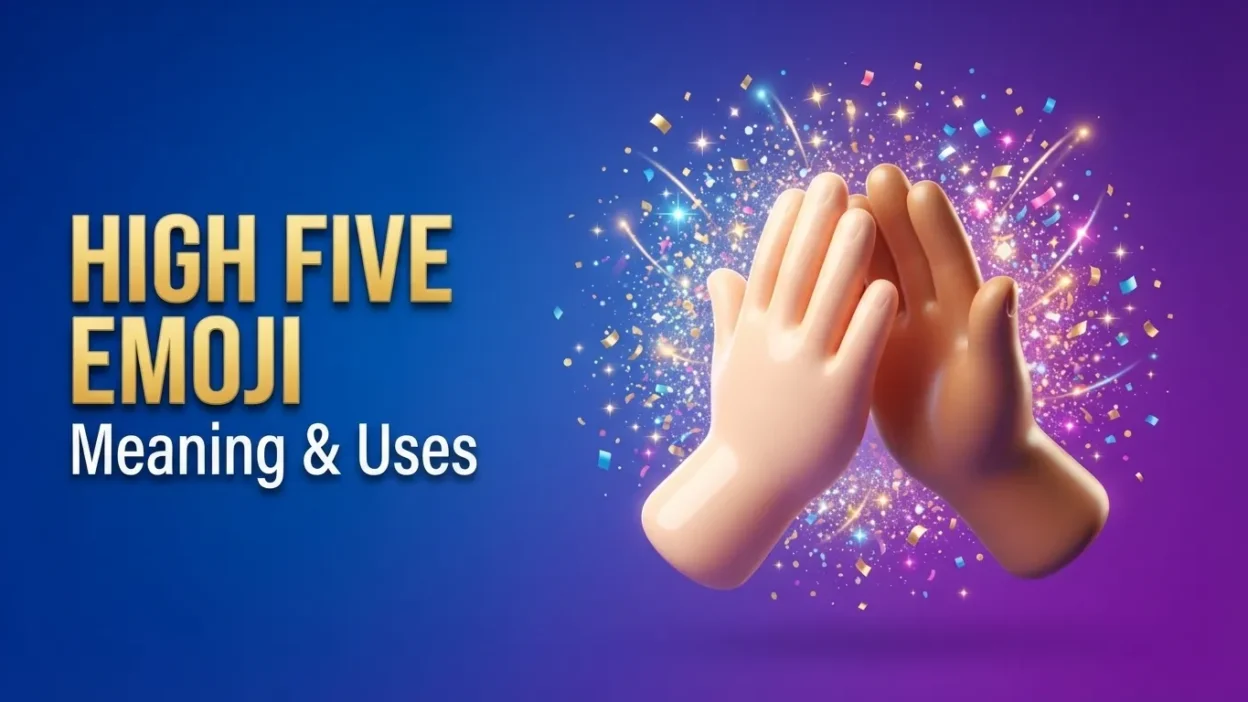
Sending a high five in a chat sounds simple until you open the emoji keyboard. There is no single button labelled “high five,” and the closest options send very different messages.
This guide explains which emoji people use for a high five, what each one actually means, and how to avoid awkward mix-ups.
Quick Answer
The 🙏 emoji (folded hands) is the one most often linked to the high five, because its official search keywords include “high five.” However, it was designed for “please,” “thank you,” and prayer. For a clearer high five, many people now use the pushing hands emoji 🫸 (rightwards pushing hand) or the 🙌 raising hands emoji for celebration. Choose by context: 🙏 for gratitude, 🙌 for celebration, 🫸 for a playful hand-to-hand moment.
What Are the High Five Emoji?
Strictly speaking, there is no dedicated high five emoji in the Unicode Standard, the system that defines emoji across phones and apps. A high five is an action between two people, and most hand emoji show only one or two hands in isolation.
What people call the “high five emoji” is really a group of hand emoji that users have adopted for the gesture. The most common are:
- 🙏 Folded hands: the emoji most often tagged “high five” in emoji keyboards
- 🙌 Raising hands: a celebration gesture
- 🫷 and 🫸 Pushing hands: palms facing left or right, often paired as a high five
- ✋ Raised hand: an open palm, used for “stop,” “hi,” or a high five
Why Does 🙏 Look Like a High Five?
The 🙏 emoji shows two palms pressed together. In Japan, where emoji began, this pose is a common sign of thanks, apology, or a polite request, similar to saying “please” or “thank you so much.”
Outside Japan, many people read the picture differently. Two flat hands meeting looks a lot like a high five, so the emoji took on a second meaning in everyday chat. Emoji keyboards reflect this: searching “high five” on most phones brings up 🙏 first.
The official name is “folded hands,” and it is also widely used for prayer. According to Emojipedia’s history of the folded hands emoji, the design was never meant to show a high five, which is why it can cause confusion. We cover this in the common mistakes section below.
The Main “High Five” Emoji Compared
| Emoji | Official name | Main meaning | High five use |
| 🙏 | Folded hands | Thanks, please, prayer, hope | Common, but may feel religious or formal |
| 🙌 | Raising hands | Celebration, praise, joy | Good for shared success |
| 🫸 | Rightwards pushing hand | Pushing, stop, hand-to-hand contact | Clear when paired with 🫷 |
| 🫷 | Leftwards pushing hand | Pushing, stop, hand-to-hand contact | Clear when paired with 🫸 |
| ✋ | Raised hand | Stop, hello, pause | Casual, one-handed high five |
| 🤝 | Handshake | Agreement, deal | Not a high five, but often confused |
| 👏 | Clapping hands | Applause, approval | Not a high five |
What Does the 🙌 Emoji Mean?
The raising hands emoji shows two hands lifted in the air. It stands for celebration, excitement, and praise, like cheering “hooray!” or “we did it!”
People often use it as a stand-in for a high five when something good has happened. For example:
- “We got the contract 🙌”
- “Finally finished the project 🙌”
- “Friday is here 🙌”
It also appears in religious contexts as a sign of praise, so the setting can shape its meaning. In casual messages, though, it almost always signals joy.
What Are the Pushing Hands Emoji 🫷🫸?
These two emoji were approved by the Unicode Consortium as part of Emoji 15.0 in 2022 and have since reached most major phones and apps. The leftwards pushing hand 🫷 and rightwards pushing hand 🫸 show a flat palm facing sideways.
They were designed to show pushing, rejecting, or saying “stop” or “wait.” Yet their search keywords also include “high five,” and many people use them that way. Put them side by side as 🫸🫷 and the two palms look like they are about to meet.
Because they are newer, they may not display correctly on older devices. If a friend uses an older phone, they might see an empty box or a question mark instead.
How to Use a High Five Emoji (With Examples)
Context decides everything. Here is how each emoji reads in real messages.
Celebrating a win: “Great job on the presentation 🙌”
Friendly thanks: “Thanks for covering my shift 🙏”
Mutual high five: “Nailed it! 🫸🫷”
To greet someone casually:
“Hey, long time no see ✋”
To agree on a plan or deal:
“Done, see you Monday 🤝”
Common Mistakes to Avoid
Many misunderstandings come from the fact that these emoji were never meant to be high fives. Watch out for these:
- Sending 🙏 in a serious or sad moment. If someone shares bad news and you reply with 🙏 meaning “high five,” it may feel strange. It can be read as prayer or sympathy.
- Using 🙏 in a heated argument. It may look sarcastic, as if you are saying “please, calm down.”
- Mixing up 👏 and 🙌. Clapping hands show applause. Raised hands show celebration. They overlap but are not identical.
- Assuming everyone sees the same design. Apple, Google, Samsung, and Microsoft draw emoji differently. A hand that looks like a high five on one phone may look like a stop sign on another.
- Overusing 🫷🫸. On older devices these may not appear, and some people read them as “stop” or “talk to the hand.”
- Using 🙏 in formal or professional messages without thinking. In some workplaces, the religious meaning matters.
Practical Tips for Better Emoji Use
A few simple habits make your messages clearer:
- Match the emoji to the mood. Use 🙌 for joy, 🙏 for gratitude, and 🫸🫷 for playful hand contact.
- Add a few words. A short phrase like “high five!” removes any doubt.
- Check your audience. People from different cultures may read the same emoji in different ways.
- Try skin tone options. 🙏, 🙌, ✋, 🫷, and 🫸 all support skin tone modifiers, which make messages feel more personal.
- Pair emoji carefully. Two emoji in a row, such as 🫸🫷, are more likely to look like a real high five than a single one.
- Keep it light at work. In team chats, 🙌 is usually the safest way to cheer someone on.
High Five Emoji on Different Platforms
Emoji look different depending on the device or app. The meaning stays the same, but the style can change the feel.
- Apple draws 🙏 as two hands pressed together with a soft look.
- Google uses a flat, friendly style.
- Samsung and Microsoft use their own artwork, which can change how “high five” or “prayer” the picture feels.
- WhatsApp, Instagram, and X may show their own versions or follow the system style, depending on your settings.
If your message is important, a quick test on another device can help. Or simply add a short phrase in words.
Frequently Asked Questions
Is there an official high five emoji?
No. Unicode has no emoji named “high five.” People use 🙏, 🙌, or the pushing hands 🫷🫸 instead.
Which emoji is closest to a real high five?
The pushing hands pair 🫸🫷 look most like two palms meeting. The 🙏 emoji is the one most often tagged “high five” in emoji search.
Is 🙏 a high five or a prayer?
Officially it is “folded hands,” used for prayer, thanks, and requests. Many people also use it as a high five, so context matters.
What is the difference between 🙌 and 👏?
🙌 shows hands raised in celebration or praise. 👏 shows clapping, which means applause or approval.
What do the 🫷 and 🫸 emoji mean?
They are pushing hand emoji, introduced in 2022. They mean “stop,” “wait,” or “push away,” though many people also use them for high fives.
Why does my phone show a box instead of the high five emoji?
Your device likely doesn’t support newer emoji such as 🫷 and 🫸. Updating your operating system or messaging app usually fixes this.
Can I use the high five emoji at work?
Yes, but choose carefully. 🙌 is usually safe for celebrating teamwork. Use 🙏 with care, since some readers see it as religious.
Do high five emoji come in different skin tones?
Yes. 🙏, 🙌, ✋, 🫷, and 🫸 all support skin tone options, so you can choose one that suits you.
Conclusion
The high five emoji is really a small family of hand symbols rather than one official character. The 🙏 emoji is the one most people associate with it, but its true meaning is thanks, hope, or prayer. For pure celebration, 🙌 is the better choice, and for a playful palm-to-palm moment, the pushing hands 🫸🫷 come closest.
The best habit is to think about your reader and the moment before you send. A clear emoji, a short phrase, and a quick thought about how it might look on another phone will keep your message friendly and misunderstanding-free in 2026 and beyond.