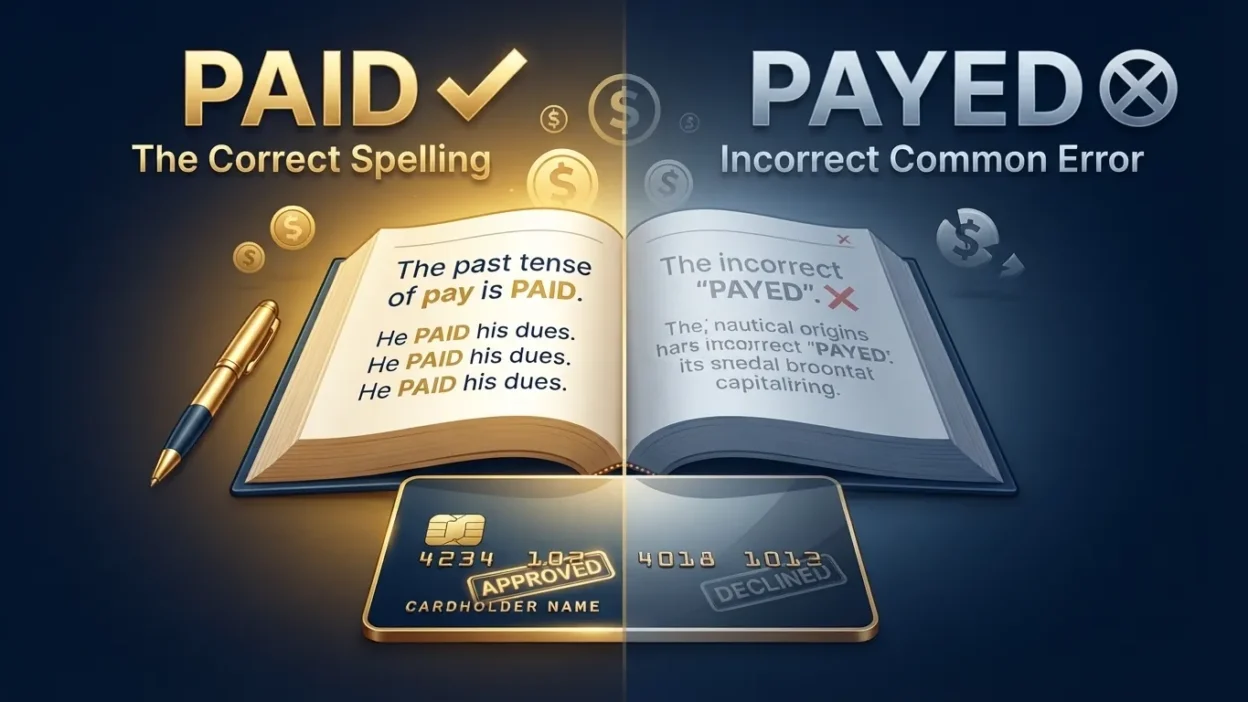
Many writers often pause over paid vs payed, and the confusion is fair, because pay is a verb we use every single day and it mostly behaves well. That is why payed versus paid keeps turning up in the drafts I edit.
It is an irregular verb, and the pattern is irregular enough that people call it troublesome, yet it is not hard to memorize. I’ve seen new learners memorize it after a few tries. The present participle is paying, while the past tense and the past participle are both paid.
So where does payed come from? It belongs to one specific usage, and that usage is sailing. When I first read about it, I pictured sailors letting a rope go slack, which is exactly what payed out means. Shipbuilders also used it for sealing seams with tar, so that nautical usage keeps a unique spelling. That spelling is right only there. For money, bills, wages, or attention, the word you want is paid.
In everyday writing, the slips I see most are payed attention and payed the bill. Those are plain mistakes, and honestly the most fixable mistakes around. Before you hit send, check your spelling and scan the grammar and punctuation, because one error can hide another. I rely on a tool like Grammarly for this: it proofreads your draft and flags the slip, so the final text looks polished.
Quick Answer:
Paid is the correct past tense and past participle of “pay” for money, bills, wages, and favors. “Payed” is only used in a rare nautical sense, such as letting out a rope (“payed out”) or sealing a ship’s seams with tar. In everyday English, always write “paid.”
Why Do People Confuse Paid and Payed?
The confusion comes from a common spelling pattern. Most regular verbs add -ed to make the past tense:
- walk → walked
- play → played
- stay → stayed
- enjoy → enjoyed
Because “pay” ends in the same “-ay” sound as “play” and “stay,” many learners expect “payed.” But “pay” is an irregular verb in its most common meaning. It follows the same unusual path as two other short verbs: say → said and lay → laid. The “y” changes to “i” and the ending becomes -d.
There is a second reason for the mix-up. “Payed” is a real word, so it does not always get flagged as an error. It simply belongs to a very different context.
What Does “Paid” Mean?
“Paid” is the past tense and the past participle of the verb “pay.” It describes giving money, or something of value, in exchange for goods, services, or work. It also covers non-money meanings, such as giving attention or receiving a benefit.
You can use “paid” in two ways:
- Simple past: “I paid the bill yesterday.”
- Past participle (after have, has, had, or be): “She has paid her rent.” “The invoice was paid.”
“Paid” also appears in many everyday words and phrases: prepaid, unpaid, overpaid, underpaid, repaid, paid leave, paid off, and well-paid.
What Does “Payed” Mean?
“Payed” is a much less common spelling. Dictionaries list it only for a nautical (sailing) meaning of “pay,” which comes from a different word origin than the money meaning. In that sense, “pay” means to coat something with tar or pitch to make it waterproof, or to let out a rope or cable gradually.
You will mostly see it in these set phrases:
- Payed out: letting a rope or chain slide out slowly. “The sailors payed out the anchor line.”
- Payed (sealing seams): covering the seams of a wooden ship with tar or pitch. “They payed the deck seams before the voyage.”
Unless you are writing about ships, ropes, or sailing, you will almost never need “payed.”
Paid vs Payed: Comparison Table
| Feature | Paid | Payed |
| Part of speech | Past tense and past participle of “pay” | Past tense and past participle of nautical “pay” |
| Main meaning | Gave money or value for something | Let out a rope or sealed a ship’s seams with tar |
| How common | Very common | Very rare |
| Where you see it | Daily life, work, school, business, news | Sailing and shipbuilding |
| Example | “He paid for lunch.” | “They payed out the rope.” |
| Correct for money? | Yes | No |
| Used in American and British English | Yes | Yes (only in nautical contexts) |
When Should You Use Paid and When Should You Use Payed?
Use “paid” when:
- You talk about money, salary, bills, taxes, or fees.
- You mean giving attention, respect, or a visit (“paid attention,” “paid a visit”).
- You describe a result or reward (“The effort paid off”).
- You are unsure. “Paid” is almost always the safe choice.
Use “payed” only when:
- You are writing about sailing or ships.
- You mean letting out a rope or cable (“payed out”).
- You mean sealing a ship’s seams with tar or pitch.
If your sentence is not about boats or ropes, write “paid.”
Examples of Paid and Payed in Sentences
Correct uses of “paid”:
- I paid for the tickets online.
- She has already paid her electricity bill.
- The company paid all employees on Friday.
- We were paid in cash after the job.
- He paid attention during the whole lesson.
- They paid a visit to their grandparents last weekend.
- All the fees must be paid before the exam.
- Her hard work finally paid off.
- The driver was paid extra for working at night.
- Have you paid the rent yet?
- My brother repaid the loan early.
Correct uses of “payed” (nautical only):
- The crew payed out the anchor chain slowly.
- The sailor payed out more line as the boat drifted.
- Workers payed the seams of the old wooden ship with tar.
Common Mistakes with Paid and Payed
Mistake 1: Using “payed” for money.
- Wrong: I payed the bill.
- Right: I paid the bill.
Mistake 2: Using “payed” with “have” or “has.”
- Wrong: She has payed her fees.
- Right: She has paid her fees.
Oversight 3: Writing “payed attention.”
- Wrong: The students payed attention.
- Right: The students paid attention.
Mistake 4: Using “paid” for the present tense.
- Wrong: I paid every month. (when you mean it is a habit)
- Right: I pay every month.
Mistake 5: Trusting the “-ed” rule. Not every verb adds -ed. Pay, say, and lay are exceptions.
Easy Memory Trick for Paid vs Payed
Remember this short rule: money means “i,” boats mean “y.”
- Paid has an i. Think: “I paid the bill.”
- Payed keeps the y. Think: yacht, a boat.
You can also learn the three exceptions together as a group:
- pay → paid
- say → said
- lay → laid
If you already know that you would never write “sayed” or “layed,” you already know not to write “payed.”
Paid vs Payed in American and British English
There is no real difference between American and British English here. Both use “paid” as the standard past tense and past participle for money and everyday meanings. Both also keep “payed” for the rare nautical sense.
So you do not need to change your spelling depending on your audience. Whether you write for readers in the US, the UK, Canada, India, Pakistan, or Australia, “paid” is the right choice for everyday writing.
Similar Words That Cause the Same Confusion
Several other verbs follow the same pattern or look similar:
- Said, not sayed. Say → said.
- Laid, not layed. Lay → laid. (“She laid the book on the table.”)
- Stayed, not staid. “Staid” is a different word that means serious and calm. The past tense of “stay” is “stayed.”
- Played, prayed, delayed. These are regular verbs, so they keep the y and add -ed.
- Pay, pays, paying. Only the past form changes to “paid.” You still write “paying” with a y.
The key rule: most verbs ending in a vowel plus y (play, stay, enjoy) just add -ed. Pay, lay, and say are the well-known exceptions.
Final Verdict:
For money, bills, wages, favors, and attention, always choose paid. Save payed for the rare moments you write about ropes, anchors, or sealing the seams of a ship. If you are not writing about sailing, “payed” is a spelling mistake.
Frequently Asked Questions
Is it paid or payed?
“Paid” is correct in almost all cases. It is the past tense and past participle of “pay” when you mean giving money or value. “Payed” appears only in nautical English.
Is “payed” a real word?
Yes, but it is rare. It is used in sailing to mean letting out a rope or sealing a ship’s seams with tar or pitch. It is not the past tense of “pay” for money.
What is the past tense of pay?
The past tense of “pay” is “paid.” For example: “Yesterday, I paid the rent.” The past participle is also “paid”: “I have paid the rent.”
Is “payed” British English?
No. “Payed” is not a British spelling of “paid.” Both British and American English use “paid” for money, and both use “payed” only in nautical contexts.
Is it “paid attention” or “payed attention”?
It is “paid attention.” The phrase uses the standard past tense of “pay,” so “payed attention” is incorrect.
Is it “paid for” or “payed for”?
It is “paid for.” Example: “She paid for the groceries.”
Why is the past tense of pay not “payed”?
Because “pay” is an irregular verb in its main meaning. Like “say” (said) and “lay” (laid), it changes the y to i and ends in -d instead of adding -ed.
Can I use “payed” in a school exam or business email?
Only if you are writing about ropes or ships. For any normal topic, “payed” will be marked as a spelling error, so use “paid.”
Remember This
- Paid is the correct past tense and past participle of “pay” for money and everyday meanings.
- Payed is rare and nautical only: letting out rope or sealing seams with tar.
- Pay, say, and lay become paid, said, and laid.
- American and British English follow the same rule.
- When in doubt, write “paid.”
Conclusion
The difference between “paid” and “payed” is small, but it matters. “Paid” is the word you will use in nearly every sentence, from paying a bill to paying attention. “Payed” lives in a narrow corner of English, where sailors let out ropes and shipbuilders seal wooden seams.
The easiest way to stay accurate is to connect “paid” with “said” and “laid,” and to remember that money means “i.” With that simple habit, you can write with confidence in emails, essays, exams, and everyday messages.