I kept running into paid off vs payed off back when I was editing drafts, and the same slips showed up in the work of so many different writers. Here is the base: pay is a verb with an odd shape, an irregular verb, yet it is easy and not hard to memorize. Add -ing and you get paying, the present participle.
The past tense and the past participle are both paid, so why does it feel troublesome? The confusion comes from payed, a unique spelling that looks right to many eyes. It is one of the most common mistakes I fix, and the rule is simple to memorize: when a loan, a car loan, a credit card, or a mortgage is cleared, the money is paid off, never payed off.
The first thing I explain is that payed has a real home. The spelling fits one specific usage, which is sailing. Sailors say a rope is payed out when they let it run loose on a boat. That usage is rare in everyday English, so in any sentence about money, I write paid. In writing, a single word on the page can make the whole text look careless, and a plain spell checker may miss it.
That is why I use Grammarly to check your spelling and flag grammar and punctuation. It proofreads the draft, and I treat proofreading as my final pass and my last step before sending. My tip is to do that pass every time, because it keeps my work polished and it is why a clean page shines.
Quick Answer
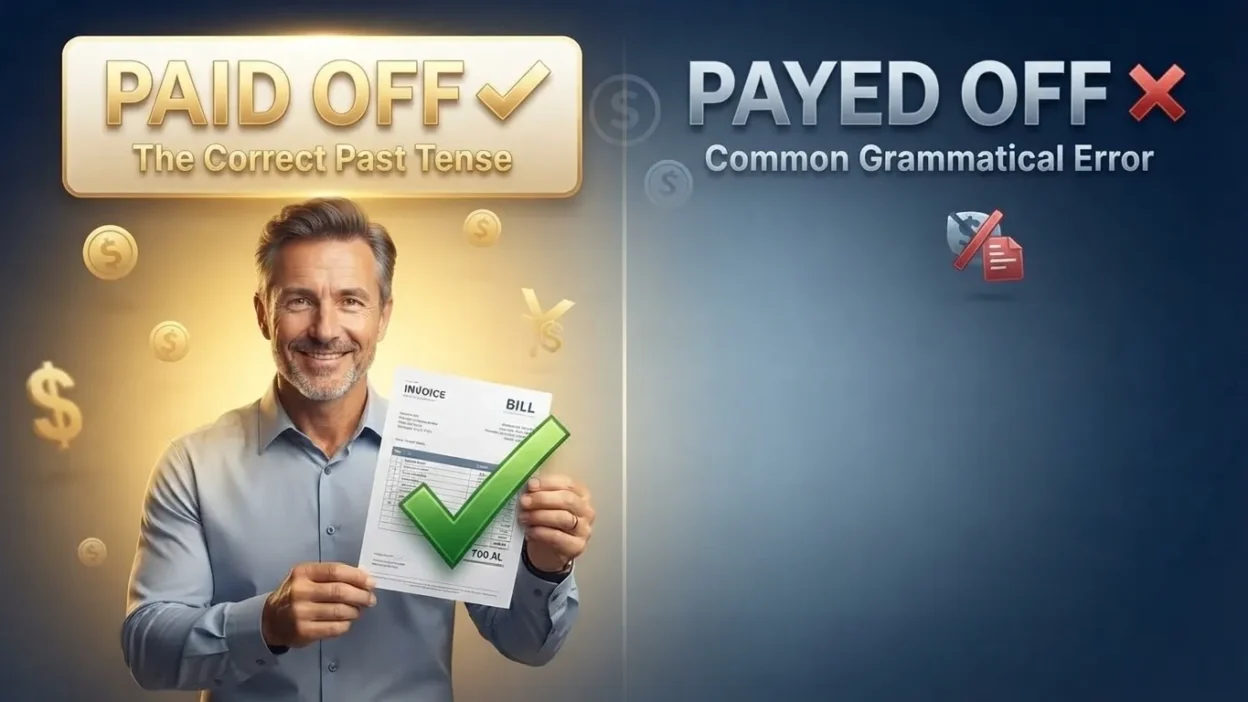
Paid off is the correct past tense and past participle of the phrasal verb “pay off.” Use it for debts that are fully repaid, plans that succeed, or people who are paid and dismissed. Payed off is incorrect in everyday English. The only exception is a rare sailing term meaning a ship turned away from the wind.
Why Do People Confuse Paid Off and Payed Off?
There are three main reasons:
- The “-ed” habit. Regular verbs like “walk” become “walked” and “play” becomes “played.” Many people apply the same pattern to “pay.”
- Spelling and sound. “Paid” and “payed” sound identical when spoken, so the ear cannot tell you which is right.
- Spell-checkers. “Payed” is a real word in specialized uses, so some tools do not flag it.
Because “pay” ends in a vowel plus “y” (like “play” and “stay”), learners expect “payed.” But “pay” follows the same irregular pattern as “say” (said) and “lay” (laid).
What Does “Paid Off” Mean?
Paid off” is the past tense and past participle of the phrasal verb “pay off.” A phrasal verb is a verb combined with a small word, here “off,” to create a new meaning. “Paid off” has four common meanings:
- To finish repaying money you owe. “She paid off her student loan.”
- To bring a good result. “His early mornings finally paid off.”
- To pay someone fully and end their job. “The company paid off the temporary workers.”
- To bribe someone (informal). “The official was paid off to stay quiet.”
You may also see “paid-off” as an adjective before a noun: “a paid-off car” means a car with no loan left on it.
What Does “Payed Off” Mean?
“Payed” is not the normal past tense of “pay.” It appears only in specialized nautical English, where it has two uses:
- To let out a rope or cable gradually. Sailors say they “payed out” the line.
- To turn a ship’s bow away from the wind. “The ship payed off to leeward.”
“Pay” also has an old sailing meaning of sealing a ship’s seams with tar, and “payed” is the past tense there too. Outside of sailing, “payed off” is considered incorrect. If you are not writing about boats, use “paid off.”
Paid Off vs Payed Off: Comparison Table
| Feature | Paid Off | Payed Off |
| Correct in everyday English | Yes | No |
| Part of speech | Past tense and past participle of “pay off” | Rare nautical past tense |
| Common meanings | Repaid a debt, brought results, paid and dismissed | Turned away from the wind (sailing) |
| Used in business and finance | Yes | No |
| Used in daily conversation | Yes | No |
| Example | “I paid off my loan.” | “The ship payed off to leeward.” |
When Should You Use Each Form?
Use “paid off” when:
- You are talking about money, debts, bills, or mortgages.
- You mean effort that led to success.
- You mean someone was paid and let go.
- You are unsure. It is the safe choice.
Use “payed off” only when:
- You are writing about sailing, and the ship turned away from the wind.
For nearly every student, worker, and general reader, the answer is always “paid off.”
Examples of Paid Off in Sentences
- We finally paid off our home loan after twenty years.
- All her hard work paid off when she passed the exam.
- He paid off the credit card bill in one payment.
- The risk paid off, and the new shop was a success.
- They have paid off most of their debts this year.
- Years of practice paid off at the piano competition.
- The company paid off the workers and closed the factory.
- I will feel so relieved once the car is paid off.
- Her patience paid off when the job offer arrived.
- The police believed the witness had been paid off.
- Our team paid off the remaining balance last week.
- Learning new skills paid off in the long run.
Example of Payed Off (Nautical Use Only)
- The bow payed off as the sailors turned the boat away from the wind.
Notice that this sentence is about a boat. In any other setting, replace “payed” with “paid.”
Common Mistakes to Avoid
- Writing “payed off” for a debt. Incorrect: “I payed off my loan.” Correct: “I paid off my loan.”
- Using “payed” with “has” or “have.” Incorrect: “She has payed off the bill.” Correct: “She has paid off the bill.”
- Mixing up “pay off” and “paid off.” Use “pay off” for the present (“I pay off my card monthly”) and “paid off” for the past.
- Forgetting the hyphen in adjectives. “A paid-off house” needs a hyphen when it comes before the noun.
- Trusting the “-ed” rule. “Pay” is irregular, so the “-ed” rule does not apply.
Easy Memory Trick
Compare “pay” with two similar verbs:
- say → said
- lay → laid
- pay → paid
In each, the “y” changes to “i” and the ending becomes “d.” If you can remember “said” and “laid,” you can remember “paid.”
Another quick check: “payed” is for ships and ropes only. If your sentence is about money, effort, or results, use “paid.”
American English vs British English
There is no real difference. Both American and British English use “paid off” for debts and results. “Payed” is a nautical term in both varieties.
One small difference is the noun “payoff” (American) and “pay-off” (often British). Both mean a reward, a final payment, or a result. For example: “The payoff for all that studying was a high score.”
Similar Words and Phrases
- Pay back: to return money you borrowed. “I will pay you back on Friday.”
- Pay down: to reduce a debt without clearing it fully. “She paid down her loan by half.”
- Pay in full: to pay the complete amount at once.
- Pay out: to give money, or in sailing to release a rope. The past tense is “paid out” in general use and “payed out” in sailing.
- Repay: to give back money. The past tense is “repaid.”
- Pay up: to pay money that is owed, often unwillingly.
- Payoff / pay-off: a noun for a final payment or a rewarding result.
Final Verdict
Use “paid off.” It is correct for debts, effort, and results, and it works in school, business, and daily writing. “Payed off” belongs only in rare sailing contexts. If you are not writing about ships and ropes, “payed” is an error.
Frequently Asked Questions
Is it “paid off” or “payed off”?
“Paid off” is correct. “Payed off” is a spelling mistake except in sailing, where it describes a ship turning away from the wind.
Is “payed” ever correct?
Yes, but only in nautical English. Sailors use “payed” when they release a rope (“payed out”) or seal seams with tar. In general writing, use “paid.”
What is the past tense of “pay off”?
The past tense is “paid off.” The past participle is also “paid off,” as in “I have paid off the loan.”
What does “paid off” mean?
It means you finished repaying a debt, your efforts led to a good result, or someone was paid and dismissed. In informal speech, it can also mean someone was bribed.
Is it “my hard work payed off” or “paid off”?
It is “my hard work paid off.” Here, “paid off” means the effort led to success.
Why is “pay” an irregular verb?
Its past tense does not follow the usual “-ed” pattern. English has many such verbs, including “say” (said) and “lay” (laid), which are older forms that kept their own spellings.
Is “paid-off” hyphenated?
Use a hyphen when it works as an adjective before a noun: “a paid-off mortgage.” Without a noun right after it, no hyphen is needed: “The mortgage is paid off.”
What is the difference between “paid off” and “paid back”?
Paid off” means finishing a debt completely. “Paid back” means returning money to a person. You can pay back a friend $20 without paying off a loan.
Remember This
- “Paid off” is correct in almost every case.
- “Payed off” is only for sailing.
- “Pay” is irregular: pay → paid, like say → said.
- Use “paid off” for debts, results, and ended jobs.
- Hyphenate “paid-off” before a noun.
Conclusion
The rule is simple: when you mean a debt was cleared or hard work brought rewards, write “paid off.” The spelling “payed off” feels natural because of the usual “-ed” pattern, but “pay” does not follow it. Remember that “payed” belongs on a boat and “paid” belongs everywhere else.
Next time you write about a loan, a lucky risk, or years of effort that finally brought results, use “paid off” with confidence. If you ever doubt yourself, think of “said” and “laid,” and the right spelling will follow.

Zevran Callix works on the Wordifs site creating clear informative articles while collaborating through wordifs@gmail.com to maintain consistency quality research readability and reader focused blogging standards worldwide digital content platform.