Has vs Have can seem confusing in the English language, but understanding the subject makes the grammar rules much easier to follow. These popular words are common in everyday conversation, especially when expressing possession.
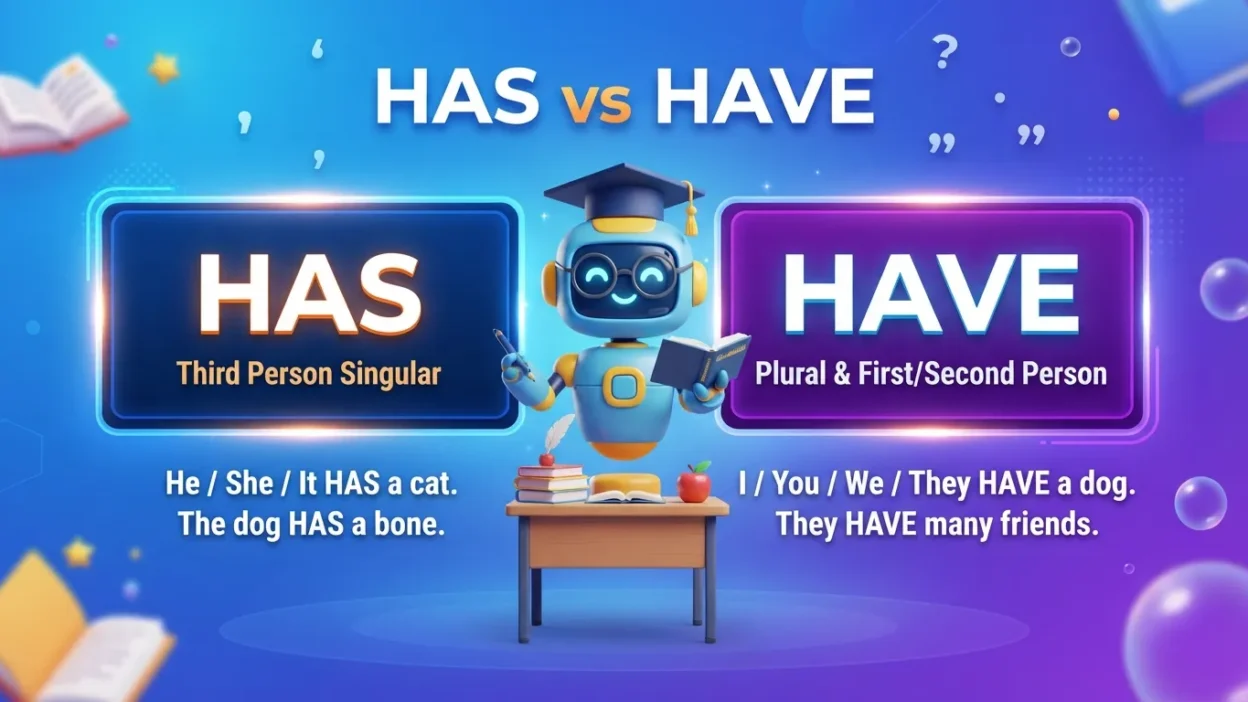
Has and Have are different forms of the verb to have, and their use depends on the grammatical contexts around them. With singular subjects, use has with he, she, and it, while plural subjects normally take have with we and they. I and you also use have, even when referring to one person.
Because to have is an irregular verb, its conjugation does not follow the usual rules for verb endings, which can make conjugating it challenging for learners. To choose the right one, check the context, subject, and pronoun before forming the sentence.
This simple method supports better usage, improves sentence structure, and makes correct usage easier to understand in everyday English. Learning these common verb forms through examples can also help learners use the words correctly rather than memorizing rules without understanding their grammatical purpose.
Quick Answer
Use has with he, she, it, and singular nouns. Use have with I, you, we, they, and plural nouns. For example, “He has a car,” but “They have cars.” In questions and negatives with do/does, use have, not “has.”
Why Do People Confuse Has and Have?
People often confuse has and have because they are different forms of the same verb. Their meaning is generally similar, but the correct form depends on the subject.
The easiest way to choose is to look at who or what performs the action:
- He has a book.
- She has a question.
- It has four legs.
- I have a book.
- You have a question.
- We have four books.
- They have four books.
Another common source of confusion is the use of does and doesn’t. After does or doesn’t, use the base form have:
- Correct: Does she have a car?
- Incorrect: Does she has a car?
- Correct: She doesn’t have a car.
- Incorrect: She doesn’t has a car.
What Is the First Word: Has?
Has is the third-person singular present form of have. It is used with he, she, it, and singular nouns.
Examples:
- He has a new job.
- She has two brothers.
- The dog has a long tail.
- Maria has a meeting today.
- The computer has a problem.
“Has” can also be used as an auxiliary verb in the present perfect:
- He has finished his homework.
- She has visited London.
- The teacher has explained the lesson.
What Is the Second Word: Have?
Have is the base form of the verb and is used with I, you, we, they, and plural nouns.
Examples:
- I have a question.
- You have a beautiful house.
- We have enough time.
- They have three children.
- The students have homework.
“Have” is also used after modal verbs and auxiliary verbs:
- She can have some cake.
- Do they have enough money?
- We don’t have much time.
- Will you have dinner with us?
Has vs Have Comparison Table
| Subject | Correct Form | Example |
| I | have | I have a car. |
| You | have | You have a choice. |
| He | has | He has a car. |
| She | has | She has a choice. |
| It | has | It has four wheels. |
| We | have | We have a plan. |
| They | have | They have a plan. |
| Singular noun | has | John has a bike. |
| Plural noun | have | John and Mary have bikes. |
When Should You Use Has and Have?
For a detailed explanation of how have and has work in English grammar, see the Cambridge Dictionary grammar guide.
Use “Has” With He, She, and It
Use has when the subject is third-person singular.
Examples:
- He has a new laptop.
- She has a beautiful voice.
- It has a broken wheel.
Use “Has” With Singular Nouns
A singular person, animal, place, or thing normally takes has.
Examples:
- The boy has a red bag.
- My sister has a new dress.
- The house has three bedrooms.
- The cat has green eyes.
Use “Have” With I and You
Use have with I and you, even though both can refer to one person.
Examples:
- I have a question.
- I have enough money.
- You have a good idea.
- You have a lot of work.
Use “Have” With We and They
Use have with we and they.
Examples:
- We have a meeting today.
- We have two options.
- They have a new house.
- They have several questions.
Use “Have” With Plural Nouns
Plural subjects normally take have.
Examples:
- The students have books.
- The children have new toys.
- My friends have tickets.
- The cars have powerful engines.
10+ Examples of Has vs Have
- She has a new phone.
- They have a new phone.
- He has two sisters.
- We have two sisters in our family.
- I have a lot of homework.
- The teacher has a question.
- You have enough time.
- The children have new shoes.
- My brother has a bicycle.
- My brothers have bicycles.
- It has a strange sound.
- The machines have strange sounds.
- Sarah has finished her work.
- They have finished their work.
- He has never visited Paris.
- We have never visited Paris.
Notice how the form changes when the subject changes:
- She has → They have
- He has → I have
- The dog has → The dogs have
Common Mistakes With Has and Have
Mistake 1: Using “Has” With I
Incorrect: I has a car.
Correct: I have a car.
Mistake 2: Using “Have” With They
Incorrect: She have a new job.
Correct: She has a new job.
Mistake 3: Using “Has” After Does
Incorrect: Does he has a car?
Correct: Does he have a car?
When does is already carrying the third-person singular grammar, the main verb returns to its base form.
Mistake 4: Using “Has” After Doesn’t
Incorrect: He doesn’t has any money.
Correct: He doesn’t have any money.
Mistake 5: Confusing Singular and Plural Nouns
Incorrect: The students has homework.
Correct: The students have homework.
The subject students is plural, so it needs have.
What Is an Easy Memory Trick for Has vs Have?
Remember this simple pattern:
HAS → He, She, It
HAVE → I, You, We, They
You can memorize it as:
He, She, It = HAS
I, You, We, They = HAVE
For a noun, ask whether it is singular or plural:
- One person/thing → usually has
- More than one → usually have
For example:
- The student has a book.
- The students have books.
Has vs Have in American and British English
The basic rules for has and have are the same in American and British English. Both varieties use has with third-person singular subjects and have with I, you, we, they, and plural subjects.
There can be differences in related expressions, particularly when talking about possession and everyday speech. British English also commonly uses have got, as in “I have got a car” or “She has got a new phone.” American English often uses “I have a car” and “She has a new phone.”
These differences do not change the fundamental subject-verb rule:
- She has a car.
- They have a car.
- I have a car.
Similar Words and Related Forms
Several forms are closely related to has and have.
Had
Had is the past form of have and is used with all subjects.
- I had a dog.
- She had a dog.
- They had a dog.
Having
Having is the -ing form of have.
- Having enough time is helpful.
- She is having lunch.
Have Got
Have got can also express possession, especially in British English and informal speech.
- I have got a car.
- She has got a new phone.
- They have got two children.
Do and Does
Do and does are important when forming many questions and negative sentences.
- Do you have a pen?
- Does she have a pen?
- We don’t have enough time.
- He doesn’t have enough time.
Final Verdict:
The main difference between has and have is the subject they follow. Use has with he, she, it, and singular nouns. Use have with I, you, we, they, and plural nouns.
Remember that after do, does, don’t, doesn’t, the verb should be have, not has. Once you identify the subject and check whether an auxiliary verb is already present, choosing the correct form becomes much easier.
Frequently Asked Questions
Is it “she has” or “she have”?
The correct form is “she has.” Because “she” is a third-person singular subject, it takes has in the present tense.
Is it “I has” or “I have”?
The correct form is “I have.” The subject “I” always takes have in the present tense.
Is it “they has” or “they have”?
The correct form is “they have.” “They” takes have, whether it refers to people, animals, or things.
Is it “does she have” or “does she has”?
The correct form is “Does she have?” After the auxiliary verb does, use the base form have.
Is it “he has” or “he have”?
The correct form is “he has.” “He” is a third-person singular subject, so it takes has.
Is “have” singular or plural?
Have can be used with “I” and “you,” as well as plural subjects such as “we,” “they,” and plural nouns. So it is not simply a plural-only form.
Can “has” and “have” mean the same thing?
They are forms of the same verb and can express similar meanings, such as possession or experience. The correct form depends mainly on the subject and sentence structure.
Remember This
HAS: he, she, it, or one singular noun.
HAVE: I, you, we, they, or plural nouns.
After does/doesn’t, always use have:
- Does she have a car?
- She doesn’t have a car.
Conclusion
Understanding has vs have is mainly about matching the verb with its subject. Use has with he, she, it, and singular nouns, while have goes with I, you, we, they, and plural nouns. This simple rule covers most everyday sentences.
The most important exception to remember is what happens after does and doesn’t. Because the auxiliary verb already carries the grammatical change, the main verb stays in its base form: “Does he have?” and “He doesn’t have.” With these rules in mind, you can use has and have confidently in both speaking and writing.

Orvian Treloux works on the Wordifs site developing structured blogs coordinating via wordifs@gmail.com to ensure accuracy originality clarity usefulness engagement and long term trust among global readers across digital platforms.