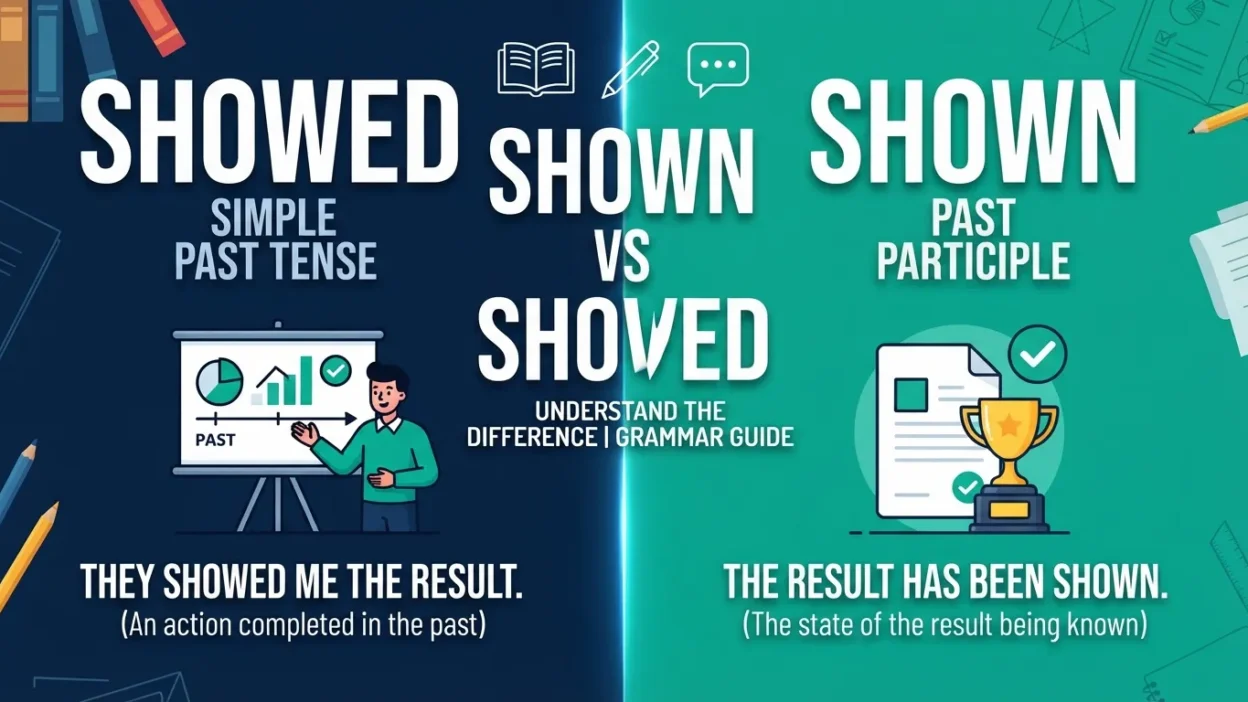
“Shown” and “showed” come from the same verb, show, so it is easy to wonder whether they can be used interchangeably. Both words are grammatically correct, but they have different roles in a sentence. Choosing the right one depends mainly on the tense and whether you are using an auxiliary verb such as have, has, had, or be.
If you have ever hesitated between “I showed him the picture” and “I have shown him the picture,” you are not alone. This guide explains the difference between shown vs showed, with simple rules, practical examples, common mistakes, and clear explanations that work for both American and British English.
Quick Answer
Showed is the simple past tense of show.
Shown is the past participle of show, so it is normally used with an auxiliary verb such as have, has, had, or be.
- I showed her my new phone. → Simple past
- I have shown her my new phone. → Present perfect
- He had shown us the results. → Past perfect
- The results were shown on the screen. → Passive voice
A useful rule is:
Show → showed → shown
For most everyday sentences, use showed when talking about a completed action in the past without an auxiliary verb. Use shown when the grammar requires a past participle.
What Does “Showed” Mean?
Showed is the simple past form of the verb show. It describes an action that happened in the past.
You can use showed when someone presented, displayed, demonstrated, or revealed something at a particular point in the past.
Examples of “Showed”
- Sarah showed me her new apartment yesterday.
- The teacher showed us how to solve the problem.
- He showed his passport at the airport.
- I showed my friend the photograph.
- The movie showed how difficult the situation was.
In these examples, showed stands as the main verb in the simple past tense.
A helpful way to recognize it is to ask: Did the action happen in the past as a completed event? If so, “showed” may be the correct choice.
What Does “Shown” Mean?
Shown is the past participle form of show. Unlike “showed,” it generally does not work by itself as the main verb in standard perfect-tense constructions.
It commonly appears after have, has, or had:
- I have shown you the answer.
- She has shown great improvement.
- They had shown us the documents.
“Shown” is also common in the passive voice:
- The results were shown on the screen.
- The painting was shown at the gallery.
- The problem was shown to be more complicated than expected.
Therefore, “shown” is not simply another version of “showed.” It performs a different grammatical function.
Shown vs Showed: The Main Difference
The easiest way to understand the difference is to look at their grammatical forms.
| Word | Verb form | Common use | Example |
| Show | Base form | Present tense, infinitive, commands | I want to show you something. |
| Showed | Simple past | Completed past action | She showed me the photo. |
| Shown | Past participle | Perfect tenses and passive voice | She has shown me the photo. |
The key distinction is simple past vs. past participle.
Use “showed” for simple past
Use showed when the sentence describes a completed past action and no auxiliary verb requires the past participle.
Correct:
- He showed me his new car.
- We showed them the way.
- She showed her work to the manager.
Incorrect in standard English:
- He shown me his new car.
- We shown them the way.
- She shown her work to the manager.
Use “shown” with auxiliary verbs
Use shown after forms of have when creating perfect tenses.
- I have shown you the evidence.
- She has shown considerable talent.
- They had shown us the results before the meeting.
It can also appear after forms of be in passive constructions:
- The document was shown to the committee.
- The video was shown during the presentation.
- Several examples were shown to the students.
When to Use “Showed”
Use showed when you are describing something that happened in the past.
Example 1: A completed action
I showed him the email yesterday.
The action happened yesterday and is presented as a completed past event.
Example 2: A past event
She showed me her photographs after dinner.
The sentence describes a specific event that took place in the past.
Example 3: A past demonstration
The instructor showed us how to use the software.
“Showed” is correct because the instructor performed the action in the past.
Example 4: A past discovery
The test showed that the machine was working properly.
Here, “showed” is the simple past form of “show.”
When to Use “Shown”
Use shown when another verb helps form the tense or voice.
Present perfect
I have shown you the document.
The auxiliary verb “have” requires the past participle “shown.”
Present perfect with “has”
She has shown excellent leadership.
“Has shown” connects a past action or evidence with the present.
Past perfect
They had shown us the original design before making changes.
“Had shown” is the past perfect construction.
Passive voice
The results were shown to the audience.
Here, “shown” is part of a passive construction.
Infinitive with “to have”
He appears to have shown remarkable patience.
The structure “to have shown” uses the past participle because “have” is part of the perfect infinitive.
Common Mistakes With Shown and Showed
Because “shown” and “showed” are both forms of the same verb, mistakes are common. Here are some of the most frequent ones.
Mistake 1: Using “shown” by itself as simple past
Incorrect:
She shown me the picture yesterday.
Correct:
She showed me the picture yesterday.
“Yesterday” indicates a completed past action, and there is no auxiliary verb requiring a past participle.
Mistake 2: Using “showed” after “have”
Incorrect:
I have showed him the results.
Correct:
I have shown him the results.
After have, use the past participle shown in standard English.
Mistake 3: Using “showed” after “had”
Incorrect:
They had showed us the report.
Correct:
They had shown us the report.
The past perfect requires had + past participle, so “had shown” is correct.
Mistake 4: Confusing passive voice
Incorrect:
The presentation was showed to the audience.
Correct:
The presentation was shown to the audience.
After “was” in this passive construction, use the past participle shown.
American English vs British English
There is generally no major difference between American and British English regarding the basic distinction between “showed” and “shown.” Both varieties use showed as the simple past form and shown as the past participle.
For example, both American and British speakers would normally say:
- I showed him the results yesterday.
- I have shown him the results.
- The results were shown on television.
There is, however, an interesting usage variation involving the past participle. In some contexts, especially informal British English, showed may occasionally be encountered as a past participle. For example, you may hear or see forms such as “has showed.” However, has shown remains the standard and widely accepted form in modern formal English.
For professional writing, academic work, websites, business communication, and edited content, have/has/had shown is the safest choice.
Shown vs Showed Examples in Everyday English
Seeing the two forms side by side makes the distinction easier.
- I showed my brother the new website.
- I have shown my brother the new website.
- The teacher showed us the answer.
- The teacher has shown us the answer.
- She showed her ID at the entrance.
- She had shown her ID before entering.
- The report showed a significant increase.
- The report has shown a significant increase.
The first sentence in each pair uses the simple past. The second uses a perfect construction.
A Simple Trick to Remember the Difference
Think of showed as the ordinary past-tense form and shown as the form that usually needs a helping verb.
Remember this pattern:
Present: show
Past: showed
Past participle: shown
Then look for the helping verb.
If you see have, has, or had, you will normally need shown:
- have shown
- has shown
- had shown
If you are simply describing what someone did in the past, showed is usually the right choice:
- I showed
- she showed
- they showed
- we showed
This simple check can prevent most mistakes.
Quick Comparison: Showed or Shown?
| Situation | Correct form | Example |
| Simple past | Showed | He showed me the letter. |
| Present perfect | Shown | He has shown me the letter. |
| Past perfect | Shown | He had shown me the letter. |
| Passive voice | Shown | The letter was shown to me. |
| Base form | Show | He wants to show me the letter. |
Frequently Asked Questions
Is “shown” past tense?
Not exactly. Shown is the past participle of “show.” The simple past form is showed. “Shown” is commonly used with auxiliary verbs such as “has,” “have,” and “had,” as well as in passive constructions.
Is “showed” grammatically correct?
Yes. Showed is the standard simple past form of “show.” For example, “She showed me her new book” is completely correct.
Should I say “I have shown” or “I have showed”?
The standard form is “I have shown.” The word “have” is followed by the past participle, so “shown” is required in standard English.
Is it “has shown” or “has showed”?
Use “has shown.” For example: “The study has shown that regular practice can improve performance.”
Is “was showed” correct?
In standard English, the usual form is “was shown.” For example: “The documentary was shown on television.”
Is “showed” used in American English?
Yes. American English uses showed as the simple past form. It also uses shown as the standard past participle.
Is “shown” used in British English?
Yes. British English also commonly uses shown as the past participle, particularly in constructions such as “has shown,” “had shown,” and “was shown.”
Can “showed” ever be used instead of “shown”?
In some varieties or informal usage, “showed” can appear as a past participle, but shown is the standard form and is preferable in formal and professional writing.
Final Summary
The difference between shown vs showed is mainly grammatical. Showed is the simple past tense of “show,” so you use it for a completed action in the past: “She showed me the picture.” Shown is the past participle, so it normally appears with auxiliary verbs such as “have,” “has,” and “had,” or in passive constructions: “She has shown me the picture” and “The picture was shown to us.”
The easiest way to remember the distinction is show → showed → shown. When you are talking about a straightforward past action, choose showed. When your sentence uses a perfect tense or passive voice, shown is usually the correct choice. Both American and British English follow essentially the same rule, making this distinction useful wherever you write or speak English.
Actionable Takeaway
Before choosing between showed and shown, check what comes before the verb:
- No auxiliary + completed past action → showed
- Have/has/had + past participle → shown
- Passive construction → shown
Correct: “I showed her the photo.”
Correct: “I have shown her the photo.”
Correct: “The photo was shown to her.”

Orvian Treloux works on the Wordifs site developing structured blogs coordinating via wordifs@gmail.com to ensure accuracy originality clarity usefulness engagement and long term trust among global readers across digital platforms.