
English has plenty of words that look or sound alike but carry completely different meanings. That is why terms such as homophone, homograph, and homonym can be confusing even for strong English speakers.
If you have ever wondered why pair and pear are different words that sound the same, or why lead can have two meanings and two pronunciations, you are dealing with these word relationships.
The good news is that the difference becomes much easier once you focus on two things: spelling and pronunciation. This guide breaks down homophone vs homograph vs homonym with clear definitions, practical examples, a comparison table, common mistakes, and easy memory tricks you can use in everyday English.
Quick Answer
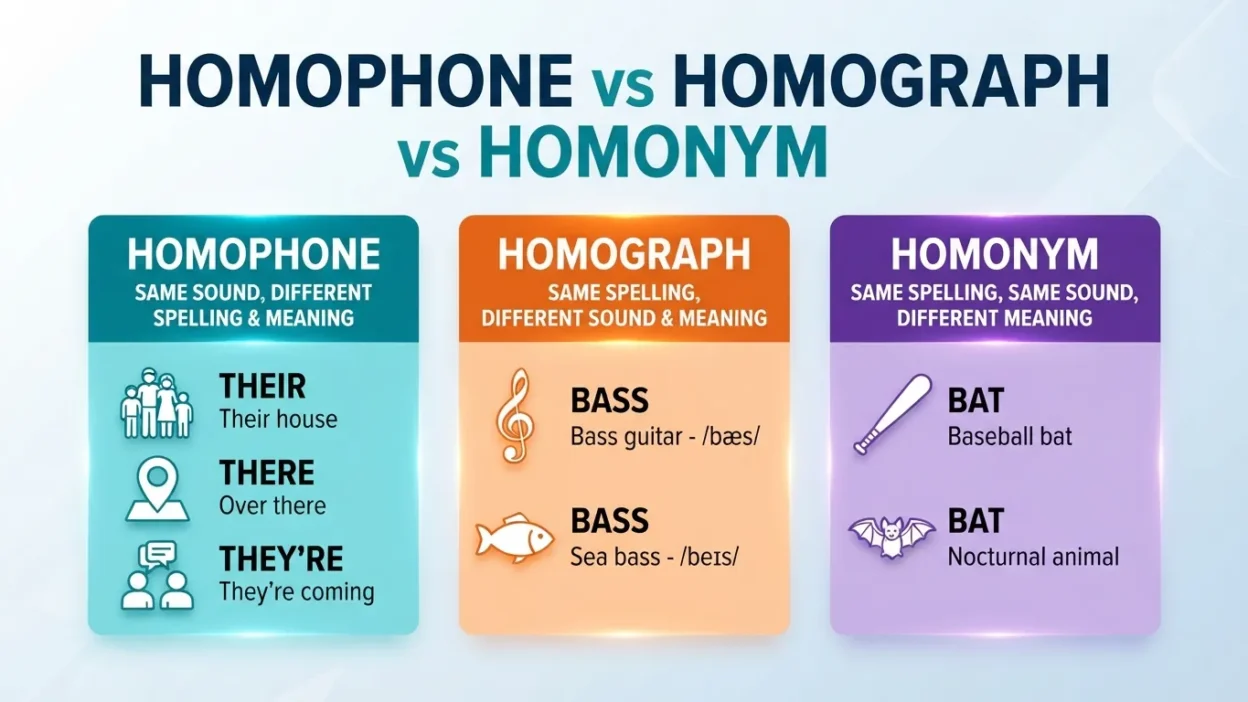
- Homophones are words that sound the same but have different meanings and usually different spellings. Example: flower and flour.
- Homographs are words that are spelled the same but have different meanings. Their pronunciation may be the same or different. Example: lead (to guide) and lead (a metal).
- Homonyms are words that share the same spelling, pronunciation, or both, while having different meanings. The exact definition can vary between dictionaries and language studies.
A simple way to remember them is:
Homophone = same sound
Homograph = same spelling
Homonym = same word form, different meaning
What Is a Homophone?
A homophone is a word that sounds the same as another word but has a different meaning. In many cases, homophones also have different spellings.
The word homo means “same,” while phone relates to sound. So, you can think of a homophone as a word with the same sound.
For example:
- flower / flour
- sea / see
- right / write
- pair / pear
- to / too / two
- brake / break
Consider this sentence:
She picked a flower while her mother measured the flour.
Both words are pronounced alike, but they have completely different meanings.
Homophones can be especially tricky in writing because listening alone does not tell you which spelling is correct. Context is what reveals the intended word.
More Homophone Examples
| Homophone | Meaning |
| bare / bear | uncovered / animal |
| knight / night | medieval soldier / period of darkness |
| one / won | number / past tense of win |
| peace / piece | absence of conflict / portion |
| mail / male | postal system / biological sex |
| weak / week | not strong / seven days |
What Is a Homograph?
A homograph is a word that is spelled the same as another word but has a different meaning. The pronunciation can be either the same or different.
The word graph relates to writing or something written, which makes same spelling a useful clue.
One of the clearest examples is lead:
- lead /liːd/ = to guide someone
- lead /lɛd/ = a heavy metal
For example:
She will lead the team.
But:
The pipe was made of lead.
The spelling is identical, but the pronunciation and meaning are different.
Another example is wind:
- wind /waɪnd/ = to twist or turn
- wind /wɪnd/ = moving air
Example:
Wind the clock carefully.
And:
The strong wind damaged the fence.
These are often called heteronyms or heterographs in more specialized discussions when identical spelling is associated with different pronunciation.
What Is a Homonym?
A homonym is the broadest and potentially most confusing term of the three.
In general English usage, homonyms are words that have the same form but different meanings. Depending on the definition being used, that can mean they have the same spelling, the same pronunciation, or both.
For example:
- bat = a flying mammal
- bat = an object used in sports
Both are spelled bat and pronounced the same way, but their meanings are unrelated.
Another example is bank:
- bank = a financial institution
- bank = the side of a river
The pronunciation and spelling are identical, while the meanings are different.
This is where terminology can overlap. Some linguistic classifications treat certain homophones and homographs as types of homonyms, while other sources use homonym more narrowly. Therefore, you may see slightly different definitions depending on the dictionary, textbook, or linguistic source.
Homophone vs Homograph vs Homonym: Comparison
| Feature | Homophone | Homograph | Homonym |
| Same pronunciation? | Yes | Sometimes | Often, depending on definition |
| Same spelling? | Usually no | Yes | Often yes, depending on definition |
| Different meaning? | Yes | Yes | Yes |
| Main clue | Sound | Spelling | Same word form |
| Example | sea / see | lead / lead | bat / bat |
The easiest distinction is to ask yourself what exactly is “the same.”
Same sound? → Homophone
Same spelling? → Homograph
Same form with different meanings? → Homonym
How Homophones, Homographs, and Homonyms Overlap
These categories are not always completely separate.
For instance, bat can be described as a homonym because it has the same spelling and pronunciation but different meanings. It is also sometimes described as a perfect homonym.
A pair such as sea and see is clearly a homophone because the pronunciation matches while the spelling differs.
Meanwhile, lead is a classic homograph because its spelling is identical but its pronunciation changes depending on its meaning.
This overlap explains why different educational resources sometimes seem to disagree. Linguistic terminology can be more precise than everyday dictionary definitions, and the classification system being used matters.
Homonym vs Homophone
The biggest difference between a homonym and a homophone is the feature being emphasized.
A homophone focuses specifically on pronunciation. The words sound alike.
A homonym focuses on words that have the same form while carrying different meanings. In broader definitions, homophones can fall under the larger homonym category.
For example:
- right and write → homophones
- bat and bat → homonyms
- bank and bank → homonyms
If you are answering a grammar question, always check how the particular source defines homonym.
Homograph vs Homophone
These two are easier to distinguish because they focus on opposite features.
A homograph has the same spelling.
A homophone has the same sound.
For example:
Homograph:
tear = a drop from your eye
tear = to rip something
Homophone:
son = male child
sun = the star at the center of our solar system
A useful memory trick is:
- Graph → writing → spelling
- Phone → sound → pronunciation
Common Mistakes to Avoid
1. Assuming all homophones are spelled the same
They are usually spelled differently. If two words are pronounced alike but written differently, they are homophones.
Their, there, and they’re are a classic example.
2. Thinking every homograph is pronounced the same
Not necessarily. Some homographs have different pronunciations.
Lead and wind demonstrate this clearly.
3. Treating “homonym” as having one universal definition
The term homonym is used differently across dictionaries and linguistic contexts. Some definitions are broad, while others distinguish homophones and homographs more strictly.
4. Choosing a word based only on pronunciation
When writing, listen for context. Their, there, and they’re sound alike in many varieties of English, but they perform different grammatical functions.
5. Confusing multiple meanings with homonyms
A word having several related meanings is often described as polysemy, rather than separate homonyms. For example, a word may develop several connected senses over time. The distinction between polysemy and homonymy can be complex and is an important topic in linguistics.
American vs British English Differences
The basic concepts of homophones, homographs, and homonyms are the same in American and British English. However, pronunciation differences between varieties can affect whether two words are actually homophones for a particular speaker.
For example, words that sound identical in one English variety may have slightly different pronunciations in another. Accent and regional pronunciation can therefore influence spoken word relationships.
Spelling differences between American and British English can also create additional confusion. Examples include color/colour, center/centre, and realize/realise. These are not normally homophones or homographs simply because the meanings are identical; they are spelling variants of the same words.
So, when identifying a homophone, focus on the pronunciation used in the variety of English being discussed.
Easy Trick to Remember the Difference
If you regularly mix these terms up, use this three-question test:
1. Do they sound the same?
If yes, think homophone.
2. Are they spelled the same?
If yes, think homograph.
3. Do they share the same form but have different meanings?
They may be homonyms, depending on the classification being used.
Think of it as:
PHONE = sound
GRAPH = spelling
NYM = name/word
This simple method makes the terminology much easier to remember.
Why These Word Types Matter
Understanding these word relationships is useful beyond grammar tests. Homophones are particularly important for spelling, proofreading, writing, and reading comprehension because a wrong spelling can change the meaning of a sentence.
Homographs and homonyms are equally valuable for understanding context. When a word has multiple meanings, readers use the surrounding words to determine what the writer intends.
For students, writers, editors, and English learners, recognizing these patterns can improve vocabulary and reduce common spelling mistakes.
FAQs
Is “sea” and “see” a homophone?
Yes. Sea and see have the same pronunciation but different spellings and meanings, making them homophones.
Is “lead” a homograph?
Yes. Lead can refer to guiding someone or to the metal. The spelling is the same, while the pronunciation and meanings differ.
Is “bat” a homonym?
Yes, under the common definition of homonym. Bat can refer to a flying mammal or sports equipment, with the same spelling and pronunciation but different meanings.
Are homophones and homonyms the same thing?
Not always. A homophone specifically involves the same pronunciation, whereas homonym is a broader or differently defined category depending on the linguistic system being used.
What is the easiest way to remember homophones and homographs?
Remember phone = sound and graph = writing. Homophones share a sound, while homographs share spelling.
Can one word be both a homograph and a homonym?
Yes. Under broad classifications, a word such as bat can be considered both a homograph and a homonym because the forms have the same spelling and pronunciation but different meanings.
Are homophones always spelled differently?
Not necessarily. Some words can have the same pronunciation and spelling while having different meanings. However, the term homophone is most commonly used when distinguishing words with the same sound but different spelling or meaning.
Why are these terms confusing?
The main reason is that homophone, homograph, and homonym can overlap, and different linguistic sources use slightly different definitions. Focusing on sound, spelling, and meaning makes the distinctions much easier.
Summary
The difference between homophone vs homograph vs homonym comes down to the relationship between spelling, pronunciation, and meaning. Homophones share a sound, homographs share spelling, and homonyms generally describe words with the same form but different meanings. Because linguistic definitions of “homonym” vary, some words can belong to more than one category.
When you encounter a confusing pair of English words, do not rely on the terminology alone. Ask whether the words sound alike, look alike, or both, and then check how their meanings differ. This approach is more reliable for everyday writing, spelling, and vocabulary than trying to memorize complicated definitions.
Actionable Takeaway
Use this quick formula whenever you get stuck:
Same sound → Homophone
Same spelling → Homograph
Same form + different meanings → Homonym
Practice with pairs such as flower/flour, lead/lead, and bat/bat. Once you start identifying the shared feature sound, spelling, or form the difference between these three terms becomes much easier to recognize.