Have you ever typed “to bad” and wondered whether it should actually be “too bad”? You are not alone. These two phrases sound almost identical when spoken, but only one is normally correct when you mean something unfortunate, disappointing, or regrettable.
The correct expression is “too bad.” The word too means “to an excessive degree” or, in the expression “too bad,” indicates that something is unfortunate or regrettable. “To bad” is generally a spelling or usage mistake when used with this meaning. Let’s look at the difference, examples, common mistakes, and an easy way to remember it.
Quick Answer
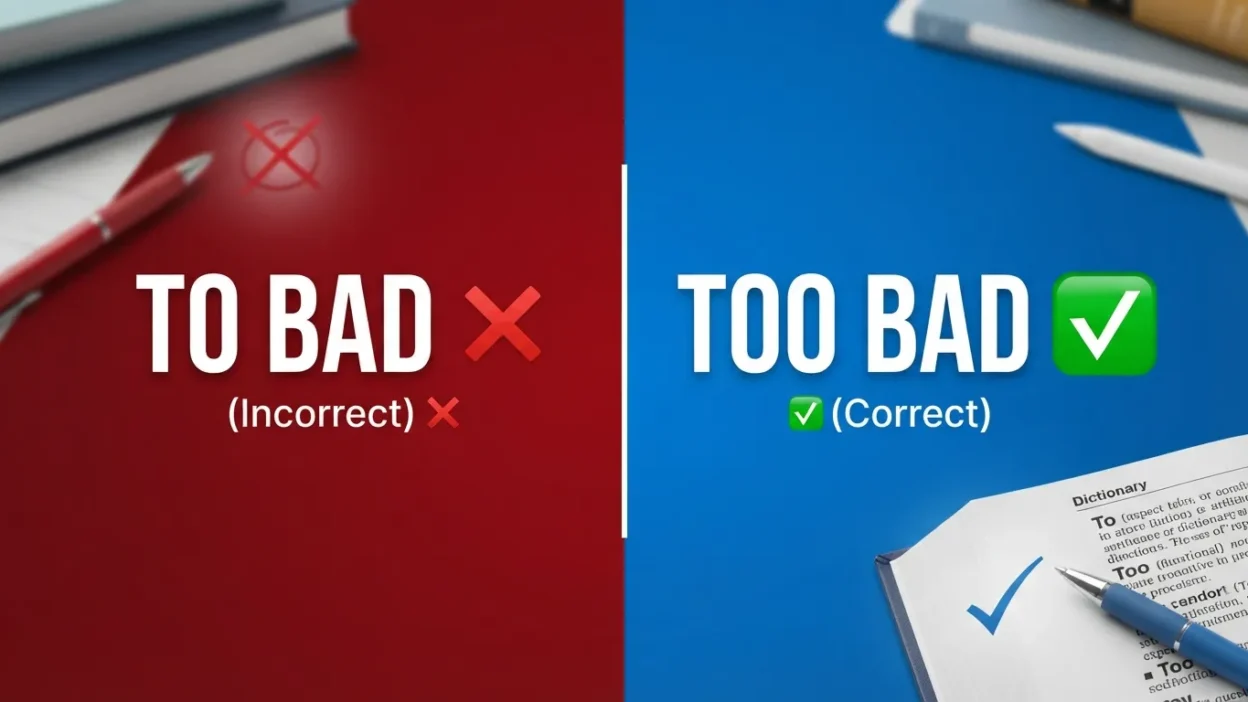
“Too bad” is correct when you mean that something is unfortunate, disappointing, or regrettable.
- ✅ Too bad you missed the concert.
- ✅ That’s too bad.
- ❌ To bad you missed the concert.
- ❌ That’s to bad.
The word to is usually used before a verb or to indicate direction, while too can mean “also” or “more than necessary.”
What Does “Too Bad” Mean?
“Too bad” is an English expression used to show disappointment, sympathy, regret, or dissatisfaction about a situation.
For example:
Too bad you couldn’t come to the party.
This means it is unfortunate that the person could not attend.
The expression can also be used by itself:
“I didn’t get the job.”
“Oh, that’s too bad.”
Here, “too bad” expresses sympathy or disappointment.
Depending on context and tone, however, “too bad” can sometimes sound sarcastic or dismissive.
“You forgot your umbrella?”
“Too bad. It’s raining.”
The exact meaning depends on the speaker’s tone and the situation.
To vs. Too: What’s the Difference?
The easiest way to understand to bad or too bad is to first understand the difference between to and too.
| Word | Main Use | Example |
| to | Shows direction, destination, or is used before a verb | We went to school. |
| too | Means “also” or “excessively” | I want to go too. |
| too | Forms expressions such as “too bad” | Too bad you missed it. |
When to Use “To”
To is commonly used as a preposition showing movement, direction, or a relationship between words.
Examples:
- She went to the store.
- I gave the book to James.
- We are going to London.
- I want to learn English.
- He decided to leave early.
It can also appear before the base form of a verb:
I need to study tonight.
In these examples, to does not mean “also” or “excessively.”
When to Use “Too”
Too has two major meanings.
First, it can mean “also.”
- I want to come too.
- She likes coffee too.
- He was invited too.
Second, too can mean “more than is desirable or necessary.”
- The coffee is too hot.
- This bag is too heavy.
- The room is too small.
In “too bad,” the word “too” belongs to the expression used to describe something unfortunate or disappointing.
Why “Too Bad” Is Correct
The phrase “too bad” has become an established English expression. It is used to describe an unfortunate situation or to express regret.
Consider this sentence:
Too bad we arrived late.
Here, too is the correct spelling because the phrase is “too bad,” not “to bad.”
Another example:
It’s too bad that the store was closed.
This sentence means that it is unfortunate that the store was closed.
Writing “It’s to bad that the store was closed” is incorrect in standard English.
Examples of “Too Bad” in Sentences
Here are some natural examples you can use in everyday English:
- Too bad you couldn’t join us.
- It’s too bad that the game was canceled.
- That’s too bad; I was hoping to see you there.
- Too bad the weather changed so quickly.
- It’s too bad she missed the opportunity.
- Too bad we didn’t know about the sale earlier.
- That’s too bad, but there will be another chance.
- Too bad you forgot your phone at home.
- It’s too bad that they had to leave early.
- Too bad I didn’t bring my camera.
These examples show how “too bad” can express disappointment, sympathy, or regret.
“Too Bad” Can Have Different Tones
One important detail is that “too bad” does not always sound exactly the same.
Sympathy
“I couldn’t attend the wedding.”
“That’s too bad.”
Here, the speaker is expressing sympathy.
Regret
It’s too bad we didn’t book the tickets earlier.
The speaker regrets what happened.
Disappointment
Too bad the restaurant was closed.
The speaker is disappointed by the situation.
Sarcasm or Dismissal
“I lost the game.”
“Too bad.”
Depending on the speaker’s tone, this could sound unsympathetic or sarcastic.
Therefore, context matters when using the expression in conversation.
Common Mistakes With “To Bad” and “Too Bad”
The biggest mistake is choosing to simply because it sounds like too.
Mistake 1: Writing “to bad”
❌ To bad you missed the show.
✅ Too bad you missed the show.
The expression is always spelled “too bad.”
Mistake 2: Confusing “too” with “to”
❌ I want too go home.
✅ I want to go home.
Here, to comes before the verb “go,” so “too” would be incorrect.
Mistake 3: Forgetting the second “o”
Because to and too are pronounced similarly, it is easy to type the wrong word.
A useful proofreading trick is to ask yourself:
Am I saying “also” or “excessively”?
If yes, too is probably the right choice.
“Too Bad” vs. “To Bad” Comparison
| Phrase | Correct? | Meaning | Example |
| Too bad | ✅ Yes | Unfortunate or disappointing | Too bad you missed the bus. |
| To bad | ❌ Usually no | Not the correct expression | To bad you missed the bus. |
| To | ✅ Yes | Direction or infinitive marker | I went to school. |
| Too | ✅ Yes | Also or excessively | She is too tired. |
The key point is simple: when you mean “unfortunate,” use “too bad.”
Is “To Bad” Ever Correct?
The sequence “to bad” can technically appear when to has its normal grammatical function and bad is part of a larger construction, but this is uncommon and does not create the familiar expression.
For example, you might encounter a sentence where to belongs to a preceding grammatical structure and bad begins a separate phrase. However, if your intended meaning is “unfortunate” or “disappointing,” the standard expression is “too bad.”
This distinction is important because simply seeing the words next to each other does not always determine grammar. Context always matters.
American vs. British English
There is no meaningful American-versus-British spelling difference for this expression.
Both American English and British English use:
“too bad”
For example:
- American English: That’s too bad.
- British English: That’s too bad.
The phrase is understood across major varieties of English.
British speakers may also use other expressions depending on the context, such as “what a shame” or “that’s unfortunate,” but “too bad” remains understandable and grammatically standard.
How to Remember “Too Bad”
A simple memory trick can help:
“Too” has two O’s because “too bad” means more than simply “bad” in the expression.
Another useful method is to remember that too can often be replaced by “also” or “excessively.”
For example:
- I am coming too. → I am coming also.
- It is too cold. → It is excessively cold.
- Too bad you missed it. → It is unfortunate that you missed it.
By contrast, to is commonly associated with direction or an infinitive:
- Go to school.
- Give it to me.
- I want to eat.
“Too Bad” in Formal and Informal English
“Too bad” is common in everyday conversation and informal writing.
For formal writing, you may sometimes prefer more precise alternatives:
- Unfortunately
- It is unfortunate that…
- It is regrettable that…
- This is disappointing.
- It is unfortunate to learn that…
For example:
Informal:
Too bad the meeting was canceled.
More formal:
It is unfortunate that the meeting was canceled.
The appropriate choice depends on your audience and the tone you want.
Frequently Asked Questions
Is “to bad” correct?
Usually, no. If you mean that something is unfortunate or disappointing, the correct expression is “too bad.”
Is it “too bad” or “to bad”?
The correct phrase is “too bad.” For example: “It’s too bad you couldn’t come.”
What does “too bad” mean?
“Too bad” generally means that something is unfortunate, disappointing, or regrettable. It can also express sympathy.
Can “too bad” sound rude?
Yes. Depending on tone and context, “too bad” can sound sympathetic, neutral, sarcastic, or dismissive.
Is “too bad” correct in American English?
Yes. “Too bad” is standard in American English.
Is “too bad” correct in British English?
Yes. British English also uses “too bad.” There is no spelling difference between the two varieties.
What is an easy way to remember “too bad”?
Remember that the expression meaning “unfortunate” is spelled with two O’s: too bad.
What are alternatives to “too bad”?
Depending on the context, you can say “that’s unfortunate,” “what a shame,” “that’s disappointing,” or simply “unfortunately.”
Final Summary
If you are wondering whether “to bad or too bad” is correct, the answer is straightforward: “too bad” is the correct expression when you mean something is unfortunate, disappointing, or regrettable. The phrase is common in everyday English and works naturally in both American and British English.
Remember that to is generally used for direction or before a verb, while too can mean “also” or “excessively.” When expressing disappointment with the phrase “too bad,” always use the spelling with two O’s. Once you connect “too” with its meanings of “also” and “excessively,” the correct choice becomes much easier to remember.
Actionable Takeaway
Before writing to bad, stop and ask what you mean. If you mean “unfortunate,” “disappointing,” or “regrettable,” write “too bad.”
Correct: Too bad you missed the party.
Incorrect: To bad you missed the party.

Kalven Driost works on the Wordifs site producing reliable content while communicating through wordifs@gmail.com to support research editing publishing consistency transparency and audience focused knowledge sharing practices for modern readers.