If you have ever wondered whether to write “infront” or “in front,” you are not alone. This is a common English spelling and grammar question, especially when writing quickly or relying on how the phrase sounds. The good news is that the correct form is simple once you understand how the words work together.
The correct spelling in standard English is “in front” two separate words. “Infront” is generally considered incorrect when you mean something is positioned ahead of or before something else. In this guide, you will learn the meaning, grammar rules, examples, common mistakes, and the difference between American and British English.
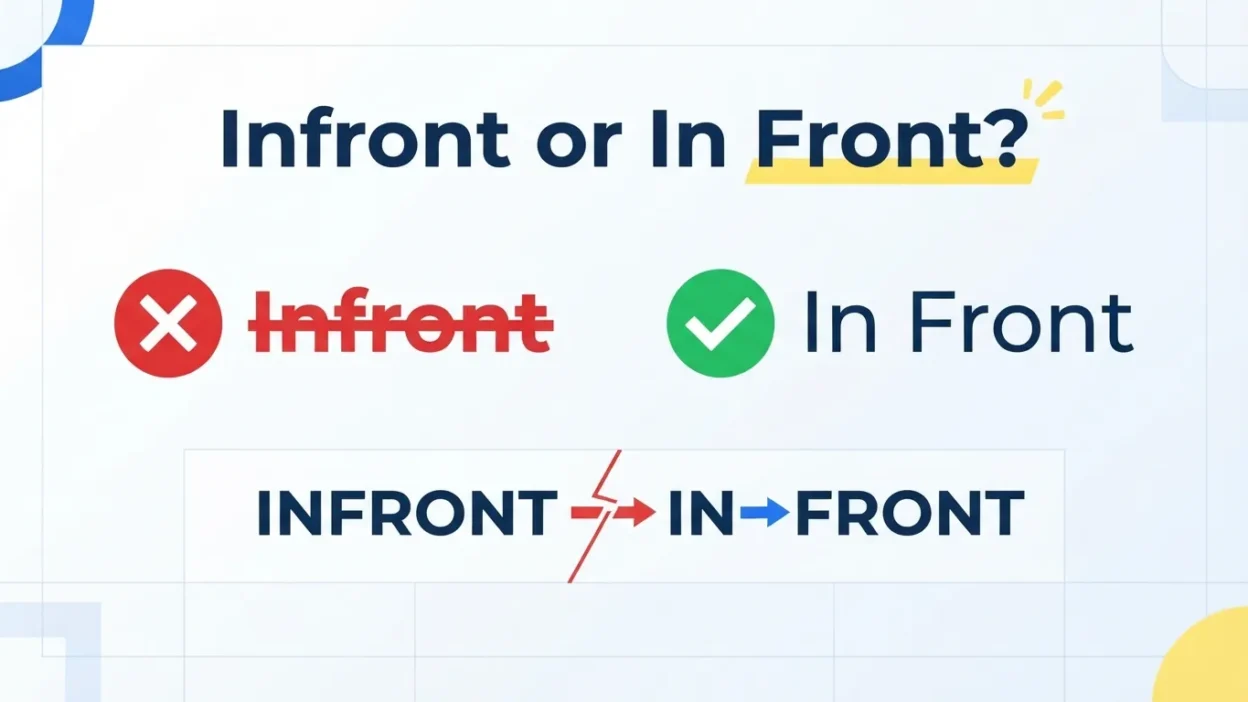
Quick Answer:
“In front” is correct. “Infront” is incorrect in standard English.
The phrase in front is written as two words and is commonly used to describe the position of a person or thing, or to indicate that something is ahead of something else.
- Correct: The car is parked in front of the house.
- Correct: She stood in front of me.
- Incorrect: The car is parked infront of the house.
- Incorrect: She stood infront of me.
There is no standard English situation in which “infront” should normally replace “in front.”
What Does “In Front” Mean?
In front is a phrase that describes a position ahead of, before, or facing something or someone.
It can refer to a physical location:
The children are playing in front of the school.
Here, the children are positioned in an area ahead of or outside the front part of the school.
It can also describe a person’s position relative to another person:
Please sit in front of me.
In this sentence, one person is positioned ahead of another.
The phrase can also have a figurative meaning, particularly when discussing progress, leadership, or visibility:
Our team is in front by five points.
In this context, in front means leading or having a higher position.
Why Is “In Front” Two Words?
The expression in front consists of the preposition in and the noun front. Together, they form a prepositional phrase.
For example:
in + front + of + the house
This creates the phrase:
in front of the house
Because in front functions as a phrase rather than a single standard compound word, it is written separately.
This is similar to other commonly used expressions such as:
- in back
- in between
- in advance
- in detail
- in place
- in line
Although English contains many compound words, not every frequently used combination becomes one word.
In Front vs. Infront: Comparison Table
| Form | Correct? | Usage | Example |
| in front | Yes | Standard English phrase | She is standing in front of the door. |
| infront | No | Nonstandard spelling | She is standing infront of the door. |
| in front of | Yes | Shows position relative to something | The bus stopped in front of the station. |
| infront of | No | Incorrect spelling | The bus stopped infront of the station. |
When writing an essay, email, article, school assignment, business document, or professional message, always use “in front.”
Examples of “In Front” in Sentences
Seeing the phrase in different contexts makes the rule easier to remember.
Physical Position
- The teacher is standing in front of the class.
- There is a large tree in front of our house.
- My car is parked in front of the building.
- A dog was sitting in front of the gate.
- Please wait in front of the restaurant.
Position Relative to a Person
- He walked in front of me.
- She sat in front of her friend.
- Don’t stand in front of the camera.
- The child ran in front of his mother.
- Someone was waiting in front of us.
Figurative or Abstract Meaning
The phrase does not always refer to physical location.
- Our company is in front of its competitors.
- The runner moved in front during the final lap.
- She is in front in the latest survey.
- The team is currently in front by two goals.
In these examples, in front can mean leading or being ahead.
“In Front Of” vs. “In Front”
A particularly important distinction is between in front and in front of.
Use in front of when you are identifying what or whom something is positioned ahead of.
For example:
The bicycle is in front of the garage.
Here, the garage identifies the reference point.
You can also use in front without of when the context is already clear:
Which team is leading?
Brazil is in front.
Another example:
Who is standing ahead?
John is in front.
So, “in front of” is not a different spelling. It is simply the longer form of the phrase used when a reference point follows it.
Common Mistakes With “Infront”
The biggest mistake is combining the two words.
Mistake 1: Writing “Infront”
Incorrect:
The teacher stood infront of the students.
Correct:
The teacher stood in front of the students.
Mistake 2: Writing “Infront Of”
Capitalizing the phrase does not make the spelling correct.
Incorrect:
The store is Infront Of the bank.
Correct:
The store is in front of the bank.
Mistake 3: Using “In Front” as One Word in Formal Writing
You may occasionally see infront in informal online writing, comments, texts, or user-generated content. That does not make it standard English.
If accuracy matters, use the established two-word form: in front.
Is “Infront” Ever Correct?
For normal English writing, no. If you mean the position ahead of someone or something, in front is the standard form.
You might encounter infront online as a typo, username, brand name, domain name, or other proper name. In those special cases, it may appear intentionally as part of a name. But that does not change the standard spelling of the English phrase.
For ordinary grammar and writing, remember:
In front = correct
Infront = incorrect
American vs. British English: Is There a Difference?
There is no meaningful American-versus-British spelling difference for this phrase.
Both American English and British English use:
in front
For example:
American English:
The school is in front of the park.
British English:
The school is in front of the park.
The spelling remains the same in both varieties.
This is useful because some English words have different American and British spellings, such as color/colour and center/centre. However, in front is not one of those cases.
How to Remember “In Front”
A simple memory trick is to think about the phrase as two separate ideas:
in + front
The word front is a normal noun, while in tells you about its position or relationship.
Try remembering this sentence:
I am standing in the front.
Even though the natural phrase in many contexts is in front, thinking of in and front separately can help prevent the common mistake of joining them.
Another useful rule is:
If you can say “in front of,” write “in front” as two words.
For example:
- in front of the house
- in front of the car
- in front of me
- in front of the store
- in front of the audience
When Should You Use “In Front”?
Use in front when you want to describe something that is ahead of another object or person, or when you want to indicate a leading position.
Common contexts include:
- Location: The bus is in front of the station.
- People: She stood in front of me.
- Objects: Put the chair in front of the desk.
- Events: He spoke in front of hundreds of people.
- Competition: Our team is in front.
- Visibility: The sign is clearly visible in front.
This makes in front a highly useful phrase in everyday conversation and formal writing.
In Front in Everyday English
You will hear and read in front constantly in everyday English.
Consider these natural examples:
“I’ll meet you in front of the library.”
“Don’t park in front of the entrance.”
“The children are sitting in front of the television.”
“She was nervous about speaking in front of everyone.”
Notice that the spelling never changes to infront, even when the phrase is used frequently.
FAQs
Is “infront” one word?
No. Infront is not the standard spelling of the phrase. The correct form is in front, written as two words.
Is “in front” grammatically correct?
Yes. In front is a standard English phrase used to describe position, location, or being ahead of someone or something.
Which is correct: “infront of” or “in front of”?
In front of is correct. The word infront should not be used in standard English.
Is “in front” American or British English?
It is used in both American English and British English. There is no spelling difference between the two varieties.
Can I use “infront” in formal writing?
You should not. In essays, professional documents, academic writing, websites, and other formal contexts, use in front.
Why do people write “infront”?
People often write infront because the phrase is pronounced naturally as a connected unit in speech. Fast typing and informal online writing can also lead to the two words being combined.
Is “in front of me” correct?
Yes. In front of me is completely correct.
Example:
The person standing in front of me is my brother.
What is the opposite of “in front”?
Depending on the context, common opposites include behind, at the back, or in back of. For example, “The car is in front of the house” contrasts with “The car is behind the house.”
Final Summary
The answer to “infront or in front?” is straightforward: in front is the correct standard English form. It should be written as two separate words, whether you are using it to describe a physical location, someone’s position, or a leading position.
Infront is generally a spelling error when used as the ordinary English phrase. This rule applies equally to American and British English. When writing anything where correct grammar and spelling matter, choose in front and in front of.
Actionable Takeaway
Before publishing or submitting your writing, check for “infront.” If you are using it to mean ahead of, before, or positioned near the front of something, separate the words.
Remember: In front = correct. Infront = incorrect.