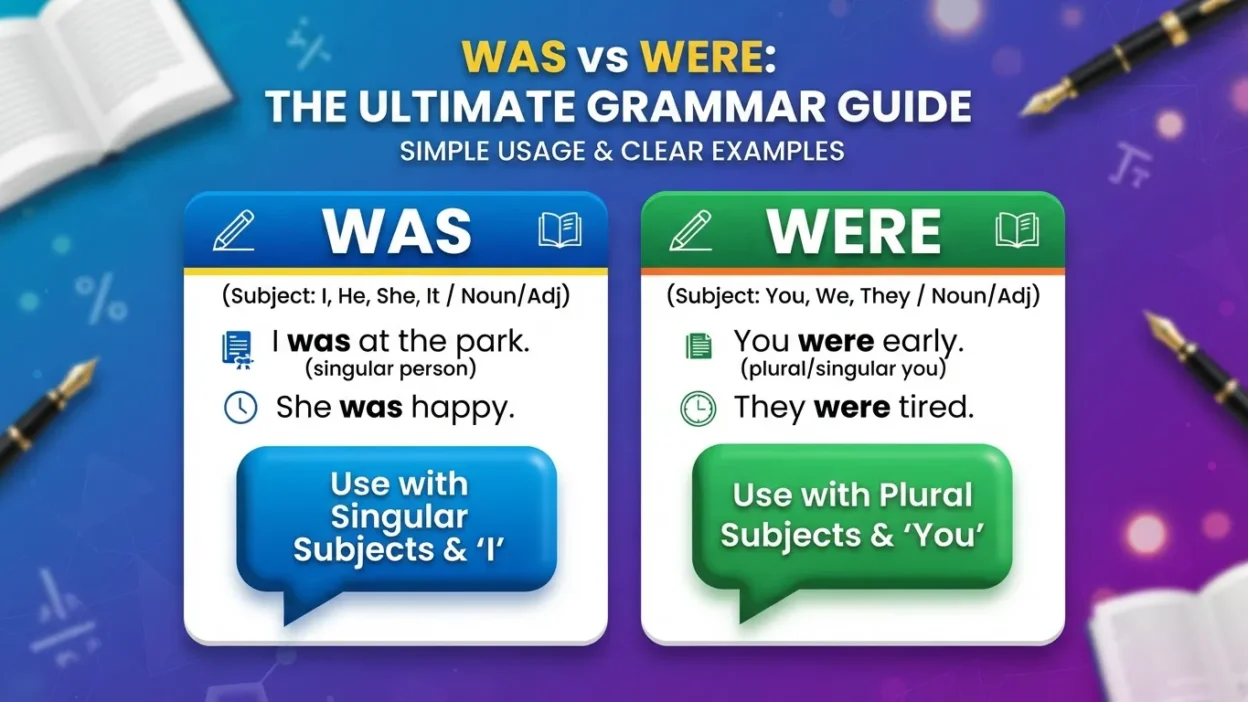
Was vs Were becomes easier when you understand the main difference between these forms of the verb to be in the simple past tense and know which subject each form agrees with. Was is used with singular subjects, such as the first person “I was” and the third person “he was,” while were works with the second-person singular “you were” and plural subjects like “they were” and “we were.” These regular simple past tense forms are not always interchangeable, so recognizing the subject is the first key to making the right choice.
The subjunctive mood changes the pattern when people are talking about hypothetical situations, wishful thinking, or an imaginary situation. In this setting, were can appear with the first-person singular and third-person singular. For instance, “If I were you” describes an unreal or imagined situation. Words and expressions such as if, wish, and as though can point toward this use, while “If I was there” may describe an actual situation, depending on its meaning and context.
When choosing between these forms, useful tools include learning to identify the subject and deciding whether the sentence describes reality or a hypothetical idea. This understanding makes it easier to use the correct form naturally. The chances of making a mistake become lower when you separate ordinary past statements from hypothetical expressions and focus on the difference in how each form works.
Quick Answer
Was is normally used with singular subjects: I was, he was, she was, and it was. Were is used with you, we, and they. Use were with I in hypothetical expressions such as “If I were you.” The correct choice depends on the subject and sentence meaning.
Why Do People Confuse Was and Were?
People often confuse was and were because both are past-tense forms of be. Their meanings are closely related, but the form changes according to the subject.
For example:
- I was tired.
- She was happy.
- We were tired.
- They were happy.
The most important thing to check is the subject of the sentence.
Another reason for confusion is that were can sometimes be used with I, especially when talking about an unreal, imagined, or hypothetical situation.
Was: What Does It Mean and When Do You Use It?
Was is the past-tense form of be used mainly with singular subjects.
Both was and were are past forms of the verb be. For more details about the verb and its different forms, see the Cambridge Dictionary explanation of “be”.
Use was with:
- I
- He
- She
- It
- Singular nouns
Examples of Was
- I was at home yesterday.
- He was very tired.
- She was excited about the trip.
- It was cold last night.
- The teacher was busy.
- My brother was sick.
In these sentences, the subjects are singular, so was is normally correct.
Were: What Does It Mean and When Do You Use It?
Were is the past-tense form of be used with you, we, they, and plural nouns.
Use were with:
- You
- We
- They
- Plural nouns
Examples of Were
- You were right.
- We were late.
- They were happy.
- The students were ready.
- My friends were outside.
- The books were on the table.
There is one important exception to remember: were can also be used with I in hypothetical or unreal situations.
For example:
If I were you, I would apologize.
Here, “I were” is correct because the sentence describes a hypothetical situation.
Was vs Were Comparison Table
| Subject | Correct Form | Example |
| I | Was | I was tired. |
| He | Was | He was busy. |
| She | Was | She was happy. |
| It | Was | It was raining. |
| You | Were | You were right. |
| We | Were | We were ready. |
| They | Were | They were late. |
| Singular noun | Was | The boy was hungry. |
| Plural noun | Were | The boys were hungry. |
| I + hypothetical situation | Were | If I were you, I would wait. |
When Should You Use Was or Were?
The easiest method is to identify the subject first.
Use Was With Singular Subjects
Use was with he, she, it, and singular nouns.
- The dog was asleep.
- Sarah was at school.
- My phone was on the desk.
Use Were With You
Always use were with you, whether you are talking to one person or several people.
- You were late.
- You were very helpful.
- You were invited to the party.
Use Were With We and They
Use were with plural subjects.
- We were hungry.
- They were excited.
- The children were playing.
Use Were in Hypothetical Situations
In formal or standard English, were is commonly used with I for unreal or hypothetical situations.
- If I were rich, I would travel more.
- If I were you, I would study tonight.
- I wish I were taller.
10+ Examples of Was vs Were
- I was tired after work.
- She was at the library.
- He was very nervous.
- It was a beautiful day.
- You were correct.
- We were ready to leave.
- They were at the restaurant.
- The child was asleep.
- The children were asleep.
- My parents were happy.
- The movie was interesting.
- If I were you, I would take the opportunity.
- If she were here, she could help us.
- I wish it were easier.
- We were surprised by the news.
Common Mistakes With Was and Were
Mistake 1: Using Was With You
❌ You was late.
✅ You were late.
You always takes were in the past tense of be.
Mistake 2: Using Were With They
❌ She were tired.
✅ She was tired.
Use was with singular third-person subjects such as he and she.
Mistake 3: Using Was With They
❌ They was happy.
✅ They were happy.
They takes were.
Mistake 4: Saying “If I Was You”
In everyday conversation, you may hear:
If I was you…
But the traditional standard form for a hypothetical situation is:
If I were you, I would talk to him.
For formal writing, If I were you is the safer choice.
Easy Memory Trick for Was vs Were
Remember this simple pattern:
I / He / She / It → WAS
You / We / They → WERE
Think:
I was, he was, she was, it was.
You were, we were, they were.
Then remember the special expression:
If I were you…
This one phrase is worth memorizing because it appears frequently in everyday and formal English.
Was vs Were in American and British English
The basic rules for was and were are essentially the same in American and British English.
Both varieties use:
- I was
- He was
- She was
- You were
- We were
- They were
Both also use were in standard hypothetical expressions such as:
If I were you, I would wait.
Differences in everyday speech can occur because speakers sometimes use informal forms that differ from traditional grammar rules. However, learners should follow the standard subject–verb agreement rules, especially in formal writing.
Similar Words and Related Forms
Was and were belong to the verb be. Other forms of this verb include:
- am — I am
- is — he is, she is, it is
- are — you are, we are, they are
- was — past form for I, he, she, it
- were — past form for you, we, they
- been — past participle
- being — present participle
Understanding the complete family of be forms can make English verb agreement much easier.
Final Verdict:
The correct choice depends mainly on the subject.
Use was with I, he, she, it, and singular nouns in ordinary past-tense statements. Use were with you, we, they, and plural nouns. For hypothetical or unreal situations, were is also used with I, as in “If I were you.”
Frequently Asked Questions
Is “I was” or “I were” correct?
I was is correct for ordinary past situations.
Example: “I was tired yesterday.”
Use I were in certain hypothetical or unreal expressions, such as “If I were you.”
Is it “you was” or “you were”?
The correct standard form is you were.
Example: “You were very helpful.”
Is it “she was” or “she were”?
The correct form is she was.
Example: “She was at home.”
Is it “they was” or “they were”?
The standard form is they were.
Example: “They were happy.”
Why do we say “If I were you”?
“If I were you” describes a hypothetical situation rather than a statement about something that actually happened. Were is traditionally used for this type of unreal or hypothetical condition.
Can “was” and “were” both be past tense?
Yes. Both are past forms of the verb be, but they are used with different subjects and sentence structures.
Which is correct: “We was” or “We were”?
The standard form is we were.
Example: “We were at school yesterday.”
Is “I wish I was” correct?
In informal speech, I wish I was is common. In careful or formal English, I wish I were is traditionally preferred when expressing an unreal or hypothetical situation.
Remember This
Was → I, he, she, it
Were → you, we, they
Hypothetical I → were
The most useful examples to remember are:
- I was there.
- She was happy.
- You were right.
- We were ready.
- They were late.
- If I were you, I would go.
Conclusion
Learning was vs were becomes simple when you first identify the subject. Use was with I, he, she, and it for ordinary past statements, while were goes with you, we, and they. Singular and plural nouns follow the same basic pattern.
The main special case is the hypothetical were, especially in expressions such as “If I were you” and “I wish I were.” Once you learn this pattern and practice a few examples, choosing between was and were becomes much more natural.

Kalven Driost works on the Wordifs site producing reliable content while communicating through wordifs@gmail.com to support research editing publishing consistency transparency and audience focused knowledge sharing practices for modern readers.