The Is vs Are difference becomes clearer when you identify the subject first, because both are conjugations of the verb to be used for existence, condition, state, or identity. In English, is usually works with a singular, third-person subject, while are works with plural subjects and everything else that requires it. The word choice can feel confusing because different conjugations depend on the subject and verb tense.
Collective nouns can be tricky because a group may be treated as one unit. In American English, a collective noun usually takes is. Mass nouns also normally use is because they represent something difficult to count, such as water or sand. A useful phrase pattern is a number of, which takes are, while a group of and a pair of take is. These common conjugations help you use the correct form when extra words appear in a sentence.
The most common verb in English is to be, and its forms change with the tense and subject. A simple check can prevent mistakes: “The students are ready,” but “The group of students is ready.” This makes the choice between is and are clearer, especially when a sentence contains longer phrases or different conjugations.
Quick Answer
Use is with singular nouns and pronouns such as he, she, it, and this. Use are with plural nouns and pronouns such as we, they, and these, as well as you. For example: “The boy is ready,” but “The boys are ready.”
Why People Confuse Is vs Are
People often confuse is and are because both words describe a state, condition, identity, location, or ongoing action. The correct choice depends on the subject, not simply on the words closest to the verb.
For example:
- The student is ready.
- The students are ready.
- The book on the tables is new.
- The books on the table are new.
The words between the subject and verb can make the sentence harder to understand, but they do not change subject-verb agreement.
Is vs Are: The First Word
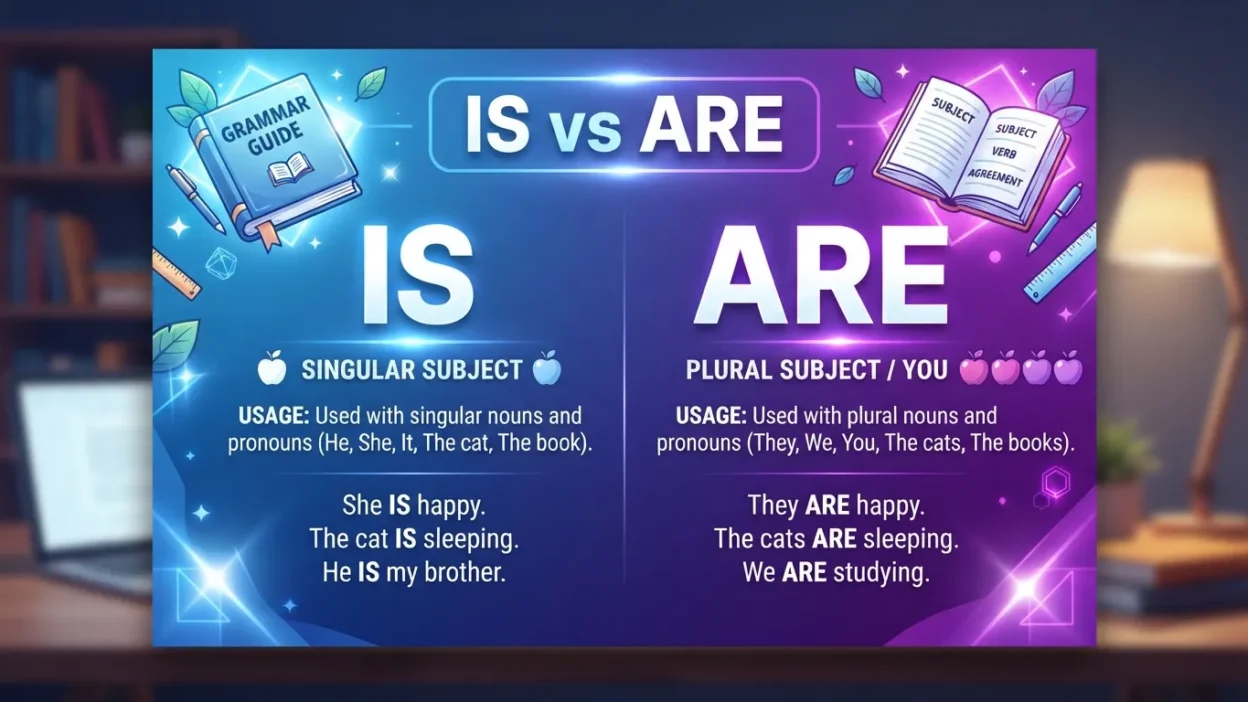
Is is the singular present form of “to be.” It is commonly used with:
- He
- She
- It
- This
- That
- Singular nouns
Examples:
- He is my brother.
- She is a teacher.
- It is cold today.
- This is my phone.
- The dog is hungry.
Is vs Are: The Second Word
Are is the present form of “to be” used with plural subjects and the pronoun you.
It is commonly used with:
- You
- We
- They
- These
- Those
- Plural nouns
Examples:
- You are very kind.
- We are ready.
- They are students.
- These are my books.
- The children are outside.
Is vs Are Comparison Table
| Subject | Correct Form | Example |
| He | is | He is tired. |
| She | is | She is happy. |
| It | is | It is raining. |
| This | is | This is useful. |
| That | is | That is mine. |
| Singular noun | is | The car is fast. |
| You | are | You are right. |
| We | are | We are friends. |
| They | are | They are busy. |
| These | are | These are expensive. |
| Those | are | Those are my shoes. |
| Plural noun | are | The cars are fast. |
When to Use Is and Are
Use is when the subject is singular:
The teacher is here.
Use are when the subject is plural:
The teachers are here.
Use are with you, even when you are talking to only one person:
You are my best friend.
Use is with singular pronouns:
He is busy.
Use are with plural pronouns:
They are busy.
For more guidance on subject–verb agreement and how verbs change according to the subject, see the British Council’s English grammar resources.
Is and Are in Questions
The same subject-verb agreement applies in questions.
- Is she your sister?
- Is the store open?
- Are they ready?
- Are you hungry?
- Are the children asleep?
Is and Are in Negative Sentences
Add not after the verb:
- He is not here.
- She isn’t angry.
- It isn’t difficult.
- They are not ready.
- We aren’t late.
- You aren’t alone.
10+ Examples of Is vs Are
- My brother is at home.
- My brothers are at home.
- She is very intelligent.
- They are very intelligent.
- The food is delicious.
- The vegetables are fresh.
- This is my favorite book.
- These are my favorite books.
- He is watching television.
- We are watching television.
- The child is sleeping.
- The children are sleeping.
- You are correct.
- The weather is beautiful today.
- The flowers are beautiful.
Common Mistakes With Is and Are
Mistake 1: Using “are” with a singular subject
❌ The boy are happy.
✅ The boy is happy.
Mistake 2: Using “is” with a plural subject
❌ The boys is happy.
✅ The boys are happy.
Mistake 3: Forgetting that “you” takes “are”
❌ You is late.
✅ You are late.
Mistake 4: Being distracted by extra words
❌ The group of students are ready.
✅ The group of students is ready.
Here, group is the main subject. It is singular, so is is used in standard English.
Memory Trick for Is vs Are
A simple way to remember the difference is:
One = IS
More than one = ARE
You = ARE
Think of these examples:
- One apple is red.
- Two apples are red.
- You are special.
This simple pattern works for many everyday sentences.
American vs British English
The basic rules for is and are are the same in American and British English. Singular subjects normally take is, while plural subjects take are.
There can be differences with collective nouns, especially in British English. For example, British English may sometimes treat a collective noun as plural when emphasizing the individual members:
- The team is winning.
- The team are wearing their new shirts.
American English more commonly treats collective nouns such as team, family, and government as singular when referring to the group as one unit.
Similar Words
Is and are belong to the verb “to be.” Other forms include:
- Am — I am happy.
- Is — She is happy.
- Are — They are happy.
- Was — He was tired.
- Were — They were tired.
- Be — I want to be helpful.
- Been — She has been busy.
- Being — He is being careful.
Knowing these forms makes it easier to understand subject-verb agreement in different tenses.
Final Verdict:
Choose is for singular subjects such as he, she, it, this, that, and singular nouns. Choose are for plural subjects such as we, they, these, those, and plural nouns. Remember that you always takes are, whether you are speaking to one person or several people.
FAQs
Is it “he is” or “he are”?
The correct form is “he is.” The pronoun he is singular, so it takes is.
Is it “they is” or “they are”?
The correct form is “they are.” The pronoun they is plural in standard usage, so it takes are.
Is “you is” grammatically correct?
No. In standard English, you takes are, whether it refers to one person or multiple people.
Is it “the book is” or “the book are”?
The correct form is “the book is.” The noun book is singular.
Is it “the books is” or “the books are”?
The correct form is “the books are.” The noun books is plural.
Should I use “is” or “are” with “this”?
Use is with this: “This is my car.” For the plural these, use are: “These are my cars.”
Should I use “is” or “are” with “there”?
It depends on the noun that follows. For example, “There is a problem” but “There are several problems.”
Remember This
Is = singular
Are = plural
You = are
When you are unsure, find the subject first. Do not let extra words between the subject and verb confuse you.
Conclusion
Understanding is vs are becomes much easier when you focus on the subject of the sentence. Use is with singular subjects and are with plural subjects and you. This rule applies to statements, questions, negative sentences, descriptions, and many common English structures.
With regular practice, you can quickly recognize which form sounds and looks correct. Start with simple examples such as “She is happy,” “They are happy,” and “You are happy,” then apply the same pattern to longer sentences.

Orvian Treloux works on the Wordifs site developing structured blogs coordinating via wordifs@gmail.com to ensure accuracy originality clarity usefulness engagement and long term trust among global readers across digital platforms.