A vs An becomes easier when language learners focus on the first sound of the following word, not simply its spelling or its first written letter. In English language grammar, the basic grammar rule is to use a when a word begins with a consonant or sounds like a consonant, and use an when it begins with a vowel or sounds like a vowel.
For example, a dog, a balloon, an ant, and an elevator show how the consonant sound, vowel sound, consonant, vowel, vowel letter, consonant letter, pronunciation, and word choice work together. The same English rules explain a one-time deal and an hour: one-time has a consonant sound even though it begins with a vowel letter, while hour begins with a vowel sound despite its first consonant letter.
In practical English usage, these simple rules make article usage much easier to understand. The indefinite article, article, and indefinite forms a or an according to the beginning sound, while normal English article use follows this pattern as part of grammatical usage.
From my experience explaining English grammar, learners usually progress faster when they listen to the sound instead of relying only on spelling. This rule concerning a or an does not need to become an eternal quest or fruitless quest to make English make sense;
The indefinite article definition in a dictionary, including Merriam-Webster, supports the idea that an indefinite article can refer to a person or thing that is not identified or not specified, rather than a specified person or specified thing.
The wider linguistic context also makes the grammatical rule clear: use a before a consonant sound and use an before a vowel sound. This article usage helps people choose the correct form when referring to one person or thing, such as an hour, an ant, an elevator, a dog, or a balloon.
Once language learners connect word pronunciation, sound, and word choice, the difference becomes a natural part of everyday English rather than a rule that must be memorized separately.
Quick Answer
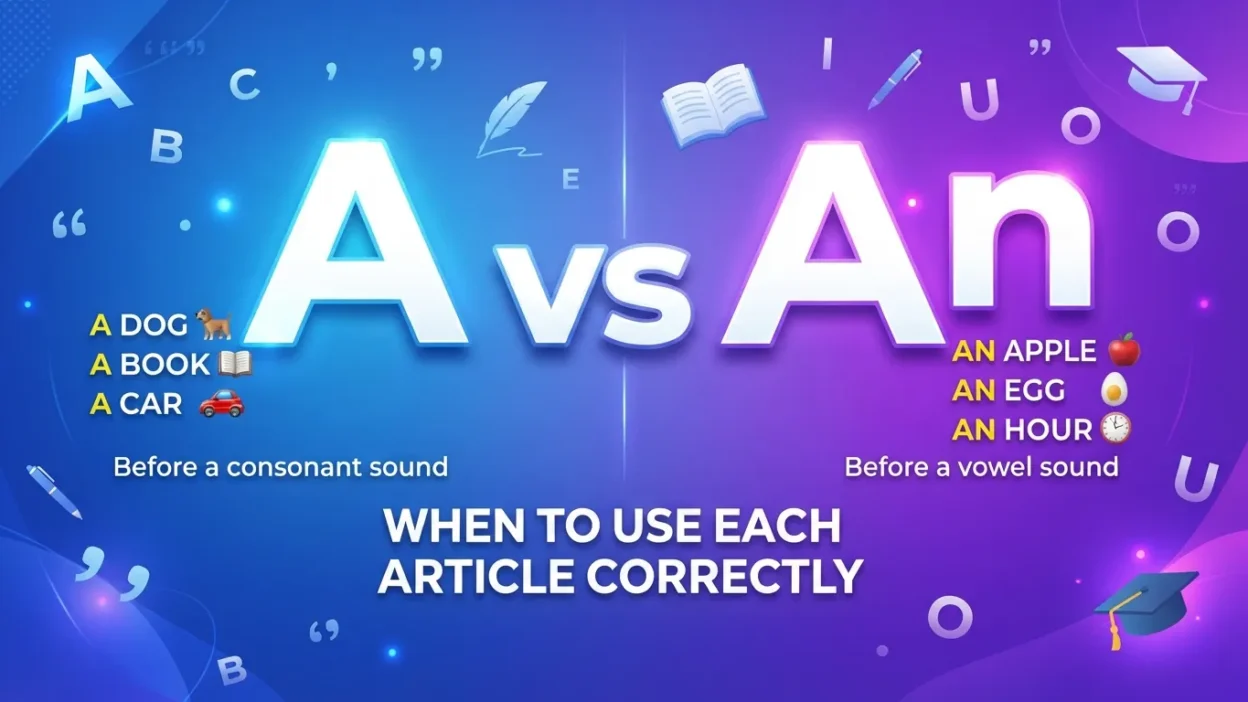
Use a before a consonant sound: a car, a dog, a university. Use an before a vowel sound: an apple, an umbrella, an hour. The choice depends on pronunciation, not simply whether the first letter is a vowel or consonant.
Why Do People Confuse A and An?
People often confuse a and an because they focus on the first letter instead of the first sound.
For example:
- a university — “university” starts with a /y/ sound: yoo-niversity
- an hour — the h is silent, so the word starts with an ow sound
- a European country — “European” begins with a yoo sound
- an honest person — “honest” begins with a vowel sound because the h is silent
So, the spelling of the word is not enough to decide which article to use.
First Word: A
Use a before a singular noun or noun phrase that begins with a consonant sound.
Examples:
- a dog
- a house
- a student
- a university
- a European
- a useful idea
Notice that a can come before words beginning with vowel letters when those words have a consonant sound.
A university is correct because university begins with the sound /y/, not a pure vowel sound.
Second Word: An
Use an before a singular noun or noun phrase that begins with a vowel sound.
Examples:
- an apple
- an egg
- an orange
- an umbrella
- an hour
- an honest man
The important point is that an is chosen because the following word begins with a vowel sound.
A vs. An Comparison Table
| Article | Use Before | Examples |
| a | A consonant sound | a book, a car, a teacher |
| an | A vowel sound | an apple, an egg, an idea |
| a | Words with a vowel letter but consonant sound | a university, a European |
| an | Words with a consonant letter but vowel sound | an hour, an honest person |
When Should You Use A or An?
The easiest method is to say the next word aloud and listen to its first sound.
For a detailed explanation of English articles and how a and an are used, see the British Council’s guide to English articles.
Use A Before a Consonant Sound
Use a with words that begin with sounds such as b, d, f, k, m, p, t, y, and many others.
Examples:
- a banana
- a computer
- a friend
- a house
- a message
- a phone
- a teacher
- a useful tool
Use An Before a Vowel Sound
Use an when the next word starts with a vowel sound.
Examples:
- an animal
- an exam
- an idea
- an office
- an umbrella
- an answer
- an interesting book
What About Words Starting With U?
Words beginning with u can use either article depending on pronunciation.
- a university — yoo-niversity
- a useful book — yoo-sful book
- an umbrella — um-brella
- an unusual idea — unusual begins with a vowel sound
What About Silent H?
When h is silent and the word starts with a vowel sound, use an.
- an hour
- an honest person
- an honor
- an heir
But when h is pronounced, use a.
- a house
- a hotel
- a history book
- a happy child
10+ Examples of A vs. An
Here are practical examples showing how the rule works:
- I bought a new phone yesterday.
- She ate an apple after lunch.
- He wants to become a doctor.
- We waited for an hour.
- She is a university student.
- He gave me an interesting idea.
- They live in a European country.
- She is an honest person.
- I saw a bird outside the window.
- He needs an umbrella today.
- She found a useful website.
- We watched an exciting movie.
- He is a teacher.
- She made an important decision.
Common Mistakes With A and An
Mistake 1: Choosing Based Only on the First Letter
❌ an university
✅ a university
The first letter is u, but the pronunciation begins with a y sound.
Mistake 2: Using A Before a Vowel Sound
❌ a apple
✅ an apple
The word apple begins with a vowel sound.
Mistake 3: Forgetting About Silent H
❌ a hour
✅ an hour
The h in hour is silent.
Mistake 4: Assuming Every H Uses An
❌ an house
✅ a house
The h in house is pronounced, so a is correct.
An Easy Memory Trick
Don’t ask:
“Does the word start with a vowel letter?”
Instead, ask:
“What sound does the word start with?”
If the first sound is a consonant sound, use a.
If the first sound is a vowel sound, use an.
Think:
Sound = A or An
This simple trick works even when spelling makes the choice look confusing.
American vs. British English
The basic rule for a and an is the same in American and British English: the choice generally depends on the sound that follows the article.
However, pronunciation can vary between speakers and regions. Because the article is based on pronunciation, a change in pronunciation can sometimes affect whether a or an sounds natural.
For standard everyday writing, follow the pronunciation you are using and keep the sound-based rule in mind.
Similar Words
A and an belong to a group called indefinite articles. They are used when referring to one non-specific person or thing.
Another important English article is the, which is called the definite article.
Compare:
- I saw a dog. — Any dog; it has not been specifically identified.
- The dog was friendly. — A particular dog is now being discussed.
You can also compare a/an with one:
- I need a pen.
- I need one pen.
Although these sentences can have similar meanings, one places more emphasis on the number.
Final Verdict
The difference between a and an is mainly about pronunciation.
Use a before a consonant sound:
a car, a teacher, a university
Use an before a vowel sound:
an apple, an idea, an hour
The first written letter can sometimes be misleading, so listen to the beginning sound of the next word.
FAQs
Is it a or an before a vowel?
Use an before a word that begins with a vowel sound, such as an apple, an egg, or an idea.
Is it a university or an university?
The correct form is a university because university begins with a yoo consonant sound.
Is it a hour or an hour?
The correct form is an hour because the h in hour is silent and the word begins with a vowel sound.
Is it a honest person or an honest person?
The correct form is an honest person because the h in honest is silent.
Is it a European or an European?
The correct form is a European because European begins with a yoo sound.
Can A come before a vowel letter?
Yes. A can come before a word beginning with a vowel letter when that word starts with a consonant sound, such as a university or a useful idea.
Can An come before a consonant letter?
Yes. An can come before a word beginning with a consonant letter when the consonant is silent, such as an hour or an honest person.
Remember This
A = consonant sound
An = vowel sound
Don’t judge the article only by the first letter. Listen to the first sound of the next word.
Conclusion
Understanding a vs. an becomes easy once you focus on pronunciation rather than spelling. Use a before consonant sounds and an before vowel sounds. This explains why we say a university but an umbrella, even though both words begin with vowel letters.
Pay special attention to words with silent letters and unusual pronunciations. Examples such as an hour, an honest person, and a European show why listening to the first sound is more reliable than simply looking at the first letter. With regular practice, choosing between a and an becomes automatic.