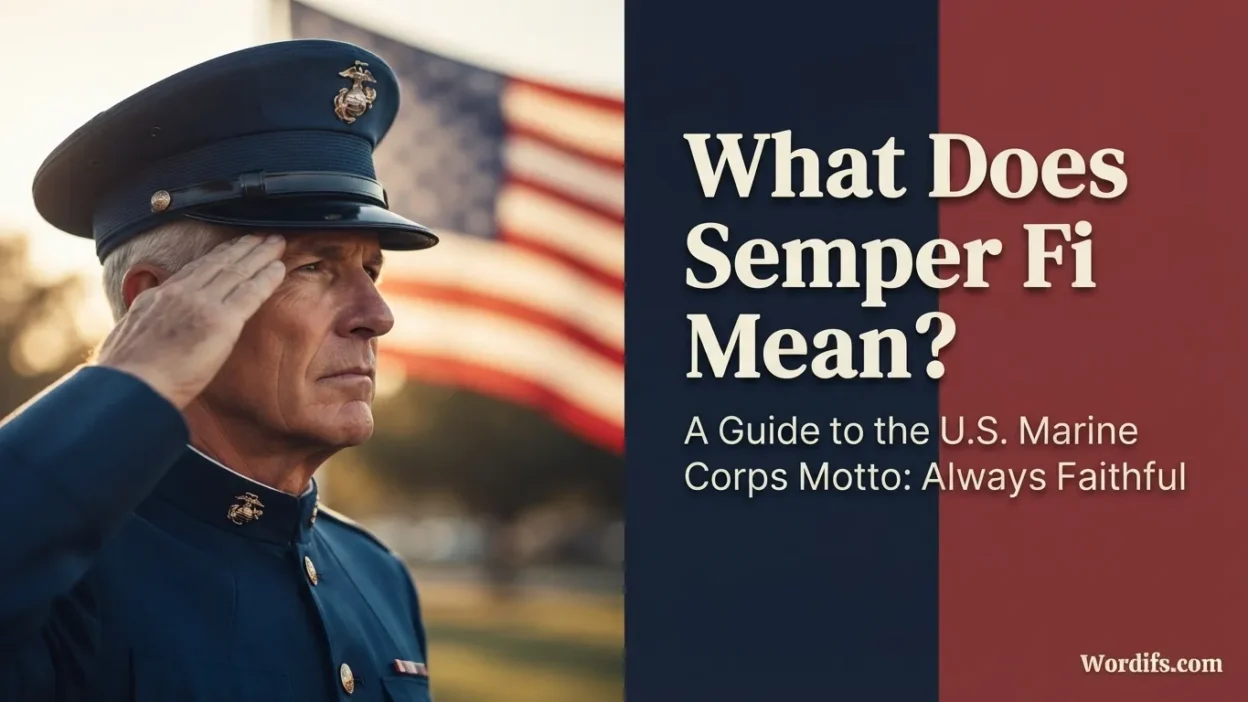
Semper Fi means “Always Faithful.” It is short for the Latin phrase Semper Fidelis, the official motto of the United States Marine Corps.
Marines use it to express loyalty to the Corps, to the country, and to each other, and many carry it for life.
Quick Answer
Semper Fi is short for Semper Fidelis, a Latin phrase meaning “Always Faithful.” It is the official motto of the United States Marine Corps, adopted in 1883. Marines use it to express lifelong loyalty to the Corps, their country, and fellow Marines, both during service and long after they leave the uniform.
Semper Fi Meaning in Plain English
Semper means “always” and fidelis means “faithful” or “loyal.” Together they give you the Semper Fidelis meaning: always faithful, always loyal.
The loyalty it points to runs in several directions:
- To fellow Marines: no one gets left behind.
- To the Corps: honoring its traditions, standards, and history.
- To the country: serving the United States and the Constitution.
- To personal integrity: staying true to your word and your values.
So the Semper Fi definition is more than a slogan. Marines treat it as a standard of behavior, which is why the phrase carries weight well beyond a motto on a poster.
Semper Fi vs. Semper Fidelis: Is There a Difference?
No, they mean the same thing. “Semper Fi” is the casual, shortened form used in conversation, while “Semper Fidelis” is the full Latin motto that appears on official emblems and documents.
| Feature | Semper Fidelis | Semper Fi |
| Form | Full Latin phrase | Shortened nickname |
| Meaning | Always Faithful | Always Faithful |
| Typical use | Official seals, ceremonies, documents | Greetings, sign-offs, conversation |
| Tone | Formal | Casual, familiar |
| Spoken by | Anyone discussing the motto | Mostly Marines, veterans, and supporters |
How Do You Pronounce Semper Fi?
Most Americans say “SEM-per FYE” for Semper Fi. For the full phrase, Marines commonly say “SEM-per fih-DAY-lis.” Classical Latin pronunciation varies, but Marines use the second version almost universally.
The History of the Marine Corps Motto
The U.S. Marine Corps traces its birth to November 10, 1775, when the Continental Congress authorized two battalions of Marines. Marines still celebrate that date every year as the Marine Corps birthday.
The motto came much later. During the early 1800s, Marines used several mottos, including “Fortitudine” (with fortitude) and “Per Mare, Per Terram” (by sea and by land), the latter borrowed from British Royal Marines tradition. Marines also had mottos tied to specific battles and eras.
In 1883, Commandant Charles McCawley adopted Semper Fidelis as the official Marine Corps motto. It has been used ever since and appears on the Marine Corps emblem and seal.
Where Did the Latin Phrase Come From?
The words Semper Fidelis were not invented by the Marines. European towns and noble families used the phrase for centuries before it reached the Corps. Its popularity comes from the simple, powerful idea of unwavering loyalty.
Semper Fidelis and the Eagle, Globe, and Anchor
The Marine Corps emblem is the Eagle, Globe, and Anchor, often shortened to EGA. The motto appears on the Marine Corps seal beneath the emblem, tying the words directly to Marine identity.
Each part of the emblem has symbolic meaning:
- Eagle: the United States.
- Globe: worldwide service.
- Anchor: naval heritage.
The motto sits alongside these as the Corps’ guiding principle, reinforcing that loyalty is at the heart of what a Marine stands for.
The Semper Fidelis March by John Philip Sousa
Many Americans know the phrase through music. In 1888, composer John Philip Sousa, then leader of the U.S. Marine Band, wrote the march “Semper Fidelis.” It is widely reported that he composed it after President Chester Arthur asked for a march to replace a song he disliked.
The march became the official march of the United States Marine Corps and is regularly played at parades, ceremonies, and military events. It is one of Sousa’s best-known works.
What Semper Fi Means to Marines
For Marines, Semper Fi is deeply personal. Recruits earn the title of Marine at the end of boot camp, and the motto becomes part of their identity from that day forward.
Here is how the phrase shows up in Marine life:
- As a greeting: Marines often say “Semper Fi” when meeting or parting.
- As a response: one Marine says it, and the other says it back.
- As a sign-off: common at the end of emails, letters, and messages.
- As a reminder: a quick way to say “I’ve got your back.”
You will also hear the saying “Once a Marine, always a Marine.” There is no such thing as an “ex-Marine” in Marine culture, and Semper Fi captures that lifelong bond.
Semper Fi Meaning in Military Culture
Semper Fi sits within a larger tradition of military mottos. Here is how it compares with others:
- U.S. Coast Guard: Semper Paratus, meaning “Always Ready.”
- U.S. Space Force: Semper Supra, meaning “Always Above.”
- U.S. Army: “This We’ll Defend.”
- U.S. Marine Corps: Semper Fidelis, “Always Faithful.”
The Marines’ core values are Honor, Courage, and Commitment. Semper Fi is the motto that ties those three values together.
How Do Marines Say Semper Fi?
Marines use it in several everyday ways:
- Verbally: a simple “Semper Fi” between Marines, active-duty or veteran.
- In writing: as an email or letter closing.
- At ceremonies: at promotions, memorials, and Marine Corps birthday balls.
- At funerals: as a final tribute to a fallen Marine.
You may also hear “Semper Fi, Marine” or “Semper Fi, Devil Dog.” Devil Dog is an affectionate nickname for Marines. Another well-known Marine expression is “Oorah,” a battle cry used for motivation and morale. It is not the same as Semper Fi and does not have the same meaning.
Can Civilians Say Semper Fi?
Yes, civilians can say Semper Fi. When someone says it to a Marine or veteran as a sign of respect, most people take it as a sincere gesture.
A few practical guidelines:
- Do: use it respectfully, especially when thanking a Marine or honoring one.
- Do: say it at Marine events, memorials, or when supporting veterans.
- Don’t: use it jokingly or mockingly.
- Don’t: claim to be a Marine if you never served. Stolen valor is taken seriously within the military community and is illegal in certain cases.
If you are a family member of a Marine, such as a spouse, parent, or sibling, saying Semper Fi is a common way to show pride and solidarity.
Semper Fi in Pop Culture and Everyday Life
The phrase appears widely outside the military:
- Tattoos: “Semper Fi” is one of the most popular military tattoos, often paired with the Eagle, Globe, and Anchor.
- Merchandise: t-shirts, bumper stickers, and decals sold across the United States.
- Movies and TV: frequently used in war films and dramas featuring Marines.
- Charities: the Semper Fi & America’s Fund, a nonprofit that supports wounded, ill, and injured service members and their families.
The phrase has also become part of broader American slang. People sometimes sign off with “Semper Fi” to mean “stay loyal” or “stay strong,” although this is most common among Marine communities.
Common Misconceptions About Semper Fi
“Semper Fi means ‘Semper Fidelity.'” Incorrect. Fidelis is the Latin word for “faithful.” “Fidelity” is an English word from the same root.
“It is the motto of the entire U.S. military.” Incorrect. It belongs to the Marine Corps. Other branches have their own mottos.
“It was the Marine Corps motto from 1775.” Incorrect. It was officially adopted in 1883.
“Only active-duty Marines can use it.” Incorrect. Veterans, family members, and supporters commonly use it.
Why Does Semper Fi Still Matter Today?
The idea behind the motto is universal. Loyalty, reliability, and keeping your word matter in any field, not just the military. Many Marines carry the phrase into civilian careers as a way of describing a commitment to teamwork and accountability.
For the Marine Corps, the motto also acts as a bridge between generations. A recruit graduating today and a veteran from Vietnam, Korea, or World War II share the same two words, and that shared language is part of what keeps the Corps tight-knit.
Frequently Asked Questions
What does Semper Fi mean in Latin?
Semper Fidelis means “Always Faithful.” Semper is “always” and fidelis is “faithful.”
Is Semper Fi only used by the Marines?
It is the official motto of the Marine Corps, so Marines use it most. Veterans, families, and civilians who support Marines also use it respectfully.
When did Semper Fidelis become the Marine Corps motto?
It was officially adopted in 1883 under Commandant Charles McCawley. Earlier mottos were used before that date.
What do Marines say back when someone says Semper Fi?
They usually say “Semper Fi” back. It works as both a greeting and a response.
Is it disrespectful to say Semper Fi if you are not a Marine?
No, not when it is said sincerely. Avoid using it to claim military service you did not earn.
What is the difference between Semper Fi and Semper Paratus?
Semper Fi means “Always Faithful” and belongs to the Marine Corps. Semper Paratus means “Always Ready” and belongs to the U.S. Coast Guard.
Who wrote the Semper Fidelis march?
John Philip Sousa wrote it in 1888 while leading the U.S. Marine Band. It is the official march of the Marine Corps.
Final Thoughts
Semper Fi means “Always Faithful,” and for Marines it is a promise rather than a slogan. It stands for loyalty to fellow Marines, to the Corps, and to the country, and it lasts long after service ends.
If you heard it in a movie, saw it on a tattoo, or got it from a Marine friend, you now know where it came from and how to use it respectfully.

Zevran Callix works on the Wordifs site creating clear informative articles while collaborating through wordifs@gmail.com to maintain consistency quality research readability and reader focused blogging standards worldwide digital content platform.