
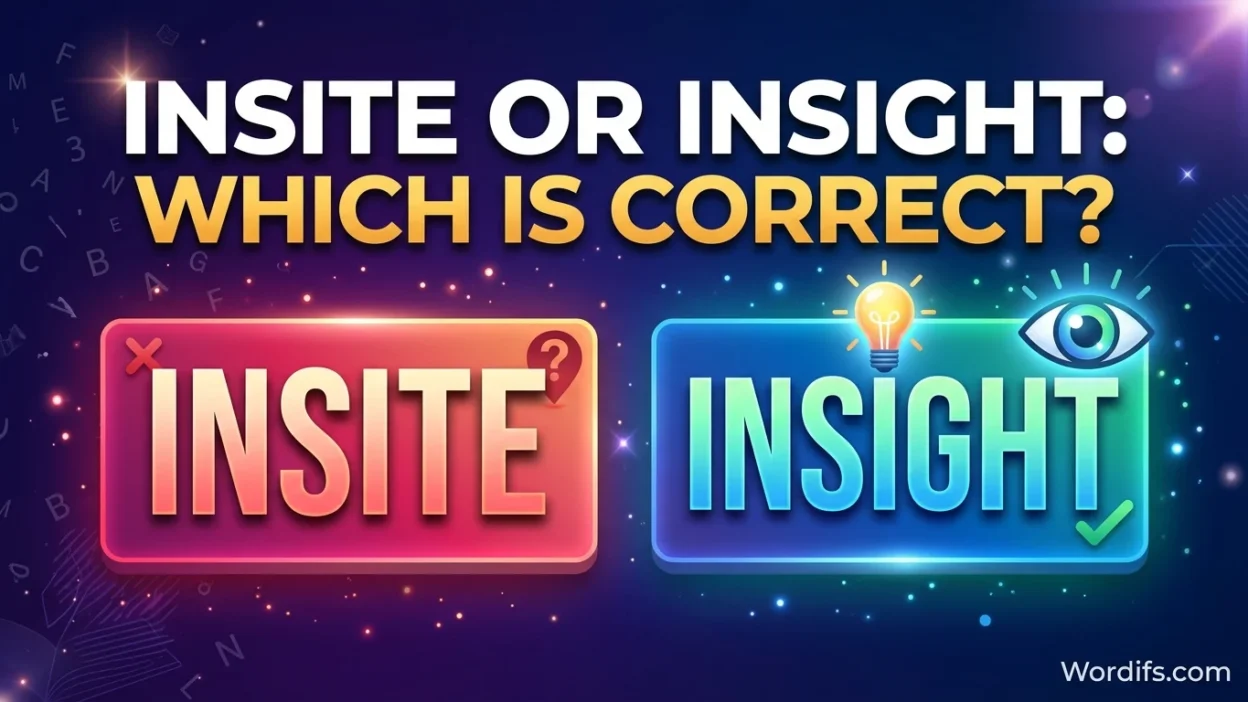
Have you ever searched for “insite or insight” and wondered which spelling is correct? These words can be confusing because they look similar, but their meanings and usage are different. Insight is a standard English noun that means a deep understanding of a person, situation, problem, or idea.
Insite, on the other hand, is not commonly accepted as a standard English word with the same meaning. It may appear as a company name, brand name, technical term, or proper noun.
If you are trying to describe understanding, awareness, or the ability to recognize the deeper meaning of something, insight is usually the correct word. For example, “The teacher provided valuable insight into English grammar” means the teacher helped students understand the subject more clearly.
In this guide, you will learn the difference between insite and insight, their meanings, spelling, pronunciation, grammar, and usage. You will also discover common mistakes, practical sentence examples, related words, and simple memory tricks to help you choose the correct word in everyday writing.
Quick Answer:
Insight is the correct standard English word when you mean deep understanding, awareness, or a valuable realization. Insite is not generally recognized as a standard English word with that meaning, although it can be used as a proper name or specialized term.
For example, “The report provides insight into customer behavior” is correct. If you want to describe understanding, knowledge, or a new realization, use insight, not insite.
Why Do People Confuse Insite and Insight?
People often confuse insite or insight because the two spellings differ by only one letter. Both begin with “ins” and contain similar sounds, making the difference easy to overlook when typing, reading, or checking a document.
However, spelling matters because a small change can affect whether a word is recognized as standard English.
There are several reasons for this common spelling confusion:
- Similar spelling: Insite and insight look almost identical.
- Similar pronunciation: In many accents, they may sound very similar when spoken quickly.
- Typing mistakes: People may accidentally type “insite” when they intend to write “insight.”
- Autocorrect errors: Spell-checking tools may not always identify the intended meaning, especially when proper names are involved.
- Unfamiliar vocabulary: English learners may not know that insight is the established word for deep understanding.
- Brand and company names: Some businesses use “Insite” as a name, which can make the spelling appear familiar.
The best way to choose the correct word is to examine the context. If your sentence refers to understanding, awareness, knowledge, or a realization, insight is generally the correct choice.
What Does Insight Mean?
Insight is a noun that means a clear, deep, or valuable understanding of a person, situation, problem, or subject. It describes the ability to recognize something important that may not be immediately obvious.
Insight can develop through experience, observation, research, education, discussion, or careful thinking. It often helps people understand not only what is happening but also why it is happening.
Insight Meaning in Simple English
In simple English, insight means understanding something deeply or seeing its real meaning more clearly.
For example:
- The teacher gave us valuable insight into English grammar.
- Her experience provided insight into the problem.
- The research offers new insight into customer behavior.
- Reading the book gave me insight into human nature.
- The discussion helped us gain a better understanding of the issue.
In these examples, insight refers to knowledge or understanding that helps someone recognize important details or discover a deeper meaning.
Insight Definition and Part of Speech
The standard dictionary definition of insight generally refers to the ability to understand the true nature of something or to gain an accurate and deep understanding of a situation.
Its main grammatical features are:
- Part of speech: Noun
- Meaning: Deep understanding, awareness, or realization
- Plural form: Insights
- Related adjective: Insightful
- Common phrase: Insight into something
Examples:
- She gained valuable insight into the subject.
- The interviews revealed several useful insights.
- His comments were thoughtful and insightful.
Understanding the noun usage of insight makes it easier to use the word correctly in sentences.
What Does Insight Mean in Different Contexts?
The meaning of insight remains connected to understanding, but its application can vary depending on the situation.
In education: Insight means understanding a subject, concept, or difficult idea more clearly.
Example: The lesson gave students insight into English grammar.
In business: Insight means useful information or understanding that supports better decisions.
Example: The survey provided insight into customer preferences.
In psychology: Insight can refer to recognizing one’s own thoughts, feelings, motivations, or behavior.
Example: Therapy helped him gain insight into his reactions.
In everyday conversation: Insight means a useful realization or a clearer understanding of a situation.
Example: Her advice gave me insight into the disagreement.
These examples show how insight is used across different contexts while retaining its central meaning of deep understanding.
What Does Insite Mean?
Insite is not generally recognized as a standard English word meaning understanding or awareness. If you want to express the idea of deep understanding, the correct spelling is usually insight.
However, “Insite” can appear in specific situations.
Insite as a Brand or Company Name
Some organizations, websites, products, or businesses may use Insite as a name. Proper names do not always follow ordinary dictionary spelling patterns.
For example, a company might use Insite as its official brand name. In that situation, the spelling may be correct because it is the name chosen by that organization.
Insite as a Typing or Spelling Error
In everyday writing, insite may simply be a misspelling of insight.
Incorrect: The article provides useful insite into the problem.
Correct: The article provides useful insight into the problem.
If the intended meaning is understanding, awareness, or knowledge, use insight.
Should You Use Insite in Formal Writing?
In standard academic, professional, and general English writing, avoid using insite when you mean insight. Use the established spelling insight instead.
If you are referring to a company, website, product, or another proper name, preserve its official spelling.
Insite vs. Insight: What Is the Difference?
The primary difference between insite and insight is that insight is the standard English word for deep understanding, while insite is generally used as a proper name, specialized term, or spelling error.
| Feature | Insite | Insight |
| Standard English word | Not generally recognized with the meaning of understanding | Yes |
| Part of speech | Depends on its specific use as a name or specialized term | Noun |
| Main meaning | May be a brand, company name, or misspelling | Deep understanding or awareness |
| Common usage | Proper names and specific contexts | Everyday, academic, and professional English |
| Related form | Depends on the name or context | Insightful |
| Plural form | Depends on the specific use | Insights |
| Example | Insite is the name of the organization. | The report offers valuable insight. |
| Correct choice for understanding | No | Yes |
Remember: When you want to describe understanding or a realization, choose insight.
How Do You Pronounce Insite and Insight?
The words insite and insight may sound almost identical in many English accents. The standard pronunciation of insight is generally represented as IN-sight, with stress on the first syllable.
Because insite is not a standard English word with a consistent dictionary pronunciation, its pronunciation may depend on how a company, brand, or individual chooses to say the name.
Insight Pronunciation
Insight: IN-sight
The first syllable receives the main stress.
Example: “The book gave me valuable insight into history.”
Insite Pronunciation
When “Insite” is used as a name, people may pronounce it like “IN-site,” but the intended pronunciation can vary by organization or individual.
If you are writing a sentence about understanding, use insight regardless of how similar the words may sound.
Does Pronunciation Help You Choose the Correct Spelling?
Pronunciation can be helpful, but it may not always distinguish these spellings because their sounds can be very similar.
The more reliable method is to focus on meaning, context, and correct spelling. If you mean a deep understanding of something, insight is the appropriate word.
When Should You Use Insite or Insight?
Choosing the right spelling becomes easier when you identify what you want to communicate.
When to Use Insight
Use insight when describing:
- Deep understanding
- Awareness of a situation
- A valuable realization
- Knowledge gained through experience
- Understanding of a problem or idea
- A useful observation
- A clearer interpretation of information
Examples:
- The report provides insight into the issue.
- The teacher shared valuable insight with the class.
- The experience helped her gain insight into human behavior.
- The research offers new insights into learning.
- His explanation gave us a better understanding of the problem.
When to Use Insite
Use Insite when it is the verified spelling of a particular company, product, organization, website, or other proper name.
Example:
“Insite is the official name of the organization.”
This sentence is appropriate only if Insite is actually the organization’s name.
Do not use insite as a substitute for insight in ordinary English writing.
A Simple Rule for Correct Word Choice
Ask yourself: Am I talking about understanding, or am I referring to a specific name?
- If you mean deep understanding, use insight.
- If you mean a company or product officially named Insite, use Insite.
- If you are unsure, check the context or the official spelling of the name.
This simple rule helps prevent spelling mistakes in emails, essays, articles, reports, and other forms of communication.
15 Examples of Insite and Insight in Sentences
The following examples demonstrate the correct use of insight and the limited situations in which Insite may be appropriate.
Examples of Insight
- The book provides valuable insight into human behavior.
- The teacher gave us useful insight into English grammar.
- Her experience helped her gain insight into the problem.
- The report offers new insights into customer preferences.
- The discussion gave me a clearer understanding of the situation.
- The research provides important insight into climate patterns.
- His mistakes gave him insight into his own weaknesses.
- The interview offered valuable insight into the company’s challenges.
- Reading different perspectives can develop awareness and understanding.
- The psychologist helped the patient gain insight into personal behavior.
- The survey provided useful insights for the marketing team.
- Her observation revealed an important detail about the problem.
- The lecture gave students a deeper understanding of the topic.
- The manager shared an insightful observation during the meeting.
- Careful analysis can provide insight into the causes of an issue.
Examples of Insite
These examples use Insite as a hypothetical proper name. They do not suggest that it is a standard English synonym for insight.
- Insite is the name of the company mentioned in the report.
- The customer visited the official Insite website.
- Our team contacted Insite for more information.
- The product guide explains how the Insite platform works.
- Please check whether Insite is the correct spelling of the brand name.
The key distinction is that insight describes understanding, whereas Insite should be used as a name only when that spelling is verified.
Common Mistakes When Using Insite and Insight
Even experienced writers can make spelling mistakes when words look or sound similar. Here are common errors to avoid.
Mistake 1: Writing Insite When You Mean Understanding
Incorrect: The article gives readers useful insite into the subject.
Correct: The article gives readers useful insight into the subject.
Why? Insight is the standard English noun that describes deep understanding or awareness.
Mistake 2: Treating Insite as a Standard Synonym for Insight
Incorrect: Insite is another common English word for deep understanding.
Correct: Insight is the standard word for deep understanding. Insite may be a proper name or a spelling error.
Why? Similar spelling does not automatically mean that two forms are interchangeable.
Mistake 3: Confusing Insight With Knowledge
Knowledge and insight are related, but their meanings are not identical.
Knowledge generally refers to facts or information that someone has learned. Insight often refers to a deeper understanding of those facts and their significance.
Example: You may know the facts about a problem but still need insight to understand why it happened.
Mistake 4: Using Insight as a Verb
Incorrect: The report will insight the audience.
Correct: The report will give the audience insight into the issue.
Why? Insight is a noun, not a standard verb. Depending on your intended meaning, you might use verbs such as explain, reveal, clarify, or illuminate.
Mistake 5: Forgetting the Plural Form
Incorrect: The interviews revealed several useful insight.
Correct: The interviews revealed several useful insights.
Why? When referring to multiple distinct findings or observations, use the plural noun insights.
Mistake 6: Ignoring Context
A spelling checker may not always identify whether you intended to write insight or a proper name such as Insite.
For example:
- The report provides valuable insight into the issue.
- Insite is the name of the company.
Both may be correct in their respective contexts. Always check the intended meaning rather than relying entirely on autocorrect.
Memory Trick: How to Remember Insite and Insight
A simple memory trick can help you remember the correct spelling.
Remember Insight With Sight
The word insight contains the word sight. Sight is associated with seeing, and insight can mean seeing or understanding something more deeply.
Example: “The experience gave me insight into the problem.”
Remember Insite as a Name
Think of Insite as a spelling that may belong to a specific company, brand, or organization. Verify the official name before using it.
The Easiest Way to Remember
- Insight = deep understanding.
- Insite = a proper name or a possible misspelling.
Remember this sentence:
“The report provides insight into the problem, while Insite is the name of the company.”
This sentence helps you see the difference between a standard English word and a possible proper name.
American vs. British English: Is There a Difference?
There is no significant difference between American and British English in the standard spelling or basic meaning of insight.
Both varieties use insight as a noun meaning deep understanding, awareness, or realization. Insite is not the standard spelling for this meaning in either variety.
| Feature | American English | British English |
| Correct word for understanding | Insight | Insight |
| Standard spelling | Insight | Insight |
| Part of speech | Noun | Noun |
| Plural form | Insights | Insights |
| Related adjective | Insightful | Insightful |
| Example | The report offers valuable insight. | The report offers valuable insight. |
If you are writing for an American or British audience, use insight when describing understanding. If you are referring to a specific organization named Insite, preserve the organization’s official spelling.
Similar Words to Insight
Learning similar words can help you improve your vocabulary and choose the most appropriate term for a sentence. These words are related to insight, but each has a slightly different meaning.
| Related word | Meaning | Example |
| Understanding | Knowing what something means | She has a clear understanding of the issue. |
| Awareness | Knowing that something exists or is happening | Public awareness is increasing. |
| Perception | The way someone interprets something | His perception changed after the discussion. |
| Realization | Becoming aware of something | I had a sudden realization. |
| Knowledge | Information gained through learning or experience | She has extensive knowledge of the subject. |
| Wisdom | Good judgment based on experience | His wisdom helped the team decide. |
| Comprehension | The ability to understand information | Reading improves comprehension. |
| Discernment | The ability to recognize differences or make good judgments | Discernment is useful when evaluating evidence. |
| Intuition | Understanding without deliberate reasoning | Her intuition helped her identify the problem. |
| Interpretation | An explanation of the meaning of something | The text allows several interpretations. |
| Observation | Noticing or examining something | Her observation revealed an important detail. |
| Clarity | The quality of being clear or easy to understand | The explanation brought clarity to the discussion. |
These terms can support your English vocabulary development and help you communicate more precisely.
Insight vs. Understanding
Insight and understanding are closely related, but insight often suggests a deeper or more revealing understanding.
Example: “I understand the instructions” means you know what to do. “I gained insight into the reasons behind the instructions” means you understand the underlying purpose.
Insight vs. Awareness
Awareness means knowing that something exists or is happening. Insight often involves understanding its meaning, causes, or importance.
Example: Awareness of a problem is the first step, while insight can help explain why the problem exists.
Insight vs. Realization
A realization is often a moment when someone becomes aware of something. Insight can refer to a deeper understanding that develops through thought or experience.
Example: “I realized I had made a mistake” describes recognition. “The experience gave me insight into my behavior” describes deeper understanding.
Insight vs. Knowledge
Knowledge refers to information or facts a person has learned. Insight refers to understanding the significance or connections behind that information.
Example: Knowing the rules of grammar is useful, but insight can help you understand why a particular sentence is structured that way.
How to Use Insight in Professional and Academic Writing
The word insight is especially useful when discussing research, education, business, psychology, and problem-solving. It can make writing more precise when you are describing meaningful findings or a deeper understanding.
Insight in Academic Writing
Academic writers use insight to describe what research, evidence, or analysis reveals.
Example: “The findings provide insight into the relationship between study habits and academic performance.”
Insight in Business Writing
In business, insight often refers to useful understanding that supports decisions.
Example: “Customer feedback provided valuable insight into changing preferences.”
Insight in Everyday Communication
In everyday conversation, insight can describe a useful observation or realization.
Example: “Your advice gave me insight into the situation.”
When using insight, make sure the surrounding sentence clearly identifies the subject being understood. Common phrases such as insight into a problem, gain insight, provide insight, and valuable insight help make your meaning clear.
Final Verdict:
The correct choice depends on what you want to communicate.
Use insight when you mean deep understanding, awareness, knowledge, or a valuable realization. It is the standard English noun used in everyday conversation, academic writing, business communication, and professional documents.
Use Insite only when it is the verified spelling of a specific company, brand, product, organization, or other proper name. Do not use it as a substitute for insight when describing understanding.
The simplest rule is: Insight means understanding; Insite may be a name or a misspelling. Check the meaning and context before choosing the spelling, and you will be much less likely to make this common English spelling mistake.
Frequently Asked Questions
1. Is it insite or insight?
Insight is the correct standard English word when you mean deep understanding, awareness, or a realization. Insite is not generally accepted as a standard word with that meaning, although it may be used as a proper name.
2. What does insight mean in simple English?
Insight means understanding something deeply or recognizing its true meaning. For example, a discussion can provide insight into a problem by helping people understand its causes.
3. Is insite a real word?
Insite may be used as a company name, brand name, or specialized term. However, it is not generally recognized as a standard English synonym for insight. If you mean deep understanding, use insight.
4. What is the difference between insite and insight?
Insight is a standard English noun meaning deep understanding or awareness. Insite is generally a proper name, specialized form, or misspelling when used in ordinary writing. The intended context determines whether Insite is appropriate as a name.
5. Is insight a noun or a verb?
Insight is a noun. It refers to deep understanding, awareness, or a valuable realization. Its related adjective is insightful.
Example: “The report provides valuable insight into the problem.”
6. What is the plural of insight?
The plural form is insights. Use it when referring to several distinct findings, observations, or realizations.
Example: “The interviews revealed several useful insights.”
7. How do you pronounce insight?
Insight is generally pronounced IN-sight, with the stress on the first syllable. The pronunciation may sound similar to the way some people say the name Insite, so context is important.
8. What are synonyms for insight?
Common related words include understanding, awareness, perception, realization, wisdom, knowledge, and discernment. These words have slightly different meanings, so choose one that fits the context.
9. Is insight spelled the same in American and British English?
Yes. Insight has the same standard spelling and basic meaning in American and British English.
10. How can I remember the correct spelling of insight?
Connect insight with sight. Just as sight relates to seeing, insight relates to seeing or understanding something more deeply. Remember: insight means understanding.
Remember This
- Insight is the standard English word for deep understanding or awareness.
- Insite may be a company name, brand name, specialized term, or misspelling.
- Use insight into when describing understanding of a subject or situation.
- Common expressions include gain insight, provide insight, valuable insight, and insightful observation.
- The plural of insight is insights.
- Insight is a noun, while insightful is an adjective.
- American and British English use the same standard spelling.
- Memory trick: Insight = seeing or understanding something more deeply.
Conclusion
Understanding the difference between insite or insight helps you improve your spelling, grammar, and overall English communication. Insight is the established English noun used to describe deep understanding, awareness, or a valuable realization.
It appears frequently in academic writing, business reports, educational discussions, and everyday conversations. Insite, however, is not generally used as a standard English word with the same meaning. It may be appropriate when referring to a particular company, brand, product, or organization, but the official name should always be verified.
To choose the correct spelling, focus on the meaning of your sentence. If you are describing knowledge, understanding, perception, or a realization, use insight.
If you are referring to a specific entity named Insite, follow its official spelling. By remembering this distinction and practicing the examples in this guide, you can avoid common spelling confusion and use the correct word confidently in your writing.