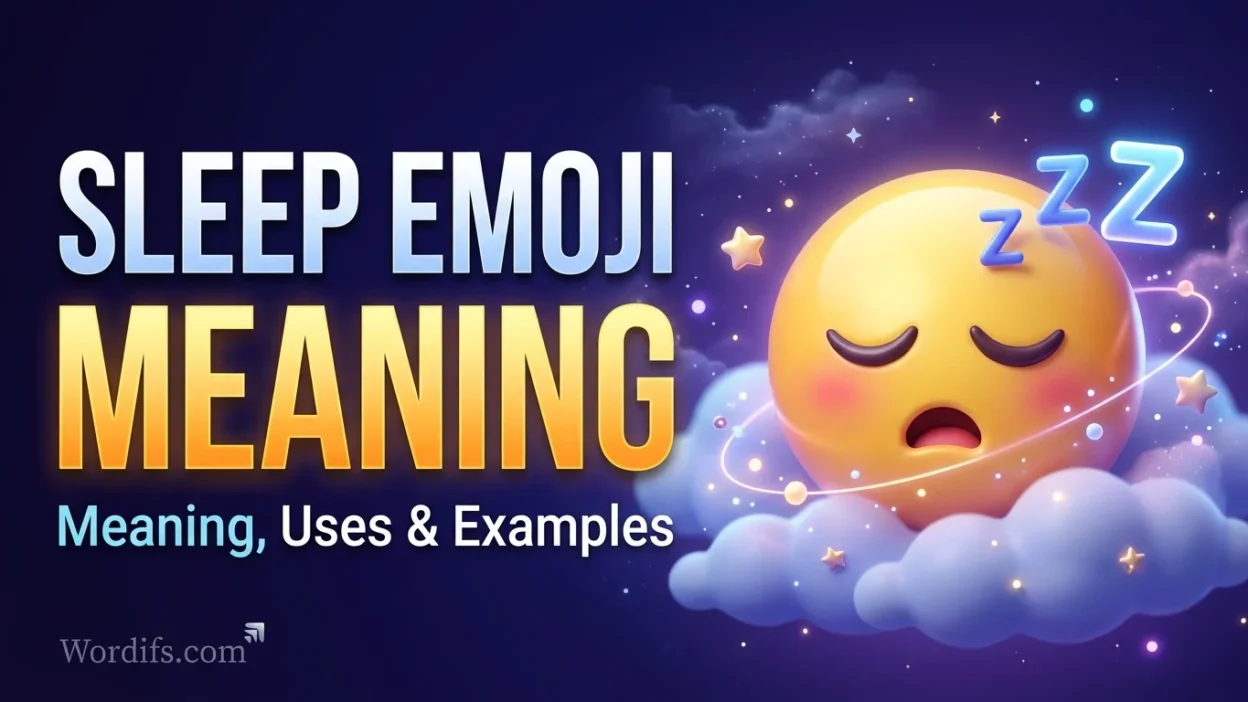
The sleep emoji (😴), officially called the Sleeping Face emoji, shows a yellow face with closed eyes and floating “z” letters. It most often means someone is asleep, very tired, or bored. People also use it to say “good night,” to joke about a dull topic, or to show they are worn out. The meaning depends on the message around it.
It looks simple, but this small icon carries a lot of tone. Used well, it feels warm or funny. Used carelessly, it can sound rude. This guide explains what the sleeping face emoji means, how it appears on different devices, how to type it, and how it differs from similar emojis.
Quick Answer
- What it is: The Sleeping Face emoji, Unicode code point U+1F634.
- Main meaning: Sleeping, napping, or feeling very sleepy.
- Common secondary meanings: Boredom, exhaustion, “good night,” or “this is dull.”
- Tone: Usually casual and playful. It can feel dismissive if aimed at someone’s message.
- Best paired with: 💤 Zzz emoji, 🌙, 🛏️, or a short text note for clarity.
What Is the Sleep Emoji?
The sleep emoji is a face-style emoji that stands for rest. It has closed eyes, a relaxed or neutral mouth, and one or more “z” symbols near the head. Those “z” letters come from comic-book style, where repeated Zs represent snoring or sleeping.
It has been part of the standard emoji set for years and remains in the current Unicode emoji list in 2026, so it works on virtually all modern phones, computers, and apps.
Technical details at a glance
| Detail | Information |
| Official name | Sleeping Face |
| Emoji | 😴 |
| Unicode code point | U+1F634 |
| HTML code | 😴 |
| Common shortcode | :sleeping: |
| Category | Smileys & Emotion, Face-Sleepy |
| Skin tone options | None (it is a yellow face, not a person) |
Because it is a standard character and not an image, it appears in text messages, emails, social media posts, and documents. Its design changes slightly between Apple, Google, Samsung, and Microsoft fonts.
What Does the Sleep Emoji Mean?
The meaning shifts with context. Here are the main uses.
Literal meanings
The most direct meaning is sleep. People use 😴 to say they are in bed, taking a nap, or about to fall asleep.
- “Long day. Heading to bed 😴”
- “Nap time after lunch 😴”
- “Baby finally asleep 😴”
Figurative meanings
The emoji also works as a tired emoji or a bored emoji when sleep is not actually happening.
- Boredom: “This meeting could have been an email 😴”
- Exhaustion: “Three exams in two days. I’m done 😴”
- Dull content: “Slow movie, no plot 😴”
- Lack of energy: “Monday mornings be like 😴”
Social and emotional meanings
In chats, 😴 can also mean “I’m out for the night,” “I’m not interested,” or “nothing is happening.” Between close friends, it can be a lighthearted tease. With strangers or coworkers, the same emoji may feel sarcastic.
How People Use the Sleep Emoji: Examples
| Situation | Example message | Likely meaning |
| Bedtime chat | “Night everyone 😴” | Saying good night |
| Study stress | “Revision till 2 a.m. 😴” | Exhaustion |
| Work humor | “Another status call 😴” | Boredom |
| Parenting | “Kids are asleep, finally 😴” | Relief and tiredness |
| Travel | “Red-eye flight, send coffee 😴” | Needing rest |
| Gaming or streaming | “Slow match 😴” | Nothing exciting happening |
| Sports | “That first half 😴” | A dull game |
Notice that the emoji usually follows the sentence. It acts like a tone marker, much like a sigh or a yawn in spoken conversation.
How the Sleep Emoji Looks on Different Platforms
Every major platform draws its own version of 😴. The idea stays the same, but the details vary.
- Apple (iPhone and Mac): A round face with closed eyes and floating Z letters.
- Google (Android and Gmail): A simple, flat style with soft features.
- Samsung: A slightly different face shape and Z placement.
- Microsoft (Windows): A rounded style that matches Windows’ design language.
- WhatsApp, X, and Facebook: Each uses its own artwork, or the system’s native set.
These differences are small, but they can change the mood. A sender might intend a gentle, sleepy face while the recipient’s device shows something that looks flatter or more serious. When tone matters, add a few words so the message does not depend on the artwork.
How to Type or Copy the Sleep Emoji
You can add 😴 in several quick ways:
- Phone keyboard: Open the emoji keyboard, search “sleep” or “sleeping,” and tap it.
- Windows: Press the Windows key + period (.), then search “sleep.”
- Mac: Press Control + Command + Space and search “sleeping.”
- Shortcode apps: Type :sleeping: in tools such as Slack or Discord and choose the suggestion.
- Copy and paste: Copy 😴 from any trusted source and paste it where you need it.
If the emoji shows as an empty box on an old device, the system likely needs a software update.
Sleep Emoji vs. Similar Emojis
Several sleep-related emojis look alike but say different things. Picking the right one avoids confusion.
| Emoji | Name | Best used for |
| 😴 | Sleeping Face | Being asleep, very tired, or bored |
| 😪 | Sleepy Face | Feeling drowsy or worn out, not fully asleep |
| 🥱 | Yawning Face | Mild boredom or tiredness |
| 💤 | Zzz | Sleep, rest, or a pause (not a face) |
| 🛌 | Person in Bed | Resting in bed or taking a break |
| 🌙 | Crescent Moon | Night, bedtime, “good night” |
| 😑 | Expressionless Face | Flat reaction, mild annoyance |
Quick rule: use 😴 when someone is deeply tired or the topic is truly dull. Use 🥱 for a lighter “meh” and 😪 for “sleepy but still awake.”
Using the Sleep Emoji in Different Settings
With friends and family
Here 😴 is safe and friendly. It works for bedtime wishes, nap jokes, and shared tiredness.
In dating and close relationships
Sending “Goodnight 😴” is a soft, low-pressure way to end the day. Be careful in the middle of a conversation, though. A lone 😴 can read as “you’re boring me.”
At work
Keep it rare. A sleepy joke about early shifts is usually fine with colleagues you know well. Avoid it in replies to someone’s idea, report, or presentation, since it may seem to mock their effort.
On social media
Creators use 😴 in captions about rest days, travel fatigue, and sleep-related tips. Brands that sell mattresses, pillows, or sleep aids also use it to match their topic.
Common Misunderstandings
- “It always means sleeping.” Not true. Many people use it for boredom or tiredness.
- “It is the same as the Zzz emoji.” The 💤 symbol has no face and often marks sleep, a pause, or something being idle.
- “It is always negative.” It can be sweet and affectionate, especially at bedtime.
- “Everyone sees the same image.” Different devices show different designs.
- “It means someone is dead or unwell.” In normal use, it does not.
Common Mistakes to Avoid
- Replying to serious news with 😴. It can come across as cold or dismissive.
- Using it alone as a response. A lone emoji leaves the meaning open to guesswork.
- Overusing it in group chats. Repeating it can sound like constant complaining.
- Mixing it with conflicting emojis. Pairing 😴 with 🔥 or 🎉 confuses the message.
- Ignoring the audience. What feels playful with friends may feel rude with a manager or client.
- Assuming platform parity. Test unusual or important messages if the tone matters.
Practical Tips for Using the Sleep Emoji
- Add a few words. “Heading to bed 😴” is clearer than 😴 alone.
- Match the mood. Soft companions like 🌙 or 💤 keep it gentle. Words like “boring” make the sarcastic meaning clear.
- Think about the receiver. If you are unsure how it will land, choose a friendlier option such as 🌙.
- Use it sparingly. One emoji per message is usually enough.
- For content creators: Place it near the end of captions or headings so it adds tone without blocking the text.
- For accessibility: Screen readers announce the emoji by name, “sleeping face,” so avoid long strings of repeated emojis.
Frequently Asked Questions
What does the 😴 emoji mean?
It means sleeping, feeling very tired, or finding something boring. In chats, it also works as a casual “good night.”
What is the official name of the sleep emoji?
The official name is Sleeping Face. Its Unicode code point is U+1F634.
Is the sleep emoji rude?
Not by itself. It becomes rude when used as a reaction to someone’s message, idea, or news, because it can suggest you are bored or uninterested.
What is the difference between 😴 and 😪?
The 😴 emoji shows someone asleep or deeply tired. The 😪 emoji shows someone sleepy but still awake, often struggling to stay up.
What is the difference between 😴 and 💤?
The 😴 emoji is a face, while 💤 is a symbol made of Zs. The Zzz emoji is often added next to a person or sentence to show sleep, rest, or something being inactive.
How do I type the sleep emoji on my keyboard?
Windows, press the Windows key + period and search “sleep.” On a Mac, press Control + Command + Space. On phones, open the emoji keyboard and search for “sleeping.”
Does the sleep emoji look the same on every phone?
No. Apple, Google, Samsung, and Microsoft each design their own version. The basic idea of closed eyes and Zs stays the same, but the style differs.
Can I use the sleep emoji in professional messages?
Yes, but only occasionally and with people you know well. For formal or sensitive messages, plain words are safer.
Conclusion
The sleep emoji is a small symbol with a clear core meaning: rest, tiredness, or boredom. Its real message depends on who sends it, who receives it, and what surrounds it. In a bedtime chat, it feels gentle. In reply to a colleague’s idea, it can feel sharp.
To use 😴 well, add a few words, pick the right similar emoji when needed, and think about your audience. Done that way, this tiny face can add warmth, humor, and personality to everyday messages in 2026 and beyond.